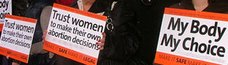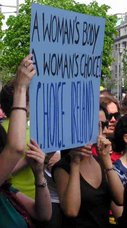
Irish Times
Monday July 28th 2008
· European court to hear women's challenge to ban on abortion
CARL O'BRIEN, Social Affairs Correspondent
THE EUROPEAN Court of Human Rights has agreed to hear a challenge by three Irish women to the Government’s ban on abortion on the basis that their rights were denied by being forced to terminate their pregnancies outside the State.
The women claim the restrictive nature of Irish law on abortion jeopardised their health and their wellbeing. Their complaint centres around four articles in the European Convention on Human Rights, including protection from “inhuman or degrading treatment” and freedom from discrimination.
The identity of the three women – known as A, B and C – will remain confidential as it proceeds through the court.
They include a woman who ran the risk of an ectopic pregnancy, where the foetus develops outside the womb; a woman who received chemotherapy for cancer; and a woman whose children were placed in care as she was unable to cope.
The Irish Family Planning Association (IFPA), which is supporting the case as part of its campaign to introduce legal abortion services in Ireland, said the grounds on which the case is being taken are “very strong”.
“We hope the case will advance quickly through the court, ultimately making a strong recommendation to the Government to reform Irish laws and the current status quo on abortion,” a spokesperson said.
The Government has been asked by the court to indicate who they wish to sit as a judge in the case and to submit its observations to the Strasbourg-based court.
The case was originally lodged with the court three years ago. However, the court has in recent weeks requested written observations from the Government and the women involved.
Any decision of the court is binding on the member states and must be complied with, except in very limited circumstances.
The court can decide to hold a public hearing, which would be likely to be held in the middle of next year. Alternatively, the court may review the case in paper format, followed by a public ruling, which could occur more quickly.
The IFPA says the case has the potential to contribute to a change in the law, just as the 1988 Norris case resulted in the decriminalisation of homosexuality.
It points to a ruling by the court two years ago which resulted in Poland being instructed to guarantee access to legal abortions.
It awarded damages to Alicia Tysiac, a 36-year-old woman who had sought an abortion when her doctor warned that giving birth again would seriously damage her already failing eyesight.
She was unable to terminate the pregnancy. After giving birth, she suffered a retinal haemorrhage, and her sight deteriorated drastically.
Anti-abortion groups here, meanwhile, argue that a new constitutional amendment is needed to prohibit abortion.
They say there is a need to restore legal protection for unborn children as a result of the 1992 Supreme Court decision in the X case, which legalised abortion in certain circumstances.
Monday, July 28, 2008


Tug of War Over Right to Choose in Poland
Tug-of-war over the right to choose
DEREK SCALLY The Irish Times July 28th 2008
The dramatic case of a 14-year-old girl who sought a termination to her pregnancy became a high-profile battle between the two sides of the bitter Polish abortion debate, writes Derek Scally.
ON A BUSY Warsaw street, a dazed teenage girl trots to keep up with her mother, who strides through the crowd, throwing anxious glances behind her. A small woman is following them, running to keep up. The mother hails a taxi and jumps in with her daughter.
"Just drive, just drive!" she screams at the driver. Outside, she hears the small woman calling in the taxi's licence plate on her mobile phone. Then the passenger door is ripped open and their pursuer climbs in.
"Leave us alone, woman!" screams the mother.
The smaller woman ignores her and barks at the speechless taxi driver: "If you don't want to have problems with the police you'll stay right where you are." The woman delivering the orders isn't an undercover police officer chasing bank robbers. She is a pro-life activist; the prize she is chasing lies inside the 14-year-old.
It's the dramatic high point of an extraordinary tale that played out last month, of an ordinary mother and daughter in the limbo of Poland's abortion laws, caught between passive public officials and intimidating pro-life activists.
The story began several weeks earlier when Anna, a single mother in Lublin, southwest Poland, got a call from a local gynaecologist. The doctor said that Anna's daughter was pregnant, even though she was underage. The father, also underage, was a boy in school, the circumstances of the pregnancy unclear. Today, Agata, the pseudonym by which the 14-year-old is now known in Poland, is reticent about how she became pregnant.
"I knew I was pregnant but it didn't feel like it was happening to me," she says, sitting in a Lublin basement bar, studying her fingers as she relives her ordeal. She is a gamine, dark-haired girl with jewel-like eyes, one minute a nervous child, the next an engaging young woman. She is a collection of pubescent contradictions who falls silent when her mother interrupts her.
"She knew she was pregnant, but she didn't know what it meant," says Anna, a thin, outspoken woman with long blond hair and a friendly, tired smile.
"When I heard, I just thought: 'What to do? What to do? Go somewhere, do something.' I felt like I was watching my own life from a distance."
When mother and daughter agreed that an abortion would be best, Anna knew they would have a fight on their hands. But she says she had no idea of the battle they would face.
Along with Ireland, Poland has some of the most restrictive abortion legislation in Europe.
Termination is permitted in only three cases: where the life or health of the mother is at risk, where the foetus is severely and irreversibly damaged or incurably ill, or where the pregnancy is the result of a criminal act. In Agata's case it was the third category: both she and the boy were minors. But the reality of modern Poland is that these already restrictive laws are applied even more restrictively. Gynaecologists may refuse to perform an abortion for reasons of conscience. If so, they are obliged under law to find another doctor who will comply with the woman's wishes. But there is no legal mechanism to sanction doctors who refuse to do so, which often happens.
"The government accepts that women have these limited rights to abortion under the law, but says it doesn't have an obligation to make these rights real," says Wanda Nowicka, head of the Women's Federation in Warsaw, and the country's leading campaigner for the liberalisation of reproductive rights.
Some 30 years ago, she says, women from all over Europe headed to communist Poland for abortions. Today, Poland is experiencing a return to "traditional" Catholic values with an active pro-life lobby and a growing number of doctors who refuse to perform even legal abortions. In 2006, among 10 million Polish women of a reproductive age, just 340 women had legal abortions, down from 682 a decade earlier.
RECENTLY IN PARLIAMENT, a new law to allow for the protection of life from the moment of conception only narrowly failed to pass.
"It's a top-down movement of Catholic clergy, opportunisitic politicians and conservative lawyers that want further restrictions," says Nowicka, pointing to a recent survey showing that 46 per cent are in favour of more liberal regulations. With the restrictive regulations, between 50,000 and 80,000 women have back-street abortions each year, costing as much as 4,000 Polish zlotych (€1,200) a time; others travel to Britain, Ukraine and Belarus. An unknown number order so-called "abortion pills" via the internet.
Anna and Agata decided against a backstreet abortion and decided to proceed officially. It was a decision they came to regret as one hospital after another in Lublin rejected their request, claiming they were unsure whether they were legally entitled to perform the procedure.
"The law is clear on this, it's people who make it complicated, and you can create obstacles if you want, without fear of disciplinary proceedings," says Monika Gasiorowska, lawyer for Anna and Agata.
"Officials told Anna she needed one statement, then another, she needed signatures, then witnessed signatures. All unnecessary obstacles. This was a crime, we had statements, but they kept putting obstacles in her way."
As her mother battled the bureaucrats, Agata spent a week waiting in a Lublin hospital as the 12-week deadline neared, after which it would be illegal to have an abortion.
A frequent visitor was Fr Krzysztof Podstawka, a pro-life activist and head of the local church-sponsored centre for single mothers. Fr Podstawka, a tanned, handsome 39-year-old, grew up in Lublin. At a cafe behind the city's Catholic University, he speaks in an earnest, modulated tone about how he became involved in the Agata case.
"I heard through the hospital that there was a girl there who needed help. There were signals that her decision to have an abortion was not fully independent," he says. "I decided to drop by to talk to her because I felt she should know all her options. I got the impression after talking to her that here was a girl who was expecting my help."
Today, he declines to elaborate on who at the hospital contacted him, and is unclear about what signals he received. But, after meetings Agata several times, he produced a letter from her in which she wrote that she was prepared to keep the baby.
"Fr Krzysztof pressured me to write the letter. I didn't think he would use it against me," says Agata, shaking her head at the memory. "He cared more about the baby than me, he would have done anything to save the baby without any regard for me."
Fr Podstawka denies pressuring Agata to write the letter, claiming she had told school friends that she wanted a baby.
After a week and no abortion, Agata and Anna left the Lublin hospital. Fr Podstawka heard through sources he declines to identify that they had contacted the Women's Federation and were travelling to Warsaw to go through with the abortion.
Mother and daughter, confident they had left their problems behind in Lublin, were shocked when the priest walked into the Warsaw clinic. "I had business in Warsaw and decided to drop by the hospital," he says.
Anna and Agata don't believe that; they say he obtained Agata's medical records from fellow pro-lifers at Lublin hospital, a breach of patient confidentiality.
"He went to the hospital in Warsaw on purpose, 1,000 per cent," says Anna vigorously. "I'd cut off my hand to swear that he came to the hospital on purpose." Shortly after Fr Podstawka arrived in Warsaw, Agata's details appeared on the internet and events spiralled out of control.
HUNDREDS OF E-MAILS began arriving in the hospital administration office, and the phones starting ringing incessantly. A crowd of pro-life campaigners picketed the hospital entrance and smuggled in gifts to Agata: a box of chocolates with a card reading "Open your heart"; a foetus development picture book. Anna's hopes that everyone would leave them alone were draining away, replaced by constant, growing psychological pressure.
"We wanted to be polite to Fr Podstawka as we're talking to you now," says Anna. "But I simply cannot understand how complete strangers forced themselves so brutally into our lives with no respect whatsoever."
As a media circus pitched up outside the hospital, the hospital director and a city official held a crisis meeting with Anna to explain why they would not now be able to perform the abortion.
"They showed me hundreds of e-mails from pro-lifers, starting with one from Fr Podstawka, containing Agata's personal data. I was so emotional I broke down in tears," says Anna. "I started screaming: 'What the f**k do they want from us?' Then the city hall official said that if they went ahead with the abortion, the protesters would ruin the hospital. 'They won't leave us alone, they'll destroy the hospital's reputation, women will be afraid to come here in future.' "
Unknown to Anna at the time, pro-life campaigners had lobbied Lublin family court to strip her of custody of Agata. The grounds: suspicion that she was forcing her daughter to have an abortion. A fax to that effect was sent to the hospital in Warsaw, just as a distraught Anna left with Agata, pushing her way through the crowd of campaigners outside.
One of them followed them through the streets of Warsaw, shouting "Agata, I love you!" When that didn't slow them down, she cornered them in the taxi, announcing: "This woman has been stripped of her parental rights."
"I don't know how she knew about the Lublin court ruling," says Anna. "It wasn't even public yet."
By now in panic, Anna dragged Agata from the taxi and hailed a passing police car that took them to the next police station. When the police heard about the Lublin court decision, Fr Podstawka had shown up once again, and mother and daughter were returned to Lublin in a police van. There, they were separated and Agata was placed in juvenile care.
After two unsuccessful attempts to have an abortion, confronting a pro-life mob and being chased through the streets of Warsaw, the 14-year-old was still pregnant and now very much alone. She was headline news, but her only contact with the outside world was the chirruping of her mobile phone, delivering text messages of "support" from strangers as well as a steady stream of texts from Fr Podstawka.
He says she contacted him first after he gave her his number. She says the messages were initiated by him, and that he made her number public on the internet.
"He would keep sending messages," Agata remembers, "saying things like: 'People from Krakow, Warsaw and Poznan are joining together to help you. Be brave.' " After 10 hours in the juvenile home, she began bleeding heavily and was rushed to hospital and placed in an isolation ward, away from her mother. For Anna, this was the lowest point in the ordeal.
"They put her in isolation to enable her to make up her own mind. It was just too much to have so many people judging us, judging me as a bad mother, a good-for-nothing," she says.
Unknown to her, assistants of Fr Podstawka were still able to visit Agata. As the pressure continued to build, health minister Eva Kopacz was forced to intervene. She arranged for Agata to travel to a clinic in another city for the termination. After that news leaked via a Catholic news agency, pro-life campaigners called for the minister's resignation; others are campaigning for her excommunication from the Catholic Church.
The health ministry declined requests for an interview, noting only in a written statement that, in Poland, the "right of a pregnant woman to have an abortion in limited circumstances is equivalent to the right of a doctor to deny health services for reasons of conscience".
IN MANY WAYS, the Agata saga is of the government's own making. Two years ago, Poland was instructed to guarantee access to legal abortions by the European Court of Human Rights in Strasbourg. It awarded damages to Alicia Tysiac, a 36-year-old woman who had sought an abortion when her doctor warned that giving birth again would seriously damage her already failing eye-sight. She was passed from one doctor to the next, each delivering a different diagnosis about the risks of giving birth, until it became too late to terminate the pregnancy. After giving birth, she suffered a retinal haemorrhage, and her sight deteriorated drastically.
In Strasbourg she won costs and €25,000 in damages and a ruling that the Polish government "must not structure its legal framework in such a way as to limit" legal access to abortion. Poland had breached Tysiac's rights by not having an effective mechanism to rule on whether she had met the legal conditions for a legal abortion.
Two years on, provisions to change that situation are in political limbo in parliament, along with the rest of a health reform bill.
"The government has still done nothing," says Tysiac, the euphoria of last year's ruling long past. "There is a complete lack of interest by the government in the situation of women, and they don't act unless they absolutely have to."
She is not sure that the situation will even improve for women refused legal abortions, particularly if the proposed appeals body is filled with doctors who have conscientious objections to abortion.
An even greater obstacle in the battle for greater reproductive rights, says Wanda Nowicka of the Women's Federation, is widespread public hypocrisy towards abortion.
"The hypocrisy extends to women who come to us seeking help. They say they are actually anti-abortion but need an abortion just in their own, special case. It's difficult to plan a revolution with people like that."
HYPOCRISY ABOUT abortion is not limited to Poland, but the Agata case did demonstrate several other uniquely Polish elements.
The strength of the religious right in Poland means that, in the public debate on abortion, it is able to define the terms, for instance, warning that liberalising abortion laws will create what they term a "culture of death".
Public officials defer to these groups, wittingly or unwittingly, and demonstrate little knowledge - or interest in knowing - about Poland's human rights obligations under various international treaties.
The most Polish element of the Agata saga, however, is a tradition of public piety, one that compels people to actively and publicly intervene in a stranger's personal decision. In the battle to prevent a "culture of death", it seems that the end justifies almost all means.
"After learning about the case, I was prepared to do virtually everything for her," said Fr Podstawka. Today, he says he regrets how the case turned into a media circus, and that Agata had an abortion. However he says he acted in clear conscience and alone, denying that he leaked Agata's details. But Agata and her mother say they have seen proof that he did just that.
"Even if law permits abortion of a pregnancy resulting from a forbidden act - sex between minors - it doesn't mean you have to agree to it," says Fr Podstawka. "From the beginning I acted as a man of faith who tried to help a girl in a difficult situation. We lost this battle but the war is not over."
Asked how she may have given him the impression that the decision to terminate the pregnancy was not her own, an incredulous Agata replies with a flash of anger in her eyes.
"Let's put it this way: if the leader of a pro-life movement wants to protect a baby, what else would he say?" In the moral hall of mirrors of modern Poland, little is as it appears. Fr Podstawka sees himself as a man of moral convictions who saw a girl in need and an unborn life to protect. Speaking to him, it is clear that, far from the Polish media portrayals, he is a measured, earnest and intense man of genuine conviction. Women's groups condemn Fr Podstawka for taking a 14-year-old girl hostage in an ideological battle, and the government for allowing him to do so. But the silent majority in Poland isn't lining up to support them in their condemnation.
Agata and Anna feel harassed and betrayed, but have limited options for redress: the only clear breach of the law was the leaking of Agata's medical details. Their lawyer is doubtful that they would secure a conviction if they pursued a case.
"Every day I have to repeat that it's over, it's gone, it won't come back," says Agata slowly. "I will feel it's over once I am able to cry and shout in Fr Krzysztof's face after all he's done to me: 'You shouldn't have done that. All those people shouldn't have done that to me.' I need to do that."
Her mother shakes her head, gathering herself up to head home. "That's not the way to do it, you can't do that," she says. "All I want, the way to solve this, is for our public servants to perform their duty."
Anna and Agata's names have been changed
DEREK SCALLY The Irish Times July 28th 2008
The dramatic case of a 14-year-old girl who sought a termination to her pregnancy became a high-profile battle between the two sides of the bitter Polish abortion debate, writes Derek Scally.
ON A BUSY Warsaw street, a dazed teenage girl trots to keep up with her mother, who strides through the crowd, throwing anxious glances behind her. A small woman is following them, running to keep up. The mother hails a taxi and jumps in with her daughter.
"Just drive, just drive!" she screams at the driver. Outside, she hears the small woman calling in the taxi's licence plate on her mobile phone. Then the passenger door is ripped open and their pursuer climbs in.
"Leave us alone, woman!" screams the mother.
The smaller woman ignores her and barks at the speechless taxi driver: "If you don't want to have problems with the police you'll stay right where you are." The woman delivering the orders isn't an undercover police officer chasing bank robbers. She is a pro-life activist; the prize she is chasing lies inside the 14-year-old.
It's the dramatic high point of an extraordinary tale that played out last month, of an ordinary mother and daughter in the limbo of Poland's abortion laws, caught between passive public officials and intimidating pro-life activists.
The story began several weeks earlier when Anna, a single mother in Lublin, southwest Poland, got a call from a local gynaecologist. The doctor said that Anna's daughter was pregnant, even though she was underage. The father, also underage, was a boy in school, the circumstances of the pregnancy unclear. Today, Agata, the pseudonym by which the 14-year-old is now known in Poland, is reticent about how she became pregnant.
"I knew I was pregnant but it didn't feel like it was happening to me," she says, sitting in a Lublin basement bar, studying her fingers as she relives her ordeal. She is a gamine, dark-haired girl with jewel-like eyes, one minute a nervous child, the next an engaging young woman. She is a collection of pubescent contradictions who falls silent when her mother interrupts her.
"She knew she was pregnant, but she didn't know what it meant," says Anna, a thin, outspoken woman with long blond hair and a friendly, tired smile.
"When I heard, I just thought: 'What to do? What to do? Go somewhere, do something.' I felt like I was watching my own life from a distance."
When mother and daughter agreed that an abortion would be best, Anna knew they would have a fight on their hands. But she says she had no idea of the battle they would face.
Along with Ireland, Poland has some of the most restrictive abortion legislation in Europe.
Termination is permitted in only three cases: where the life or health of the mother is at risk, where the foetus is severely and irreversibly damaged or incurably ill, or where the pregnancy is the result of a criminal act. In Agata's case it was the third category: both she and the boy were minors. But the reality of modern Poland is that these already restrictive laws are applied even more restrictively. Gynaecologists may refuse to perform an abortion for reasons of conscience. If so, they are obliged under law to find another doctor who will comply with the woman's wishes. But there is no legal mechanism to sanction doctors who refuse to do so, which often happens.
"The government accepts that women have these limited rights to abortion under the law, but says it doesn't have an obligation to make these rights real," says Wanda Nowicka, head of the Women's Federation in Warsaw, and the country's leading campaigner for the liberalisation of reproductive rights.
Some 30 years ago, she says, women from all over Europe headed to communist Poland for abortions. Today, Poland is experiencing a return to "traditional" Catholic values with an active pro-life lobby and a growing number of doctors who refuse to perform even legal abortions. In 2006, among 10 million Polish women of a reproductive age, just 340 women had legal abortions, down from 682 a decade earlier.
RECENTLY IN PARLIAMENT, a new law to allow for the protection of life from the moment of conception only narrowly failed to pass.
"It's a top-down movement of Catholic clergy, opportunisitic politicians and conservative lawyers that want further restrictions," says Nowicka, pointing to a recent survey showing that 46 per cent are in favour of more liberal regulations. With the restrictive regulations, between 50,000 and 80,000 women have back-street abortions each year, costing as much as 4,000 Polish zlotych (€1,200) a time; others travel to Britain, Ukraine and Belarus. An unknown number order so-called "abortion pills" via the internet.
Anna and Agata decided against a backstreet abortion and decided to proceed officially. It was a decision they came to regret as one hospital after another in Lublin rejected their request, claiming they were unsure whether they were legally entitled to perform the procedure.
"The law is clear on this, it's people who make it complicated, and you can create obstacles if you want, without fear of disciplinary proceedings," says Monika Gasiorowska, lawyer for Anna and Agata.
"Officials told Anna she needed one statement, then another, she needed signatures, then witnessed signatures. All unnecessary obstacles. This was a crime, we had statements, but they kept putting obstacles in her way."
As her mother battled the bureaucrats, Agata spent a week waiting in a Lublin hospital as the 12-week deadline neared, after which it would be illegal to have an abortion.
A frequent visitor was Fr Krzysztof Podstawka, a pro-life activist and head of the local church-sponsored centre for single mothers. Fr Podstawka, a tanned, handsome 39-year-old, grew up in Lublin. At a cafe behind the city's Catholic University, he speaks in an earnest, modulated tone about how he became involved in the Agata case.
"I heard through the hospital that there was a girl there who needed help. There were signals that her decision to have an abortion was not fully independent," he says. "I decided to drop by to talk to her because I felt she should know all her options. I got the impression after talking to her that here was a girl who was expecting my help."
Today, he declines to elaborate on who at the hospital contacted him, and is unclear about what signals he received. But, after meetings Agata several times, he produced a letter from her in which she wrote that she was prepared to keep the baby.
"Fr Krzysztof pressured me to write the letter. I didn't think he would use it against me," says Agata, shaking her head at the memory. "He cared more about the baby than me, he would have done anything to save the baby without any regard for me."
Fr Podstawka denies pressuring Agata to write the letter, claiming she had told school friends that she wanted a baby.
After a week and no abortion, Agata and Anna left the Lublin hospital. Fr Podstawka heard through sources he declines to identify that they had contacted the Women's Federation and were travelling to Warsaw to go through with the abortion.
Mother and daughter, confident they had left their problems behind in Lublin, were shocked when the priest walked into the Warsaw clinic. "I had business in Warsaw and decided to drop by the hospital," he says.
Anna and Agata don't believe that; they say he obtained Agata's medical records from fellow pro-lifers at Lublin hospital, a breach of patient confidentiality.
"He went to the hospital in Warsaw on purpose, 1,000 per cent," says Anna vigorously. "I'd cut off my hand to swear that he came to the hospital on purpose." Shortly after Fr Podstawka arrived in Warsaw, Agata's details appeared on the internet and events spiralled out of control.
HUNDREDS OF E-MAILS began arriving in the hospital administration office, and the phones starting ringing incessantly. A crowd of pro-life campaigners picketed the hospital entrance and smuggled in gifts to Agata: a box of chocolates with a card reading "Open your heart"; a foetus development picture book. Anna's hopes that everyone would leave them alone were draining away, replaced by constant, growing psychological pressure.
"We wanted to be polite to Fr Podstawka as we're talking to you now," says Anna. "But I simply cannot understand how complete strangers forced themselves so brutally into our lives with no respect whatsoever."
As a media circus pitched up outside the hospital, the hospital director and a city official held a crisis meeting with Anna to explain why they would not now be able to perform the abortion.
"They showed me hundreds of e-mails from pro-lifers, starting with one from Fr Podstawka, containing Agata's personal data. I was so emotional I broke down in tears," says Anna. "I started screaming: 'What the f**k do they want from us?' Then the city hall official said that if they went ahead with the abortion, the protesters would ruin the hospital. 'They won't leave us alone, they'll destroy the hospital's reputation, women will be afraid to come here in future.' "
Unknown to Anna at the time, pro-life campaigners had lobbied Lublin family court to strip her of custody of Agata. The grounds: suspicion that she was forcing her daughter to have an abortion. A fax to that effect was sent to the hospital in Warsaw, just as a distraught Anna left with Agata, pushing her way through the crowd of campaigners outside.
One of them followed them through the streets of Warsaw, shouting "Agata, I love you!" When that didn't slow them down, she cornered them in the taxi, announcing: "This woman has been stripped of her parental rights."
"I don't know how she knew about the Lublin court ruling," says Anna. "It wasn't even public yet."
By now in panic, Anna dragged Agata from the taxi and hailed a passing police car that took them to the next police station. When the police heard about the Lublin court decision, Fr Podstawka had shown up once again, and mother and daughter were returned to Lublin in a police van. There, they were separated and Agata was placed in juvenile care.
After two unsuccessful attempts to have an abortion, confronting a pro-life mob and being chased through the streets of Warsaw, the 14-year-old was still pregnant and now very much alone. She was headline news, but her only contact with the outside world was the chirruping of her mobile phone, delivering text messages of "support" from strangers as well as a steady stream of texts from Fr Podstawka.
He says she contacted him first after he gave her his number. She says the messages were initiated by him, and that he made her number public on the internet.
"He would keep sending messages," Agata remembers, "saying things like: 'People from Krakow, Warsaw and Poznan are joining together to help you. Be brave.' " After 10 hours in the juvenile home, she began bleeding heavily and was rushed to hospital and placed in an isolation ward, away from her mother. For Anna, this was the lowest point in the ordeal.
"They put her in isolation to enable her to make up her own mind. It was just too much to have so many people judging us, judging me as a bad mother, a good-for-nothing," she says.
Unknown to her, assistants of Fr Podstawka were still able to visit Agata. As the pressure continued to build, health minister Eva Kopacz was forced to intervene. She arranged for Agata to travel to a clinic in another city for the termination. After that news leaked via a Catholic news agency, pro-life campaigners called for the minister's resignation; others are campaigning for her excommunication from the Catholic Church.
The health ministry declined requests for an interview, noting only in a written statement that, in Poland, the "right of a pregnant woman to have an abortion in limited circumstances is equivalent to the right of a doctor to deny health services for reasons of conscience".
IN MANY WAYS, the Agata saga is of the government's own making. Two years ago, Poland was instructed to guarantee access to legal abortions by the European Court of Human Rights in Strasbourg. It awarded damages to Alicia Tysiac, a 36-year-old woman who had sought an abortion when her doctor warned that giving birth again would seriously damage her already failing eye-sight. She was passed from one doctor to the next, each delivering a different diagnosis about the risks of giving birth, until it became too late to terminate the pregnancy. After giving birth, she suffered a retinal haemorrhage, and her sight deteriorated drastically.
In Strasbourg she won costs and €25,000 in damages and a ruling that the Polish government "must not structure its legal framework in such a way as to limit" legal access to abortion. Poland had breached Tysiac's rights by not having an effective mechanism to rule on whether she had met the legal conditions for a legal abortion.
Two years on, provisions to change that situation are in political limbo in parliament, along with the rest of a health reform bill.
"The government has still done nothing," says Tysiac, the euphoria of last year's ruling long past. "There is a complete lack of interest by the government in the situation of women, and they don't act unless they absolutely have to."
She is not sure that the situation will even improve for women refused legal abortions, particularly if the proposed appeals body is filled with doctors who have conscientious objections to abortion.
An even greater obstacle in the battle for greater reproductive rights, says Wanda Nowicka of the Women's Federation, is widespread public hypocrisy towards abortion.
"The hypocrisy extends to women who come to us seeking help. They say they are actually anti-abortion but need an abortion just in their own, special case. It's difficult to plan a revolution with people like that."
HYPOCRISY ABOUT abortion is not limited to Poland, but the Agata case did demonstrate several other uniquely Polish elements.
The strength of the religious right in Poland means that, in the public debate on abortion, it is able to define the terms, for instance, warning that liberalising abortion laws will create what they term a "culture of death".
Public officials defer to these groups, wittingly or unwittingly, and demonstrate little knowledge - or interest in knowing - about Poland's human rights obligations under various international treaties.
The most Polish element of the Agata saga, however, is a tradition of public piety, one that compels people to actively and publicly intervene in a stranger's personal decision. In the battle to prevent a "culture of death", it seems that the end justifies almost all means.
"After learning about the case, I was prepared to do virtually everything for her," said Fr Podstawka. Today, he says he regrets how the case turned into a media circus, and that Agata had an abortion. However he says he acted in clear conscience and alone, denying that he leaked Agata's details. But Agata and her mother say they have seen proof that he did just that.
"Even if law permits abortion of a pregnancy resulting from a forbidden act - sex between minors - it doesn't mean you have to agree to it," says Fr Podstawka. "From the beginning I acted as a man of faith who tried to help a girl in a difficult situation. We lost this battle but the war is not over."
Asked how she may have given him the impression that the decision to terminate the pregnancy was not her own, an incredulous Agata replies with a flash of anger in her eyes.
"Let's put it this way: if the leader of a pro-life movement wants to protect a baby, what else would he say?" In the moral hall of mirrors of modern Poland, little is as it appears. Fr Podstawka sees himself as a man of moral convictions who saw a girl in need and an unborn life to protect. Speaking to him, it is clear that, far from the Polish media portrayals, he is a measured, earnest and intense man of genuine conviction. Women's groups condemn Fr Podstawka for taking a 14-year-old girl hostage in an ideological battle, and the government for allowing him to do so. But the silent majority in Poland isn't lining up to support them in their condemnation.
Agata and Anna feel harassed and betrayed, but have limited options for redress: the only clear breach of the law was the leaking of Agata's medical details. Their lawyer is doubtful that they would secure a conviction if they pursued a case.
"Every day I have to repeat that it's over, it's gone, it won't come back," says Agata slowly. "I will feel it's over once I am able to cry and shout in Fr Krzysztof's face after all he's done to me: 'You shouldn't have done that. All those people shouldn't have done that to me.' I need to do that."
Her mother shakes her head, gathering herself up to head home. "That's not the way to do it, you can't do that," she says. "All I want, the way to solve this, is for our public servants to perform their duty."
Anna and Agata's names have been changed
UN Human Rights Committee Makes Recommendation on Abortion to Ireland
UN Human Rights Committee makes recommendation on abortion to Ireland.
13. The Committee reiterates its concern regarding the highly restrictive circumstances under which women can lawfully have an abortion in the State party. While noting the establishment of the Crisis Pregnancy Agency, the Committee regrets that the progress in this regard is slow. (arts. 2, 3, 6, 26)
The State party should bring its abortion laws into line with the Covenant. It should take measures to help women avoid unwanted pregnancies so that they do not have to resort to illegal or unsafe abortions that could put their lifes at risk (article 6) or to abortions abroad (articles 26 and 6).
13. The Committee reiterates its concern regarding the highly restrictive circumstances under which women can lawfully have an abortion in the State party. While noting the establishment of the Crisis Pregnancy Agency, the Committee regrets that the progress in this regard is slow. (arts. 2, 3, 6, 26)
The State party should bring its abortion laws into line with the Covenant. It should take measures to help women avoid unwanted pregnancies so that they do not have to resort to illegal or unsafe abortions that could put their lifes at risk (article 6) or to abortions abroad (articles 26 and 6).
Abortion raised in Report of UN Human Rights Committee Examination of Ireland
Irish Times July 24th 2008
· State urged to control suspected rendition flights
THE UN Human Rights Committee in Geneva has called on the Government to establish a regime for the control of suspected rendition flights through its airports, and has also urged an amendment to the keynote article of the Constitution dealing with the family to ensure its wording is "gender-neutral".
The international committee of jurists has also urged amendments to the recent Immigration Bill to ensure the rights of refugees and asylum-seekers are protected, and to remove provisions in the legislation that would allow for summary deportation even in cases that are being reviewed or where appeals have been lodged in the courts.
The UN committee has also thrown its weight behind criticisms of overcrowding and "slopping out" conditions in Irish prisons.
These are among 19 recommendations in the committee's concluding observations on Ireland's compliance with the International Covenant on Civil and Political Rights, which have been seen by The Irish Times.
The observations follow two days of questioning in Geneva last week of the Government on its compliance with the covenant, which it signed in 1989. The Government was represented by the Attorney General, Paul Gallagher, and the secretary general of the Department of Justice, Sean Aylward.
The committee praised various measures taken by the Government since 1989, including the Mental Health Act in 2001, the incorporation of the European Convention on Human Rights into domestic law, and the establishment of a Human Rights Commission, the Garda Ombudsman Commission, the Equality Authority and the Equality Tribunal.
However, it recommended measures to ensure the effective functioning of the Garda Ombudsman Commission and to enhance the independence of the Human Rights Commission by increasing its resources and making it directly answerable to the Oireachtas. At the moment it falls under the responsibility of the Department of Justice.
This recommendation comes as news emerged yesterday of a proposal that the Irish Human Rights Commission and the Equality Authority be merged with a number of other bodies, including the Disability Authority, the Data Protection Commissioner and the Equality Tribunal.
The Irish Human Rights Commission yesterday responded to this suggestion by recalling its position under the Belfast Agreement, and stressed that any changes should comply fully with the letter and spirit of the agreement, and in no way undermine human rights protection.
The UN committee also urged the Government to ensure the Civil Partnership Bill will include tax and welfare benefits. It called for the reinforcement of measures to ensure equality between women and men, including more funding for the institutions established to promote it.
It recommended that the State bring its abortion laws into line with the articles in the covenant dealing with the right to life and equality between men and women, so that women did not have to resort to illegal or unsafe abortions.
It outlined a number of recommendations for amendments to the Immigration, Residence and Protection Bill, including the outlawing of summary removal, full access to early and free legal representation and an independent appeals procedure. The Minister for Justice should not appoint members of the new Protection Review Tribunal, it stated.
Welcoming the observations, Irish Council for Civil Liberties deputy director Tanya Ward urged the Government to immediately acknowledge these concerns and address them in a substantive and meaningful way.
· UN committee not accepting Ireland's excuses for inaction on human rights
"Much done, more to do" describes the UN Human Rights Committee's observations on Ireland's human rights record, writes Carol CoulterLegal Affairs Editor
IN THE 19 years since Ireland signed up to the UN Covenant on Civil and Political Rights much progress has been made, as the UN committee charged with overseeing it acknowledges in its third progress report on Ireland. It identifies about 19 areas where compliance should be improved.
This follows the third report from the Government, as part of the monitoring process that goes with signing up to the covenant. Every five years a report is submitted by the signatory, known as the "State party", followed by a questioning of government representatives at a meeting in Geneva.
The UN committee is assisted in its questioning by the preparation of a "Shadow Report" by human rights NGOs. That meeting took place last week, where Ireland, represented by the Attorney General Paul Gallagher and the secretary general of the Department of Justice Seán Aylward, sought to defend Ireland's record.
It is clear from the final observations, issued yesterday, that many of Ireland's excuses for inaction or lack of provision were not accepted, and a number of both policy and structural changes in its human rights machinery have been recommended. Action is urged in the following areas:
HUMAN RIGHTS COMMISSION
While welcoming the establishment of the Irish Human Rights Commission, the committee regretted the limited resources of the commission as well as its administrative link to a Government department (Justice). It urged strengthening of the independence and capacity of the Irish Human Rights Commission by endowing it with adequate and sufficient resources, and linking it to the Oireachtas.
CIVIL PARTNERSHIP BILL
The committee, while noting the State party's intention to adopt legislation on a Civil Partnership Bill, expressed concern that no provisions on taxation and social welfare are proposed. It is concerned the State party has not recognised a change of gender by transgender persons by allowing revised birth certificates for these persons.
DOMESTIC VIOLENCE
The committee, while noting efforts by the State party in combating domestic violence, is still concerned about continuing impunity due to high rates of complaint withdrawal, and few convictions. It regrets the lack of gender-based statistics on complaints, prosecutions and sentences in matters of violence against women.
EQUALITY
The committee was concerned that, despite considerable progress in recent years, inequalities between women and men continue to persist in many areas of life, and urged increased funding for the institutions established to promote and protect gender equality.
COUNTER-TERRORISM
The State party should introduce a definition of "terrorist acts" in legislation, limited to offences which can justifiably be equated with terrorism and its consequences. It urged the State party to establish a regime for control of suspicious flights and to ensure all allegations of so-called renditions are publicly investigated.
ABORTION
The committee reiterated its concern regarding the highly restrictive circumstances under which women can lawfully have an abortion in the State party. While noting the establishment of the Crisis Pregnancy Agency, the committee regrets that the progress in this regard is slow.
POLICING AND CRIMINAL JUSTICE
The committee said the State party should take measures to ensure effective functioning of the Garda Síochána Ombudsman Commission. The State party should give full effect to rights of suspects to contact counsel before, and to have counsel present during, interrogation.
PRISONS
The committee has numerous concerns about prisoners. Overcrowding and "slopping out" of human waste should be priority issues, it said.
RELIGION
It expressed concern at the requirement that judges take a religious oath, and that most primary schools were denominational, and urged that alternative non-denomination primary education be available.
IMMIGRATION
It expressed concern at a number of aspects of the Immigration, Residence and Protection Bill over summary deportation, absence of an immediate right to legal assistance and independence of the appeals procedure.
· State urged to control suspected rendition flights
THE UN Human Rights Committee in Geneva has called on the Government to establish a regime for the control of suspected rendition flights through its airports, and has also urged an amendment to the keynote article of the Constitution dealing with the family to ensure its wording is "gender-neutral".
The international committee of jurists has also urged amendments to the recent Immigration Bill to ensure the rights of refugees and asylum-seekers are protected, and to remove provisions in the legislation that would allow for summary deportation even in cases that are being reviewed or where appeals have been lodged in the courts.
The UN committee has also thrown its weight behind criticisms of overcrowding and "slopping out" conditions in Irish prisons.
These are among 19 recommendations in the committee's concluding observations on Ireland's compliance with the International Covenant on Civil and Political Rights, which have been seen by The Irish Times.
The observations follow two days of questioning in Geneva last week of the Government on its compliance with the covenant, which it signed in 1989. The Government was represented by the Attorney General, Paul Gallagher, and the secretary general of the Department of Justice, Sean Aylward.
The committee praised various measures taken by the Government since 1989, including the Mental Health Act in 2001, the incorporation of the European Convention on Human Rights into domestic law, and the establishment of a Human Rights Commission, the Garda Ombudsman Commission, the Equality Authority and the Equality Tribunal.
However, it recommended measures to ensure the effective functioning of the Garda Ombudsman Commission and to enhance the independence of the Human Rights Commission by increasing its resources and making it directly answerable to the Oireachtas. At the moment it falls under the responsibility of the Department of Justice.
This recommendation comes as news emerged yesterday of a proposal that the Irish Human Rights Commission and the Equality Authority be merged with a number of other bodies, including the Disability Authority, the Data Protection Commissioner and the Equality Tribunal.
The Irish Human Rights Commission yesterday responded to this suggestion by recalling its position under the Belfast Agreement, and stressed that any changes should comply fully with the letter and spirit of the agreement, and in no way undermine human rights protection.
The UN committee also urged the Government to ensure the Civil Partnership Bill will include tax and welfare benefits. It called for the reinforcement of measures to ensure equality between women and men, including more funding for the institutions established to promote it.
It recommended that the State bring its abortion laws into line with the articles in the covenant dealing with the right to life and equality between men and women, so that women did not have to resort to illegal or unsafe abortions.
It outlined a number of recommendations for amendments to the Immigration, Residence and Protection Bill, including the outlawing of summary removal, full access to early and free legal representation and an independent appeals procedure. The Minister for Justice should not appoint members of the new Protection Review Tribunal, it stated.
Welcoming the observations, Irish Council for Civil Liberties deputy director Tanya Ward urged the Government to immediately acknowledge these concerns and address them in a substantive and meaningful way.
· UN committee not accepting Ireland's excuses for inaction on human rights
"Much done, more to do" describes the UN Human Rights Committee's observations on Ireland's human rights record, writes Carol CoulterLegal Affairs Editor
IN THE 19 years since Ireland signed up to the UN Covenant on Civil and Political Rights much progress has been made, as the UN committee charged with overseeing it acknowledges in its third progress report on Ireland. It identifies about 19 areas where compliance should be improved.
This follows the third report from the Government, as part of the monitoring process that goes with signing up to the covenant. Every five years a report is submitted by the signatory, known as the "State party", followed by a questioning of government representatives at a meeting in Geneva.
The UN committee is assisted in its questioning by the preparation of a "Shadow Report" by human rights NGOs. That meeting took place last week, where Ireland, represented by the Attorney General Paul Gallagher and the secretary general of the Department of Justice Seán Aylward, sought to defend Ireland's record.
It is clear from the final observations, issued yesterday, that many of Ireland's excuses for inaction or lack of provision were not accepted, and a number of both policy and structural changes in its human rights machinery have been recommended. Action is urged in the following areas:
HUMAN RIGHTS COMMISSION
While welcoming the establishment of the Irish Human Rights Commission, the committee regretted the limited resources of the commission as well as its administrative link to a Government department (Justice). It urged strengthening of the independence and capacity of the Irish Human Rights Commission by endowing it with adequate and sufficient resources, and linking it to the Oireachtas.
CIVIL PARTNERSHIP BILL
The committee, while noting the State party's intention to adopt legislation on a Civil Partnership Bill, expressed concern that no provisions on taxation and social welfare are proposed. It is concerned the State party has not recognised a change of gender by transgender persons by allowing revised birth certificates for these persons.
DOMESTIC VIOLENCE
The committee, while noting efforts by the State party in combating domestic violence, is still concerned about continuing impunity due to high rates of complaint withdrawal, and few convictions. It regrets the lack of gender-based statistics on complaints, prosecutions and sentences in matters of violence against women.
EQUALITY
The committee was concerned that, despite considerable progress in recent years, inequalities between women and men continue to persist in many areas of life, and urged increased funding for the institutions established to promote and protect gender equality.
COUNTER-TERRORISM
The State party should introduce a definition of "terrorist acts" in legislation, limited to offences which can justifiably be equated with terrorism and its consequences. It urged the State party to establish a regime for control of suspicious flights and to ensure all allegations of so-called renditions are publicly investigated.
ABORTION
The committee reiterated its concern regarding the highly restrictive circumstances under which women can lawfully have an abortion in the State party. While noting the establishment of the Crisis Pregnancy Agency, the committee regrets that the progress in this regard is slow.
POLICING AND CRIMINAL JUSTICE
The committee said the State party should take measures to ensure effective functioning of the Garda Síochána Ombudsman Commission. The State party should give full effect to rights of suspects to contact counsel before, and to have counsel present during, interrogation.
PRISONS
The committee has numerous concerns about prisoners. Overcrowding and "slopping out" of human waste should be priority issues, it said.
RELIGION
It expressed concern at the requirement that judges take a religious oath, and that most primary schools were denominational, and urged that alternative non-denomination primary education be available.
IMMIGRATION
It expressed concern at a number of aspects of the Immigration, Residence and Protection Bill over summary deportation, absence of an immediate right to legal assistance and independence of the appeals procedure.
Wednesday, July 23, 2008
Current Position in Northern Ireland on Abortion
1) Current Position in Northern Ireland
· Women in NI are not entitled to the same funded NHS care for abortion as other tax payers. Women in Northern Ireland have fewer rights to abortion than women living in Italy or the Republic of Ireland. They are still subject to the 1861 Offences against the Person Act as NI was excluded from the 1967 Abortion Act.
· The status quo violates Northern Irish womens’ rights as UK citizens under the European Convention on Human Rights, the Convention on Ending all Forms of Discrimination against Women (CEDAW) and the International Covenant on Civil and Political Rights.
· Women in NI do not have the same reproductive and abortion rights that the UK government advocates for women in developing countries, and funds, in the interests of safe motherhood and family planning.
· A woman who is raped or a victim of incest or both, or carrying a foetus with major congenital abnormalities is not entitled to an abortion in Northern Ireland. They are expected to continue the pregnancy and give birth
· The only grounds for a legal abortion in Northern Ireland are where 'there is a threat to the life of the woman, or a risk of real and serious harm to her long-term or permanent health (physical or mental)'. 60-80 abortions are performed in Northern Ireland each year on this basis.
· Department of Health statistics show that in 2007 alone, 1,343 Northern Irish women travelled to England and Wales for a private abortion. Since the 1967 Abortion Act, official data show that almost 50,000 women have travelled from Northern Ireland to England and Wales to access abortion.
· NI women are not entitled to NHS funding for abortion, so must find at short notice up to £2,000 to pay for travel, accommodation and the cost of abortion. Only better-off women can afford this, adding to the inequity of access to healthcare for poorer, more vulnerable women. No help is available for young women, less wealthy women, unsupported, socially excluded women, learning disabled women, women with uncertain residency status in this respect.
· There have been recorded deaths of women from illegal back-street abortion in Northern Ireland.
· Abortion is not a devolved matter to Scotland, but, exceptionally, is proposed to be devolved to Northern Ireland when they take responsibility for the criminal law in future. Northern Ireland MPs in Westminster voted in May 2008 to reduce the upper time limit for abortions to 12 weeks in England, Scotland and Wales. Abortion is a free vote issue in the Commons at every stage of the HFE Bill.
2) fpa are campaigning to extend access to abortion to women in Northern Ireland - http://www.fpa.org.uk/news/campaigns/current%5Fcampaigns/detail.cfm?contentid=993
3) Voice for Choice is a coalition of charities and groups calling for policymakers to defend and extend women's choice on abortion - http://www.vfc.org.uk/
4) Amendments to the Abortion Act 1967 tabled to the Human Fertilisation and Embryology Bill appear as new clauses, as abortion is not contained within the text of the Bill. The amendment tabled is New Clause 30.
New Clause 30 Amendment of the Abortion Act 1967: Application to Northern Ireland
Diane Abbott, Jacqui Lait, Dr Evan Harris, Katy Clark, John Bercow, John McDonnell
To move the following Clause:—
'(1) Section 7 of the Abortion Act 1967 (c.87) (short title, commencement and extent) is amended as follows.
(2) For subsection (3) substitute—
"(3) This Act extends to Northern Ireland.".’
· Women in NI are not entitled to the same funded NHS care for abortion as other tax payers. Women in Northern Ireland have fewer rights to abortion than women living in Italy or the Republic of Ireland. They are still subject to the 1861 Offences against the Person Act as NI was excluded from the 1967 Abortion Act.
· The status quo violates Northern Irish womens’ rights as UK citizens under the European Convention on Human Rights, the Convention on Ending all Forms of Discrimination against Women (CEDAW) and the International Covenant on Civil and Political Rights.
· Women in NI do not have the same reproductive and abortion rights that the UK government advocates for women in developing countries, and funds, in the interests of safe motherhood and family planning.
· A woman who is raped or a victim of incest or both, or carrying a foetus with major congenital abnormalities is not entitled to an abortion in Northern Ireland. They are expected to continue the pregnancy and give birth
· The only grounds for a legal abortion in Northern Ireland are where 'there is a threat to the life of the woman, or a risk of real and serious harm to her long-term or permanent health (physical or mental)'. 60-80 abortions are performed in Northern Ireland each year on this basis.
· Department of Health statistics show that in 2007 alone, 1,343 Northern Irish women travelled to England and Wales for a private abortion. Since the 1967 Abortion Act, official data show that almost 50,000 women have travelled from Northern Ireland to England and Wales to access abortion.
· NI women are not entitled to NHS funding for abortion, so must find at short notice up to £2,000 to pay for travel, accommodation and the cost of abortion. Only better-off women can afford this, adding to the inequity of access to healthcare for poorer, more vulnerable women. No help is available for young women, less wealthy women, unsupported, socially excluded women, learning disabled women, women with uncertain residency status in this respect.
· There have been recorded deaths of women from illegal back-street abortion in Northern Ireland.
· Abortion is not a devolved matter to Scotland, but, exceptionally, is proposed to be devolved to Northern Ireland when they take responsibility for the criminal law in future. Northern Ireland MPs in Westminster voted in May 2008 to reduce the upper time limit for abortions to 12 weeks in England, Scotland and Wales. Abortion is a free vote issue in the Commons at every stage of the HFE Bill.
2) fpa are campaigning to extend access to abortion to women in Northern Ireland - http://www.fpa.org.uk/news/campaigns/current%5Fcampaigns/detail.cfm?contentid=993
3) Voice for Choice is a coalition of charities and groups calling for policymakers to defend and extend women's choice on abortion - http://www.vfc.org.uk/
4) Amendments to the Abortion Act 1967 tabled to the Human Fertilisation and Embryology Bill appear as new clauses, as abortion is not contained within the text of the Bill. The amendment tabled is New Clause 30.
New Clause 30 Amendment of the Abortion Act 1967: Application to Northern Ireland
Diane Abbott, Jacqui Lait, Dr Evan Harris, Katy Clark, John Bercow, John McDonnell
To move the following Clause:—
'(1) Section 7 of the Abortion Act 1967 (c.87) (short title, commencement and extent) is amended as follows.
(2) For subsection (3) substitute—
"(3) This Act extends to Northern Ireland.".’
Irish Times Blog from July 11th- Abortion on Internet Revives Old Controversy
July 11, 2008
Abortion on the internet revives an old controversy
Filed under: Medicine, Feminism, Abortion, Deaglan de Breadun — Deaglán @ 10:01 am
As a morning-radio addict, I find it often has a soporific effect and helps me go back to sleep before the inevitable moment when the day must start. But I nearly jumped out of bed when the BBC’s Today programme reported that medications which induce an abortion can now be obtained on the internet.
This morning’s programme revealed that a group called Women on Web is offering customers the opportunity to perform abortions on themselves with a combination of pills that are ordered by post.
Women on Web is reportedly available in five languages and mails the drugs mifepristone and misoprostol only to jurisdictions where abortion is heavily restricted, and to women who declare they are less than nine weeks pregnant. Women in Northern Ireland - and presumably the Republic - have used the internet site to purchase the medications for a minimum donation of €70 (£55) a time.
However the report adds that a study published in the British Journal of Obstetrics and Gynaecology found that 11% of 400 customers went on to need a surgical procedure - either because the drugs had not completed the abortion or because of excessive bleeding.
Needless to say, anti-abortion campaigners are already up in arms over this development. Journalists in Ireland will feel a strong sense of déjà vu. Those of us who were around in the 1980s spent a great deal of time on the “A-word” and now it could be a case of back to the future. Way back then, before the internet and cheap cross-channel air travel, it was a case of taking the mailboat to England which, whatever one’s moral stance on the issue, must have been pretty rough on a woman already several months pregnant.
Northern Ireland Family Planning Association director Audrey Simpson told the BBC: “The Women On Web site is very helpful and reputable. But for Northern Ireland women, it is encouraging them to break the law - and as an organisation, we have to work within the law. We’re really concerned about women accessing the rogue sites - we’re hearing about it and we know it’s happening. There are potentially serious medical complications for women from sites which aren’t well managed and this could be the new era of backstreet abortions.”
Deaglán de Bréadún
Abortion on the internet revives an old controversy
Filed under: Medicine, Feminism, Abortion, Deaglan de Breadun — Deaglán @ 10:01 am
As a morning-radio addict, I find it often has a soporific effect and helps me go back to sleep before the inevitable moment when the day must start. But I nearly jumped out of bed when the BBC’s Today programme reported that medications which induce an abortion can now be obtained on the internet.
This morning’s programme revealed that a group called Women on Web is offering customers the opportunity to perform abortions on themselves with a combination of pills that are ordered by post.
Women on Web is reportedly available in five languages and mails the drugs mifepristone and misoprostol only to jurisdictions where abortion is heavily restricted, and to women who declare they are less than nine weeks pregnant. Women in Northern Ireland - and presumably the Republic - have used the internet site to purchase the medications for a minimum donation of €70 (£55) a time.
However the report adds that a study published in the British Journal of Obstetrics and Gynaecology found that 11% of 400 customers went on to need a surgical procedure - either because the drugs had not completed the abortion or because of excessive bleeding.
Needless to say, anti-abortion campaigners are already up in arms over this development. Journalists in Ireland will feel a strong sense of déjà vu. Those of us who were around in the 1980s spent a great deal of time on the “A-word” and now it could be a case of back to the future. Way back then, before the internet and cheap cross-channel air travel, it was a case of taking the mailboat to England which, whatever one’s moral stance on the issue, must have been pretty rough on a woman already several months pregnant.
Northern Ireland Family Planning Association director Audrey Simpson told the BBC: “The Women On Web site is very helpful and reputable. But for Northern Ireland women, it is encouraging them to break the law - and as an organisation, we have to work within the law. We’re really concerned about women accessing the rogue sites - we’re hearing about it and we know it’s happening. There are potentially serious medical complications for women from sites which aren’t well managed and this could be the new era of backstreet abortions.”
Deaglán de Bréadún
UK Voice For Choice Press Release:MPs Seek Equal Access to Abortion for All Women in the UK by Extending 1967 Abortion Act to Northern Ireland
Move to give Northern Irish women full family planning rights
MPs seek equal access to abortion for all women in the UK by extending 1967 Abortion Act to Northern Ireland
For IMMEDIATE release: 9.30am Wednesday 23rd July 2008
Today a cross-party group of MPs have tabled an amendment to the Human Fertilisation and Embryology Bill intending to give women in Northern Ireland- for the first time- the right to fair and rapid access to safe, legal abortion care when they need it.
Currently Northern Irish women are the only women in the UK who do not have access to safe abortion and are denied the NHS treatment and funding for abortion permitted to other UK women. Northern Ireland is not covered by the 1967 Abortion Act.
The Human Fertilisation and Embryology Bill is expected to reach report stage in the House of Commons after the summer recess – probably some time from mid-October. MPs will have a free vote on this issue then.
Dr Audrey Simpson, Director of fpa (Family Planning Association) Northern Ireland said
“A Northern Irish woman in the twenty first century who is the victim of rape or incest is expected to give birth, or find up to £2,000 to travel for treatment in England where women have the right to access safe abortion. These are a vulnerable group of women who need support – not to be forced to find money and travel long distances on their own.”
Diane Abbot MP, who has tabled the new clause, said
“This fundamental inequity must be remedied. Forty years after the 1967 Act women in Northern Ireland are still facing conditions more reminiscent of the 19th century. All women in the UK must be given fair and rapid access to safe, legal abortion when they need it. The Abortion Act must be extended to include women in Northern Ireland.”
Marge Berer, Chair of Voice for Choice the coalition of pro-choice groups in the UK, said:
“This is an opportunity for the voices of the women of Northern Ireland to be heard. The UK Parliament must stop ignoring the needs of its own citizens.”
The move to end health inequality by giving women in Northern Ireland access to safe, legal abortion is supported by the British Medical Association, fpa¸ British Pregnancy Advisory Service, MSI, Brook, Antenatal Results and Choices, Abortion Rights, Doctors for a Woman’s Choice on Abortion, Education for Choice, the Pro-Choice Forum, the Trade Union Movement and religious groups.
MPs seek equal access to abortion for all women in the UK by extending 1967 Abortion Act to Northern Ireland
For IMMEDIATE release: 9.30am Wednesday 23rd July 2008
Today a cross-party group of MPs have tabled an amendment to the Human Fertilisation and Embryology Bill intending to give women in Northern Ireland- for the first time- the right to fair and rapid access to safe, legal abortion care when they need it.
Currently Northern Irish women are the only women in the UK who do not have access to safe abortion and are denied the NHS treatment and funding for abortion permitted to other UK women. Northern Ireland is not covered by the 1967 Abortion Act.
The Human Fertilisation and Embryology Bill is expected to reach report stage in the House of Commons after the summer recess – probably some time from mid-October. MPs will have a free vote on this issue then.
Dr Audrey Simpson, Director of fpa (Family Planning Association) Northern Ireland said
“A Northern Irish woman in the twenty first century who is the victim of rape or incest is expected to give birth, or find up to £2,000 to travel for treatment in England where women have the right to access safe abortion. These are a vulnerable group of women who need support – not to be forced to find money and travel long distances on their own.”
Diane Abbot MP, who has tabled the new clause, said
“This fundamental inequity must be remedied. Forty years after the 1967 Act women in Northern Ireland are still facing conditions more reminiscent of the 19th century. All women in the UK must be given fair and rapid access to safe, legal abortion when they need it. The Abortion Act must be extended to include women in Northern Ireland.”
Marge Berer, Chair of Voice for Choice the coalition of pro-choice groups in the UK, said:
“This is an opportunity for the voices of the women of Northern Ireland to be heard. The UK Parliament must stop ignoring the needs of its own citizens.”
The move to end health inequality by giving women in Northern Ireland access to safe, legal abortion is supported by the British Medical Association, fpa¸ British Pregnancy Advisory Service, MSI, Brook, Antenatal Results and Choices, Abortion Rights, Doctors for a Woman’s Choice on Abortion, Education for Choice, the Pro-Choice Forum, the Trade Union Movement and religious groups.
Monday, July 21, 2008
Joint Spanish NGO Statement- Madrid July 14th
We would like to share with you all a common statement launched today by the Spanish Federation of Family Planning (FPFE); the Spanish Society of Contraception (SEC); the Spanish Federation of Associations Defending Public Health (FADSP); and the Spanish Association of Clinics Accredited for the Voluntary Interruption of Pregnancies (ACAI), concerning the situation of abortion in Spain.
Kind regards,
Alejandra Herranz
Communication Officer
Spanish Federation of Family Planning- FPFE
Webpage: www.fpfe.org
Common Statement by FPFE, SEC, FADSP and ACAI
A law allowing abortion on demand with a gestational limit and decriminalizing it, are be the best formula to guarantee the right to abortion
Madrid, July 14, 2008.- The Spanish Federation of Family Planning; the Spanish Society of Contraception; the Spanish Federation of Associations Defending Public Health; and the Spanish Association of Clinics Accredited for the Voluntary Interruption of Pregnancies, have expressed in a common statement their satisfaction for the announcement from the Government to modify the current legislation on abortion.
The common statement includes the signatures of Ms Isabel Serrano Fuster, gynaecologist and President of the Spanish Federation of Family Planning (FPFE); Ms Esther de la Viuda, gynaecologist and President of the Spanish Society of Contraception (SEC); Ms Carmen Ortíz Ibáñez, radiologist and President of the Spanish Federation of Associations Defending Public Health (FADSP); and Mr Santiago Barambio, gynaecologist and President of the Spanish Association of Clinics Accredited for the Voluntary Interruption of Pregnancies (ACAI). Such common statement reflects the institutional, common position of the four entities that have reached consensus on abortion and the reasons to modify the current legislation.
The common statement stresses the following:
The reasons to broaden the legal framework are the same of the past years, however, like many other times, many individuals (for example, women who have aborted legally but even this, they were humiliated without mercy) have to suffer in order to change the situation of the abortion legal framework.
A woman could have more than 25 sons or daughters if she does not use any contraceptive method to avoid pregnancies. No one discuss the fact that pregnancies must be planned with contraceptive methods. However, even using contraceptive methods, unwanted pregnancies can happen. Forced pregnancies, are nonsense.
If we accept the human right to control fertility, we have to recognise the right to choose on all those aspects linked to sexual and reproductive life, in addition to access all the necessary health care.
From these premises, two elements should guide any change concerning the legal regulation of the pregnancy interruption; the acknowledgement that woman are the one and only that can decide on their pregnancies as well as the acknowledgement of the implication of the Public Health care.
With the current legal framework, women do not have the last word. At present, in Spain, abortion is considered a crime except in case a doctor authorises a woman to abort. However, this evidence has not been the engine of change but what has open the eyes of many individuals concerning the fact of the confirmation of any anti-choice associations (commonly know as “pro-life”), pursue with impunity those women. Or even the Civil Guard or the Police can take women to declare at Court or even that their clinical records can be made public.
The role of the Spanish Health Care System
Protecting health means reducing abortions, starting from the improvement of family planning services, as well as guaranteeing the practice of abortions in safe, adequate health conditions. Despite this, there has done a little concerning prevention, and the public health care related to abortion is more deficient. A woman does not know where to go because neither her health centre nor her specialist, want to know about her problem. Even those women with fetus with malformations, have been derived from a public hospital to private ones, generally due to purely ideological reasons. The majority of abortions are paid by women and many of them have to leave their autonomous / regional community for there are not public resources or private ones to provide health care to these women. Sometimes, such women have to put up with the mistreat of professionals “protected” by the conscientious objection.
What do we expect from the Government?
We hope that the current legislation will change in a brave, decided way. We hope that those changes proposed by the Socialist Party will include abortion (together with its protocols and human and material resources) in those services given trough the National Health Care System.
Women are not respected nor protected if they are not allowed to decide freely upon something that is closely linked to their intimacy, like the fact of undergoing an abortion or not. The fact of supposing that women should be controlled for they can damage themselves or even acting happily concerning such a painful situation is simply cruel. Women who abort are legally adults and should not be slated as they have lately been. Thus, we need a legal framework to allow abortion by women’s decision within a right gestation term.
The next step is to define the term we are speaking about. Recent statements by the Spanish Society of Gyneacology and Obstetrics (SEGO) said that from a medical point of view the abortion is acceptable until the 22 weeks of gestation. The most developed countries in Europe keep this 22-weeks term which allow the incorporation of serious pathological cases or even malformated fetus –many of them can be diagnosed in the second quarter.
In our opinion, a bill of terms until 22 weeks plus the fact of stopping considering abortion as a crime should be the best formula to guarantee the right to abortion.
The PSOE and the Government have the opportunity to do something else to defend women. Along the way, both will have by their side those organizations committed to sexual and reproductive health, family planning, contraception, the right to abortion and the public health care system.
Kind regards,
Alejandra Herranz
Communication Officer
Spanish Federation of Family Planning- FPFE
Webpage: www.fpfe.org
Common Statement by FPFE, SEC, FADSP and ACAI
A law allowing abortion on demand with a gestational limit and decriminalizing it, are be the best formula to guarantee the right to abortion
Madrid, July 14, 2008.- The Spanish Federation of Family Planning; the Spanish Society of Contraception; the Spanish Federation of Associations Defending Public Health; and the Spanish Association of Clinics Accredited for the Voluntary Interruption of Pregnancies, have expressed in a common statement their satisfaction for the announcement from the Government to modify the current legislation on abortion.
The common statement includes the signatures of Ms Isabel Serrano Fuster, gynaecologist and President of the Spanish Federation of Family Planning (FPFE); Ms Esther de la Viuda, gynaecologist and President of the Spanish Society of Contraception (SEC); Ms Carmen Ortíz Ibáñez, radiologist and President of the Spanish Federation of Associations Defending Public Health (FADSP); and Mr Santiago Barambio, gynaecologist and President of the Spanish Association of Clinics Accredited for the Voluntary Interruption of Pregnancies (ACAI). Such common statement reflects the institutional, common position of the four entities that have reached consensus on abortion and the reasons to modify the current legislation.
The common statement stresses the following:
The reasons to broaden the legal framework are the same of the past years, however, like many other times, many individuals (for example, women who have aborted legally but even this, they were humiliated without mercy) have to suffer in order to change the situation of the abortion legal framework.
A woman could have more than 25 sons or daughters if she does not use any contraceptive method to avoid pregnancies. No one discuss the fact that pregnancies must be planned with contraceptive methods. However, even using contraceptive methods, unwanted pregnancies can happen. Forced pregnancies, are nonsense.
If we accept the human right to control fertility, we have to recognise the right to choose on all those aspects linked to sexual and reproductive life, in addition to access all the necessary health care.
From these premises, two elements should guide any change concerning the legal regulation of the pregnancy interruption; the acknowledgement that woman are the one and only that can decide on their pregnancies as well as the acknowledgement of the implication of the Public Health care.
With the current legal framework, women do not have the last word. At present, in Spain, abortion is considered a crime except in case a doctor authorises a woman to abort. However, this evidence has not been the engine of change but what has open the eyes of many individuals concerning the fact of the confirmation of any anti-choice associations (commonly know as “pro-life”), pursue with impunity those women. Or even the Civil Guard or the Police can take women to declare at Court or even that their clinical records can be made public.
The role of the Spanish Health Care System
Protecting health means reducing abortions, starting from the improvement of family planning services, as well as guaranteeing the practice of abortions in safe, adequate health conditions. Despite this, there has done a little concerning prevention, and the public health care related to abortion is more deficient. A woman does not know where to go because neither her health centre nor her specialist, want to know about her problem. Even those women with fetus with malformations, have been derived from a public hospital to private ones, generally due to purely ideological reasons. The majority of abortions are paid by women and many of them have to leave their autonomous / regional community for there are not public resources or private ones to provide health care to these women. Sometimes, such women have to put up with the mistreat of professionals “protected” by the conscientious objection.
What do we expect from the Government?
We hope that the current legislation will change in a brave, decided way. We hope that those changes proposed by the Socialist Party will include abortion (together with its protocols and human and material resources) in those services given trough the National Health Care System.
Women are not respected nor protected if they are not allowed to decide freely upon something that is closely linked to their intimacy, like the fact of undergoing an abortion or not. The fact of supposing that women should be controlled for they can damage themselves or even acting happily concerning such a painful situation is simply cruel. Women who abort are legally adults and should not be slated as they have lately been. Thus, we need a legal framework to allow abortion by women’s decision within a right gestation term.
The next step is to define the term we are speaking about. Recent statements by the Spanish Society of Gyneacology and Obstetrics (SEGO) said that from a medical point of view the abortion is acceptable until the 22 weeks of gestation. The most developed countries in Europe keep this 22-weeks term which allow the incorporation of serious pathological cases or even malformated fetus –many of them can be diagnosed in the second quarter.
In our opinion, a bill of terms until 22 weeks plus the fact of stopping considering abortion as a crime should be the best formula to guarantee the right to abortion.
The PSOE and the Government have the opportunity to do something else to defend women. Along the way, both will have by their side those organizations committed to sexual and reproductive health, family planning, contraception, the right to abortion and the public health care system.
SPAIN- Government Steps in to Protect Identity of Women Who Abort
Source: El Pais newspaper, 11/07/08
Government steps in to protect identity of women who abort
Aiming to put words into action after last weekend’s Socialist Party convention, the Cabinet plans to take the first step today on the road to revamping Spain’s existing abortion laws.
While there are still a number of issues to resolve before a final reform bill on the conditions in which abortion is legal can be introduced to Congress, the Cabinet will today decree that the identity of women having abortions must remain confidential from the first visit they make to an authorized clinic and cannot be accessed later, even by judicial order.
The new decree, which was drafted by the Health and Justice Ministries, comes in response to recent investigations into the activities of abortion clinics in which women patients have been called as witnesses.
Apart from protecting the identity of women, the new regulations also aim to make confidential the identity of the doctors that carry out abortions.
In some cases, medics are still charged by judges under dubious circumstances for carrying out allegedly illegal abortions. Critics of Spain’s present abortion law see it as too rigid. For example, women pregnant as the result of rape must abort within 12 weeks, although the terms are longer should the termination be necessary for health reasons.
Government steps in to protect identity of women who abort
Aiming to put words into action after last weekend’s Socialist Party convention, the Cabinet plans to take the first step today on the road to revamping Spain’s existing abortion laws.
While there are still a number of issues to resolve before a final reform bill on the conditions in which abortion is legal can be introduced to Congress, the Cabinet will today decree that the identity of women having abortions must remain confidential from the first visit they make to an authorized clinic and cannot be accessed later, even by judicial order.
The new decree, which was drafted by the Health and Justice Ministries, comes in response to recent investigations into the activities of abortion clinics in which women patients have been called as witnesses.
Apart from protecting the identity of women, the new regulations also aim to make confidential the identity of the doctors that carry out abortions.
In some cases, medics are still charged by judges under dubious circumstances for carrying out allegedly illegal abortions. Critics of Spain’s present abortion law see it as too rigid. For example, women pregnant as the result of rape must abort within 12 weeks, although the terms are longer should the termination be necessary for health reasons.
UK- Abortion Change Debate Postponed To Autumn
Abortion change debate postponed to autumn
21-Jul-08
The debate on the Human Fertilisation and Embryology Bill, which proposed changes to the Abortion Act of 1967, has been delayed until the autumn.
The debate was originally scheduled to have taken place last week but has now been put back until after the summer recess.
Leader of the House of Commons MP Harriet Harman (Labour, Camberwell and Peckham) said that the bill had been delayed to allow more time for debate.
A number of amendments to the Abortion Act have been tabled including plans to carry out early medical abortions (EMAs) in GP practices and polyclinics.
The need for two doctor’s signatures could be scrapped and EMAs may be allowed to take place at home under the proposals.
Nurses could be handed powers to carry out abortions by next year.
21-Jul-08
The debate on the Human Fertilisation and Embryology Bill, which proposed changes to the Abortion Act of 1967, has been delayed until the autumn.
The debate was originally scheduled to have taken place last week but has now been put back until after the summer recess.
Leader of the House of Commons MP Harriet Harman (Labour, Camberwell and Peckham) said that the bill had been delayed to allow more time for debate.
A number of amendments to the Abortion Act have been tabled including plans to carry out early medical abortions (EMAs) in GP practices and polyclinics.
The need for two doctor’s signatures could be scrapped and EMAs may be allowed to take place at home under the proposals.
Nurses could be handed powers to carry out abortions by next year.
Girl, 14, in HSE Care Decides Against Abortion
Girl, 14, in HSE care decides against abortion
By Evelyn Ring Irish Examiner Monday July 21st 2008
A 14-YEAR-OLD pregnant girl in the care of the Health Service Executive (HSE) decided against an abortion just before the authority was due to ask the district court to allow her travel abroad for the procedure.
Her mother was believed to be absolutely opposed to her ending her pregnancy while her father, who lives abroad, supported her wish.
There were fears that the mother’s position would complicate and prolong the court hearing of an application due to be submitted by the HSE about two weeks ago.
The HSE decided to ask the district court to let the girl travel for the abortion following a psychiatric assessment of the teenager, who has a history of mild self-harm.
She had told both the HSE and her family that she wanted to have the pregnancy terminated as soon as possible.
She had also indicated earlier that she would seek to have the pregnancy ended on her own if she was not permitted to travel.
It is not known why the girl changed her mind. A HSE spokesperson said it did not comment on individual children in the care of the authority.
In 1997 the district court gave permission for a pregnant 13-year-old girl, who was at risk of suicide, to travel for an abortion.
The girl in that case, who was in the care of the then Eastern Health Board, became pregnant after being raped. The court decided she should travel for the termination while still the subject of a care order.
The girl’s parents, however, changed their minds about supporting her decision to end the pregnancy, and appealed the matter to the High Court.
The appeal judge, however, ruled that as the girl, known as Miss C, was likely to take her own life if forced to continue with the pregnancy, she was entitled to travel for an abortion.
The decision was based on the Supreme Court’s decision in the 1992 X case.
The X Case arose when the High Court granted an injunction preventing a pregnant 14-year-old rape victim from leaving Ireland to have an abortion in Britain. Two weeks later the Supreme Court overturned the decision.
By Evelyn Ring Irish Examiner Monday July 21st 2008
A 14-YEAR-OLD pregnant girl in the care of the Health Service Executive (HSE) decided against an abortion just before the authority was due to ask the district court to allow her travel abroad for the procedure.
Her mother was believed to be absolutely opposed to her ending her pregnancy while her father, who lives abroad, supported her wish.
There were fears that the mother’s position would complicate and prolong the court hearing of an application due to be submitted by the HSE about two weeks ago.
The HSE decided to ask the district court to let the girl travel for the abortion following a psychiatric assessment of the teenager, who has a history of mild self-harm.
She had told both the HSE and her family that she wanted to have the pregnancy terminated as soon as possible.
She had also indicated earlier that she would seek to have the pregnancy ended on her own if she was not permitted to travel.
It is not known why the girl changed her mind. A HSE spokesperson said it did not comment on individual children in the care of the authority.
In 1997 the district court gave permission for a pregnant 13-year-old girl, who was at risk of suicide, to travel for an abortion.
The girl in that case, who was in the care of the then Eastern Health Board, became pregnant after being raped. The court decided she should travel for the termination while still the subject of a care order.
The girl’s parents, however, changed their minds about supporting her decision to end the pregnancy, and appealed the matter to the High Court.
The appeal judge, however, ruled that as the girl, known as Miss C, was likely to take her own life if forced to continue with the pregnancy, she was entitled to travel for an abortion.
The decision was based on the Supreme Court’s decision in the 1992 X case.
The X Case arose when the High Court granted an injunction preventing a pregnant 14-year-old rape victim from leaving Ireland to have an abortion in Britain. Two weeks later the Supreme Court overturned the decision.
Abortion Report- Legal Battle Leads To Landmark Abortion Consultation Paper
Abortion report - Legal battle leads to landmark abortion consultation paper
More than 40 years after abortion was legalised in Britain, the public in Northern Ireland are being asked for the first time for their views
Date: Thursday, July 17, 2008
Source: Irish News
Author: Seanin Graham
A landmark legal battle launched seven years ago about abortion services in Northern Ireland has led to the first ever public consultation on the issue.
The Department of Health yesterday published a 20-page 'guidance' document on the laws and clinical practices relating to the procedure, which remains strictly limited to women whose physical or mental health may be seriously damaged by the pregnancy.
It insists existing laws on abortion in the north will not be changed with the report's publication.
The development stems from legal action by the Family Planning Association (FPA)in 2001, which claimed that not all women were being made aware of their rights by healthcare professionals.
After the FPA won the right to a judicial review in 2004, the courts ordered the department to review the "adequacy" of services for women seeking terminations and to issue "appropriate guidance".
A 10-week consultation period will now begin, allowing the public to have their say on the matter.
Abortion laws in the north differ radically from those in England, Scotland and Wales.
The guidance document repeatedly states that abortion is only legal in the north if there is a "serious threat to the life of the woman" or it "would adversely affect her physical or mental health".
Women seeking abortion must show that continuing their pregnancy would lead to "real and serious" risks to their health, which are "permanent or long term".
Foetal abnormality is not recognised as grounds for termination, unlike in Britain.
Authors accept that the onus will be on the patient's GP to determine whether an abortion is warranted and that this will be a "difficult decision".
"Each case requires careful and sensitive assessment within the law as outlined in this guidance," the paper states.
"It is important for practitioners to appreciate that anyone who unlawfully performs a termination of pregnancy is liable to criminal prosecution with a maximum penalty of life imprisonment."
The guidance highlights that two doctors - if it is practical - who are familiar with the patient's medical history should make a clinical judgment on whether an abortion is legally warranted.
However, it states that in an emergency "it may be sufficient" for a single doctor to assess whether a termination is appropriate.
One of the most difficult issues for medics lies in determining if the pregnancy is likely to cause long-term difficulties for the patient's physical or mental health.
The paper points to specific problems in assessing women who have a history of psychiatric problems or severe learning disabilities.
It recommends that a psychiatrist should be involved in the care of patients with mental health problems.
Similarly, child and adolescent psychiatrists should be involved in any assessment of under-18s suffering from mental illness.
There are long waiting lists in the mental health sector in Northern Ireland, especially in child and adolescent services.
The guidance, meanwhile, states that staff who have "conscientious objections" to abortion on moral or religious grounds should have their rights "recognised and respected" - except in circumstances where the woman's life is in "immediate danger".
There are no measures in place across the north's health trusts to deal with such objections and the document recommends that "appropriate arrangements" should be introduced to deal with such requests.
If a doctor, nurse or midwife has an objection, they should refer the patient to another health professional.
The guidance adds: "Staff with a conscientious objection cannot opt out of providing general care for women undergoing termination of pregnancy. The personal beliefs of staff should not prejudice general patient care."
Gaining patient consent and providing adequate information and services to women both before and after abortion is also dealt with in the document.
Women must have "sufficient competence" to understand the procedure, and their consent must be voluntary.
Counselling and support should be provided to the woman, both before and after the procedure. The guidance document notes that counselling is not a regulated activity in the north.
Access to services should also be ensured for non-English-speaking women and those with speech problems, hearing impairments and physical or learning disabilities.
The Department of Health last night said the guidance "simply restates the legal position" and cannot make any changes to the law.
"Health professionals involved in this area of work have told us they are uncertain about the law in relation to abortion and this guidance offers clinical advice and good practice advice to help them make informed decisions and take appropriate action," a spokesman said.
"It is intended that, following consultation, the finalised guidance will be published in early October 2008."
QUESTIONS AND ANSWERS
Q: Is abortion legal in Northern Ireland?
A: Abortions are strictly limited and can only be performed if it can be proved that the pregnancy would damage the physical or mental health of the woman. Fetal abnormality is not recognised as grounds for termination in the north, unlike in Britain.
Q: What is the law in England, Wales and Scotland?
A: The 1967 Abortion Act legalised terminations up to 24 weeks of pregnancy. Women from Northern Ireland are not entitled to an NHS abortion in England.
Q. Do the 2008 guidelines on abortion for Northern Ireland change existing laws?
A: The Department of Health has said it simply restates the current legal position.
Q: How many legal abortions are carried out in Northern Ireland each year?
A: Official government figures suggest there are 70 to 80 abortions carried out annually.
Q: How many women travel to Britain for abortions?
A: An average of 1,300 women travel from Northern Ireland to England for abortions each year. The average cost is £1,000 for medical fees and travel.
More than 40 years after abortion was legalised in Britain, the public in Northern Ireland are being asked for the first time for their views
Date: Thursday, July 17, 2008
Source: Irish News
Author: Seanin Graham
A landmark legal battle launched seven years ago about abortion services in Northern Ireland has led to the first ever public consultation on the issue.
The Department of Health yesterday published a 20-page 'guidance' document on the laws and clinical practices relating to the procedure, which remains strictly limited to women whose physical or mental health may be seriously damaged by the pregnancy.
It insists existing laws on abortion in the north will not be changed with the report's publication.
The development stems from legal action by the Family Planning Association (FPA)in 2001, which claimed that not all women were being made aware of their rights by healthcare professionals.
After the FPA won the right to a judicial review in 2004, the courts ordered the department to review the "adequacy" of services for women seeking terminations and to issue "appropriate guidance".
A 10-week consultation period will now begin, allowing the public to have their say on the matter.
Abortion laws in the north differ radically from those in England, Scotland and Wales.
The guidance document repeatedly states that abortion is only legal in the north if there is a "serious threat to the life of the woman" or it "would adversely affect her physical or mental health".
Women seeking abortion must show that continuing their pregnancy would lead to "real and serious" risks to their health, which are "permanent or long term".
Foetal abnormality is not recognised as grounds for termination, unlike in Britain.
Authors accept that the onus will be on the patient's GP to determine whether an abortion is warranted and that this will be a "difficult decision".
"Each case requires careful and sensitive assessment within the law as outlined in this guidance," the paper states.
"It is important for practitioners to appreciate that anyone who unlawfully performs a termination of pregnancy is liable to criminal prosecution with a maximum penalty of life imprisonment."
The guidance highlights that two doctors - if it is practical - who are familiar with the patient's medical history should make a clinical judgment on whether an abortion is legally warranted.
However, it states that in an emergency "it may be sufficient" for a single doctor to assess whether a termination is appropriate.
One of the most difficult issues for medics lies in determining if the pregnancy is likely to cause long-term difficulties for the patient's physical or mental health.
The paper points to specific problems in assessing women who have a history of psychiatric problems or severe learning disabilities.
It recommends that a psychiatrist should be involved in the care of patients with mental health problems.
Similarly, child and adolescent psychiatrists should be involved in any assessment of under-18s suffering from mental illness.
There are long waiting lists in the mental health sector in Northern Ireland, especially in child and adolescent services.
The guidance, meanwhile, states that staff who have "conscientious objections" to abortion on moral or religious grounds should have their rights "recognised and respected" - except in circumstances where the woman's life is in "immediate danger".
There are no measures in place across the north's health trusts to deal with such objections and the document recommends that "appropriate arrangements" should be introduced to deal with such requests.
If a doctor, nurse or midwife has an objection, they should refer the patient to another health professional.
The guidance adds: "Staff with a conscientious objection cannot opt out of providing general care for women undergoing termination of pregnancy. The personal beliefs of staff should not prejudice general patient care."
Gaining patient consent and providing adequate information and services to women both before and after abortion is also dealt with in the document.
Women must have "sufficient competence" to understand the procedure, and their consent must be voluntary.
Counselling and support should be provided to the woman, both before and after the procedure. The guidance document notes that counselling is not a regulated activity in the north.
Access to services should also be ensured for non-English-speaking women and those with speech problems, hearing impairments and physical or learning disabilities.
The Department of Health last night said the guidance "simply restates the legal position" and cannot make any changes to the law.
"Health professionals involved in this area of work have told us they are uncertain about the law in relation to abortion and this guidance offers clinical advice and good practice advice to help them make informed decisions and take appropriate action," a spokesman said.
"It is intended that, following consultation, the finalised guidance will be published in early October 2008."
QUESTIONS AND ANSWERS
Q: Is abortion legal in Northern Ireland?
A: Abortions are strictly limited and can only be performed if it can be proved that the pregnancy would damage the physical or mental health of the woman. Fetal abnormality is not recognised as grounds for termination in the north, unlike in Britain.
Q: What is the law in England, Wales and Scotland?
A: The 1967 Abortion Act legalised terminations up to 24 weeks of pregnancy. Women from Northern Ireland are not entitled to an NHS abortion in England.
Q. Do the 2008 guidelines on abortion for Northern Ireland change existing laws?
A: The Department of Health has said it simply restates the current legal position.
Q: How many legal abortions are carried out in Northern Ireland each year?
A: Official government figures suggest there are 70 to 80 abortions carried out annually.
Q: How many women travel to Britain for abortions?
A: An average of 1,300 women travel from Northern Ireland to England for abortions each year. The average cost is £1,000 for medical fees and travel.
Abortion Report- Calls for guides to go further as more women opt for foreign abortions
Abortion report - Calls for guides to go further as more women opt for foreign abortions
Date: Thursday, July 17, 2008
Source: Irish News
Author: Seanin Graham
Women facing crisis pregnancies in Northern Ireland are travelling to Barcelona and Amsterdam for abortions, The Irish News has learned.
Cheap flights and less costly procedures are being linked to the development, which comes amid increasing concerns about the availability of "DIY" abortion pills on the internet.
The Family Planning Association (FPA) said that while official figures showed a decrease in the number of women travelling to Britain for abortions, it was not representative of the total figure for those leaving the north for the procedure.
The FPA also revealed a surge in the number of non-English speaking women seeking its services.
Georgie McCormick of the FPA said the organisation welcomed the new guidelines on abortion from the Department of Health, but said they needed to go further to protect women's health.
She added that there were concerns about large numbers of women continuing to travel outside Northern Ireland for abortions.
"Twenty years ago women said they were going on a shopping trip to London when really they were travelling there for an abortion. Now it's become the norm to say you're taking a weekend break in Barcelona or Amsterdam when you are really having a private procedure," Ms McCormick said.
"Some of these women are travelling to clinics, having the procedure, and coming back in the one day, and are putting their health at risk.
"We are also disturbed by reports of local women buying abortion drugs online, which can be extremely risky and is a new form of backstreet abortion.
"If we ignore this we ignore the health needs of women.
"While we are not calling for a complete extension of the 1967 abortion law to Northern Ireland, we feel some change is needed to the legalisation on grounds other than medical ones."
Ms McCormick said the FPA offices "often" get telephone calls from medical professionals who wish to know where to refer women who are seeking terminations.
"There appears to be a lack of clarity among GPs making referrals, especially for women who have mental health problems, which is very worrying."
Ms McCormick said it is facing new demands with an increasing caseload of women from ethnic minorities, who did not speak English.
"There is a problem with language and some women bring interpreters. However we sometimes have to find interpreters and this is costly - up to £75 per hour in addition to travel expenses," she said.
"We are glad that the guidance refers to services needed for women with special needs and we hope that is carried through."
Anti-abortion campaigners claim that the guidelines will "push abortion through the back door".
The anti-abortion group Precious Life presented a 50,000-name submission to government opposing the draft document.
On average, 70 to 80 abortions are carried out in the north each year.
"Since the Department of Health issued their abortion guidelines, Precious Life volunteers have been working day and night on the campaign," group director Bernie Smith said.
"We are presenting submissions asking the department to amend their guidelines and give protection to our unborn children and their mothers."
Meanwhile, the four main political party leaders in Northern Ireland wrote to Westminster MPs in May to state their opposition to plans to extend the 1967 Abortion Act.
It has been reported that an amendment could be tabled to the Embryology Bill which would extend the Abortion Act to Northern Ireland.
Responding to the initial concerns about the draft guideline paper, Audrey Simpson, director of the FPA, said it did not go far enough in outlining the duty of care for health professionals.
"Anyone who says this is attempt to bring in abortion through the back door obviously hasn't read the guidelines and doesn't have a clue," she said.
"One of our main concerns is that they do not include recommendations or advice for doctors whose patients want to have an abortion outside Northern Ireland."
Breedagh Hughes, general secretary of the Royal College of Midwives (RCM), said the guidelines were "urgently needed" to ensure good practice for both midwives and the women they're caring for.
Ms Hughes revealed that many midwives are becoming "anxious" about carrying out abortions because they are concerned about the legality of the procedure.
"Quite a number of abortions are carried out in Northern Ireland due to foetal abnormalities, which is illegal. The Department of Health say there is a average of 80 abortions a year, but we believe the figure is much higher. They are recorded on the labour ward as stillbirths.
"There has been a noticeable rise in the number of objections from midwives who are concerned that they are complicit in an illegal act.
"With this guidance at least there is a reassurance that they are acting within the law and acting within the best interests of the woman," she said.
Date: Thursday, July 17, 2008
Source: Irish News
Author: Seanin Graham
Women facing crisis pregnancies in Northern Ireland are travelling to Barcelona and Amsterdam for abortions, The Irish News has learned.
Cheap flights and less costly procedures are being linked to the development, which comes amid increasing concerns about the availability of "DIY" abortion pills on the internet.
The Family Planning Association (FPA) said that while official figures showed a decrease in the number of women travelling to Britain for abortions, it was not representative of the total figure for those leaving the north for the procedure.
The FPA also revealed a surge in the number of non-English speaking women seeking its services.
Georgie McCormick of the FPA said the organisation welcomed the new guidelines on abortion from the Department of Health, but said they needed to go further to protect women's health.
She added that there were concerns about large numbers of women continuing to travel outside Northern Ireland for abortions.
"Twenty years ago women said they were going on a shopping trip to London when really they were travelling there for an abortion. Now it's become the norm to say you're taking a weekend break in Barcelona or Amsterdam when you are really having a private procedure," Ms McCormick said.
"Some of these women are travelling to clinics, having the procedure, and coming back in the one day, and are putting their health at risk.
"We are also disturbed by reports of local women buying abortion drugs online, which can be extremely risky and is a new form of backstreet abortion.
"If we ignore this we ignore the health needs of women.
"While we are not calling for a complete extension of the 1967 abortion law to Northern Ireland, we feel some change is needed to the legalisation on grounds other than medical ones."
Ms McCormick said the FPA offices "often" get telephone calls from medical professionals who wish to know where to refer women who are seeking terminations.
"There appears to be a lack of clarity among GPs making referrals, especially for women who have mental health problems, which is very worrying."
Ms McCormick said it is facing new demands with an increasing caseload of women from ethnic minorities, who did not speak English.
"There is a problem with language and some women bring interpreters. However we sometimes have to find interpreters and this is costly - up to £75 per hour in addition to travel expenses," she said.
"We are glad that the guidance refers to services needed for women with special needs and we hope that is carried through."
Anti-abortion campaigners claim that the guidelines will "push abortion through the back door".
The anti-abortion group Precious Life presented a 50,000-name submission to government opposing the draft document.
On average, 70 to 80 abortions are carried out in the north each year.
"Since the Department of Health issued their abortion guidelines, Precious Life volunteers have been working day and night on the campaign," group director Bernie Smith said.
"We are presenting submissions asking the department to amend their guidelines and give protection to our unborn children and their mothers."
Meanwhile, the four main political party leaders in Northern Ireland wrote to Westminster MPs in May to state their opposition to plans to extend the 1967 Abortion Act.
It has been reported that an amendment could be tabled to the Embryology Bill which would extend the Abortion Act to Northern Ireland.
Responding to the initial concerns about the draft guideline paper, Audrey Simpson, director of the FPA, said it did not go far enough in outlining the duty of care for health professionals.
"Anyone who says this is attempt to bring in abortion through the back door obviously hasn't read the guidelines and doesn't have a clue," she said.
"One of our main concerns is that they do not include recommendations or advice for doctors whose patients want to have an abortion outside Northern Ireland."
Breedagh Hughes, general secretary of the Royal College of Midwives (RCM), said the guidelines were "urgently needed" to ensure good practice for both midwives and the women they're caring for.
Ms Hughes revealed that many midwives are becoming "anxious" about carrying out abortions because they are concerned about the legality of the procedure.
"Quite a number of abortions are carried out in Northern Ireland due to foetal abnormalities, which is illegal. The Department of Health say there is a average of 80 abortions a year, but we believe the figure is much higher. They are recorded on the labour ward as stillbirths.
"There has been a noticeable rise in the number of objections from midwives who are concerned that they are complicit in an illegal act.
"With this guidance at least there is a reassurance that they are acting within the law and acting within the best interests of the woman," she said.
Friday, July 18, 2008
Abortion Banned, But Still Continues
Abortion banned, but still continues
Last year Franca, a single, unemployed teaching graduate was admitted to a hospital in Nigeria suffering from severe pain, a heavily distended stomach and vaginal bleeding. She had undergone an unsafe abortion, carried out by a chemist who scooped out the foetus with a curette. A week later she died from kidney failure and septic infection. She was 23.
It may be hard to imagine what would drive a woman to risk her life to abort a pregnancy. But nearly 20 million women do it every year, almost all in the world's poorest countries. Around 68,000 of them will die, driven to using people who lack proper medical training or attempted by the women themselves, because abortions are heavily restricted or illegal. One expert calls it the killing fields of women in the developing world and it's a topic some people still don't want to talk about.
Just over half way through the UN's Millennium Development Goal (MDG) to cut the number of maternal deaths in developing countries by 75 per cent and to provide universal access to reproductive services by 2015, there are signs that these targets are not on track. A recent report said maternal death remained high or very high in most of the 68 subject countries. West Africa has some of the worst rates and in countries like Niger, one woman in eight dies in pregnancy.
More worrying still is the knock-on effect of the US-imposed Gag Rule on critical contraceptive and community services. Services crucial to preventing unwanted pregnancies and unsafe abortion. Reintroduced by President Bush in 2001, the policy bars funding to organizations involved in counselling, referring or lobbying on abortion, even when using private funds.
"A clinician sitting with a woman can't advise her of what she can do under their country's law," says Gill Greer, Director-General of the International Planned Parenthood Federation (IPPF). "It goes against their ethics and against the highest standards of medical care and against their human rights. It says women aren't valued."
Greer says organizations are forced to abandon strategies they know save lives or lose crucial funding. Those refusing to sign are seeing integrated services cut or abandoned due to lack of funds. Last year a US congressional vote to exempt contraceptives from the policy was carried, but later dropped, after threats to a larger funding bill. "I regretfully believe right-wing groups will continue to represent contraceptive services as abortion-related," says Greer.
Matilda Owusu-Ansah, former director of resources for the Planned Parenthood Association of Ghana (PPAG), told an October hearing of the US House of Representatives into the impact of the Gag Rule, that "to sign would have been to turn our back on women, consigning them to risk their lives and health. It would have meant breaking with medical standards. The rule was playing politics with women's lives."
Losing around $2m has been debilitating. PPAG is the second biggest distributor of contraceptives in rural Ghana and third biggest nationally. Condom distribution has fallen by 40 per cent, clinical services by more than 50 per cent and free contraception to the poorest in rural areas is no longer available. Owusu-Ansah says their clinics have seen a 50 per cent rise in the number of women coming in for post-abortion care.
Integrated services also make access to other US-funded programmes difficult.
"We hoped we would be able to continue our HIV prevention programs by applying to the President's Emergency Plan for AIDS Relief," says Owusu-Ansah. "Sadly, this was not the case. Any partner that receives integrated funds must comply with the restrictions on both US family planning and HIV/AIDS assistance. This includes the Gag Rule."
The IPPF says that between 2001-2005 it lost around $75m and important contraceptive supplies. In contrast, the UK has boosted funding for schemes, including the Global Safe Abortion Fund, which provides two-year grants to NGOs. It initially pledged £3m but has now provided a further £7.5m.
"The work of many organisations to promote and protect the health and rights of women by providing information or counselling about safe abortion, or awareness of the benefits of legal reform, is compromised," says Gillian Merron, minister for the Department for International Development.
Liberalising abortion laws is a burning political issue. Safe abortion is not directly addressed in the MDG and universal access to contraception was only added last year.
"The UN won't talk about abortion, people are nervous talking about it, even international agencies," says Diana Thomas, a spokesperson for Marie Stopes.
"It's taken seven years just to force through this clarification."
Campaigners say tackling maternal death effectively will not happen unless the issue of unsafe abortion, the elephant in the room, is properly addressed. "When one confuses morality with public health issues the results are often tragic," says Greer.
Details of Franca's death are shocking. Before she died, hospital ultrasounds revealed pelvic abscesses. A significant amount of pus was drained from her peritoneal cavity. Dehydrated, vomiting, unable to urinate and feverish, she later developed fits. Large amounts of blood had collected around her open cervix and tests showed anaemia and kidney damage. Her parents were unable to afford the dialysis that might have saved her.
Studies have indicated a ban on abortion does not reduce its incidence. The Lancet medical journal reported in December that the rate of abortion is the same whether legal or illegal. Rather, when restricted, it's more likely to be unsafe. In countries where the situation is critical, where the social and financial implications of an unwanted pregnancy are crippling and with women risking haemorrhages, perforations, septicaemia and more, organizations feel their right to lobby is imperative.
There are positive signs that regionally the issue is being addressed. The Maputo Plan of Action - an agreement ratified by 48 African Union countries to adopt national and regional frameworks in sexual and reproductive health - listed the prevention of unsafe abortion as one of its objectives in achieving the MDG in Africa. This was despite efforts by the US, the IPPF say, to weaken the language and purpose of the agreement.
Source: The Guardian (UK), 18 July 2008
Last year Franca, a single, unemployed teaching graduate was admitted to a hospital in Nigeria suffering from severe pain, a heavily distended stomach and vaginal bleeding. She had undergone an unsafe abortion, carried out by a chemist who scooped out the foetus with a curette. A week later she died from kidney failure and septic infection. She was 23.
It may be hard to imagine what would drive a woman to risk her life to abort a pregnancy. But nearly 20 million women do it every year, almost all in the world's poorest countries. Around 68,000 of them will die, driven to using people who lack proper medical training or attempted by the women themselves, because abortions are heavily restricted or illegal. One expert calls it the killing fields of women in the developing world and it's a topic some people still don't want to talk about.
Just over half way through the UN's Millennium Development Goal (MDG) to cut the number of maternal deaths in developing countries by 75 per cent and to provide universal access to reproductive services by 2015, there are signs that these targets are not on track. A recent report said maternal death remained high or very high in most of the 68 subject countries. West Africa has some of the worst rates and in countries like Niger, one woman in eight dies in pregnancy.
More worrying still is the knock-on effect of the US-imposed Gag Rule on critical contraceptive and community services. Services crucial to preventing unwanted pregnancies and unsafe abortion. Reintroduced by President Bush in 2001, the policy bars funding to organizations involved in counselling, referring or lobbying on abortion, even when using private funds.
"A clinician sitting with a woman can't advise her of what she can do under their country's law," says Gill Greer, Director-General of the International Planned Parenthood Federation (IPPF). "It goes against their ethics and against the highest standards of medical care and against their human rights. It says women aren't valued."
Greer says organizations are forced to abandon strategies they know save lives or lose crucial funding. Those refusing to sign are seeing integrated services cut or abandoned due to lack of funds. Last year a US congressional vote to exempt contraceptives from the policy was carried, but later dropped, after threats to a larger funding bill. "I regretfully believe right-wing groups will continue to represent contraceptive services as abortion-related," says Greer.
Matilda Owusu-Ansah, former director of resources for the Planned Parenthood Association of Ghana (PPAG), told an October hearing of the US House of Representatives into the impact of the Gag Rule, that "to sign would have been to turn our back on women, consigning them to risk their lives and health. It would have meant breaking with medical standards. The rule was playing politics with women's lives."
Losing around $2m has been debilitating. PPAG is the second biggest distributor of contraceptives in rural Ghana and third biggest nationally. Condom distribution has fallen by 40 per cent, clinical services by more than 50 per cent and free contraception to the poorest in rural areas is no longer available. Owusu-Ansah says their clinics have seen a 50 per cent rise in the number of women coming in for post-abortion care.
Integrated services also make access to other US-funded programmes difficult.
"We hoped we would be able to continue our HIV prevention programs by applying to the President's Emergency Plan for AIDS Relief," says Owusu-Ansah. "Sadly, this was not the case. Any partner that receives integrated funds must comply with the restrictions on both US family planning and HIV/AIDS assistance. This includes the Gag Rule."
The IPPF says that between 2001-2005 it lost around $75m and important contraceptive supplies. In contrast, the UK has boosted funding for schemes, including the Global Safe Abortion Fund, which provides two-year grants to NGOs. It initially pledged £3m but has now provided a further £7.5m.
"The work of many organisations to promote and protect the health and rights of women by providing information or counselling about safe abortion, or awareness of the benefits of legal reform, is compromised," says Gillian Merron, minister for the Department for International Development.
Liberalising abortion laws is a burning political issue. Safe abortion is not directly addressed in the MDG and universal access to contraception was only added last year.
"The UN won't talk about abortion, people are nervous talking about it, even international agencies," says Diana Thomas, a spokesperson for Marie Stopes.
"It's taken seven years just to force through this clarification."
Campaigners say tackling maternal death effectively will not happen unless the issue of unsafe abortion, the elephant in the room, is properly addressed. "When one confuses morality with public health issues the results are often tragic," says Greer.
Details of Franca's death are shocking. Before she died, hospital ultrasounds revealed pelvic abscesses. A significant amount of pus was drained from her peritoneal cavity. Dehydrated, vomiting, unable to urinate and feverish, she later developed fits. Large amounts of blood had collected around her open cervix and tests showed anaemia and kidney damage. Her parents were unable to afford the dialysis that might have saved her.
Studies have indicated a ban on abortion does not reduce its incidence. The Lancet medical journal reported in December that the rate of abortion is the same whether legal or illegal. Rather, when restricted, it's more likely to be unsafe. In countries where the situation is critical, where the social and financial implications of an unwanted pregnancy are crippling and with women risking haemorrhages, perforations, septicaemia and more, organizations feel their right to lobby is imperative.
There are positive signs that regionally the issue is being addressed. The Maputo Plan of Action - an agreement ratified by 48 African Union countries to adopt national and regional frameworks in sexual and reproductive health - listed the prevention of unsafe abortion as one of its objectives in achieving the MDG in Africa. This was despite efforts by the US, the IPPF say, to weaken the language and purpose of the agreement.
Source: The Guardian (UK), 18 July 2008
Thursday, July 17, 2008
North Bids To Clarify Legal Status Of Abortion
North bids to clarify legal status of abortion
Gerry Moriarty Irish Times July 17th 2008
The Department of Health in Northern Ireland has embarked on a consultation process
to try to establish clearly when abortions are legal in the North.
The 1967 British Abortion Act does not apply to Northern Ireland and the four main parties
oppose its extension to the North. Under current legislation, abortions are permitted in the
North where 'there is a threat to the life of the woman, or a risk of real and serious harm to
her long-term or permanent health (physical or mental)'
Health Minister Michael McGimpsey initiated the consultation after the Family Planning
Association in the North succeeded in a 2004 judicial review requiring the department to
clarify the circumstances in which a termination of pregnancy is legal in Northern
Ireland.
'The department is required to produce guidance on the termination of pregnancy in
Northern Ireland. It is important to note that this guidance does not and cannot change
the current law on abortion in Northern Ireland' said a spokeswoman for the department.
'Health professionals involved in this area of work have told us they are uncertain about
the law in relation to abortion, and this guidance offers clinical advice to help them make
informed decisions and take appropriate action. It is intended that, following consultation,
the finalised guidance will be published in early October 2008.'
The consultation started yesterday and will run for 10 weeks.
Gerry Moriarty Irish Times July 17th 2008
The Department of Health in Northern Ireland has embarked on a consultation process
to try to establish clearly when abortions are legal in the North.
The 1967 British Abortion Act does not apply to Northern Ireland and the four main parties
oppose its extension to the North. Under current legislation, abortions are permitted in the
North where 'there is a threat to the life of the woman, or a risk of real and serious harm to
her long-term or permanent health (physical or mental)'
Health Minister Michael McGimpsey initiated the consultation after the Family Planning
Association in the North succeeded in a 2004 judicial review requiring the department to
clarify the circumstances in which a termination of pregnancy is legal in Northern
Ireland.
'The department is required to produce guidance on the termination of pregnancy in
Northern Ireland. It is important to note that this guidance does not and cannot change
the current law on abortion in Northern Ireland' said a spokeswoman for the department.
'Health professionals involved in this area of work have told us they are uncertain about
the law in relation to abortion, and this guidance offers clinical advice to help them make
informed decisions and take appropriate action. It is intended that, following consultation,
the finalised guidance will be published in early October 2008.'
The consultation started yesterday and will run for 10 weeks.
UN Human Rights Panel Raises Fears Over Irish Policies
Irish Times
Wednesday July 16th 2008
UN human rights panel raises fears over Irish policies
JOHN ZAROCOSTAS in Geneva
AN INDEPENDENT UN human rights expert panel has raised concerns over some of Ireland’s policies on the treatment of asylum-seekers and imprisonment for civil debt.
On a positive note, Ireland was commended by some experts such as Christine Chanet for the creation of the Irish Human Rights Commission and moves to protect the rights of same sex couples.
The Irish delegation stressed the constitutional constraints related to the issue.
Video recording of interrogations was also a good development, Ms Chanet said.
During a two-day review of Irelands human rights track record, experts from the independent human right committee meeting at the historic Palais Wilson – (the seat of the League of Nations which was superseded after World War II by the UN) voiced their apprehensions over some of Ireland’s policies.
An issue of major concern were some of Ireland’s practices related to the detention of asylum seekers which under the Immigration Act of 2003 that had increased the period of detention from 10 up to 21 days.
The detention of asylum applicants in prisons was also critically examined as was the issue of overcrowding and other aspects such as being locked in cells for more than 17 hours a day.
The periodic review of Ireland’s policies is part of its obligations as one of the 161 state parties and 70 signatories to the International Covenant on Civil and Political Rights.
Detention in custody for up to 72 hours without charges was also identified as an issue of concern.
The experts took particular interest in the imprisonment of persons on matters related to civil debt which is in breach of the covenant statutes.
Moreover, Prof Iulia Motoc of Romania, asked when Ireland would apply the principle of the covenant to same sex relationships.
The Romanian expert also inquired about the problem of domestic violence, problems related to trafficking and also noted corporal punishment “still happens” in the country.
The problems women faced in getting an abortion was also raised by quite a number of panellists
Wednesday July 16th 2008
UN human rights panel raises fears over Irish policies
JOHN ZAROCOSTAS in Geneva
AN INDEPENDENT UN human rights expert panel has raised concerns over some of Ireland’s policies on the treatment of asylum-seekers and imprisonment for civil debt.
On a positive note, Ireland was commended by some experts such as Christine Chanet for the creation of the Irish Human Rights Commission and moves to protect the rights of same sex couples.
The Irish delegation stressed the constitutional constraints related to the issue.
Video recording of interrogations was also a good development, Ms Chanet said.
During a two-day review of Irelands human rights track record, experts from the independent human right committee meeting at the historic Palais Wilson – (the seat of the League of Nations which was superseded after World War II by the UN) voiced their apprehensions over some of Ireland’s policies.
An issue of major concern were some of Ireland’s practices related to the detention of asylum seekers which under the Immigration Act of 2003 that had increased the period of detention from 10 up to 21 days.
The detention of asylum applicants in prisons was also critically examined as was the issue of overcrowding and other aspects such as being locked in cells for more than 17 hours a day.
The periodic review of Ireland’s policies is part of its obligations as one of the 161 state parties and 70 signatories to the International Covenant on Civil and Political Rights.
Detention in custody for up to 72 hours without charges was also identified as an issue of concern.
The experts took particular interest in the imprisonment of persons on matters related to civil debt which is in breach of the covenant statutes.
Moreover, Prof Iulia Motoc of Romania, asked when Ireland would apply the principle of the covenant to same sex relationships.
The Romanian expert also inquired about the problem of domestic violence, problems related to trafficking and also noted corporal punishment “still happens” in the country.
The problems women faced in getting an abortion was also raised by quite a number of panellists
US: Voters To Decide If Fertilised Egg Is A Person
Voters to decide if fertilized human egg is a person
Tuesday July 15th 2008
US: A Colorado ballot, if passed, would give fertilised eggs the same legal rights and protections as people, writes Ashley Surdin in Los Angeles
A PROPOSAL to define a fertilised human egg as a person will feature in a referendum in Colorado this November, marking the first time the question of when life begins will go before voters in the US.
The Human Life Amendment, also known as the personhood amendment, says the words "person" or "persons" in the state constitution should "include any human being from the moment of fertilisation".
If voters agreed, legal experts say, it would give fertilised eggs the same legal rights and protections to which people are entitled.
The initiative is funded by Colorado for Equal Rights, a grass-roots anti-abortion organisation. Its purpose, initiative sponsor Kristi Burton said, is to lay a legal and legislative basis for protecting the unborn. Its passage would also open the door to modifying other laws for the same purpose, she said.
As to what laws could then be modified, Burton would not elaborate. "We try not to focus on some of the issues that will be taken care of later on," she said, repeatedly saying that the amendment is not aimed at outlawing abortion.
But that is the objective, according to one of the measure's biggest supporters, Colorado Right to Life. "The goal is to restore legal protection to preborn babies from the moment they are conceived, which is the only way we're going to stop abortion," said Leslie Hanks, group vice-president.
Critics say the aim is not just to outlaw abortion in Colorado but ultimately to overturn Roe v Wade by igniting a court battle that would bring the issue to the US Supreme Court, where, proponents of the measure hope, a conservative majority would strike down the 1973 decision that legalised abortion nationwide.
And the amendment carries broader implications, critics say, such as limiting medical research involving embryos, inviting intrusive government oversight of pregnancies, and banning certain contraception, including the morning-after pill and the intrauterine device, or IUD.
"If we give fertilised eggs legal rights, abortion could be considered murder and a woman could be sent to jail for making the difficult life decision to terminate a pregnancy," said Crystal Clinkenbeard, spokeswoman for Protect Families, Protect Choice, a coalition of medical professionals, community groups and religious leaders who oppose the amendment.
The measure also could expand the reach of the law into other arenas, legal experts say. For instance, if a woman miscarries, she could be held responsible if it were found she caused it, even unintentionally. If she smoked or drank while pregnant, her behaviour might be considered negligent. Damaged eggs might be eligible for monetary damages.
The use of fertilised eggs at fertility clinics or in medical research labs would come into question because the disposal of unused eggs could be considered homicide. "Because this amendment would define a person in a given way and expand the universe of who persons are, it expands the reach of laws that deal with persons," said Bill Araiza, a law professor at Loyola University in Los Angeles.
The amendment also calls into question pregnant women's medical access, said Scott Moss, a professor at the University of Colorado Law School.
"If a pregnant woman is really two people with exactly equal rights, then it is not clear the pregnant woman can undergo any medical treatment that jeopardises a fertilised egg," he said, adding that the amendment would generate a flood of litigation.
Colorado is the first state to succeed in putting this particular question to voters, but several others have tried to recognise fertilised eggs as persons through ballot initiatives or legislation.
"Even though the success wasn't immediate, this battle isn't over," said Robert Muise, a lawyer with the Michigan-based Thomas More Law Centre, a Christian public interest firm that has drafted language for efforts in Oregon, Montana and Georgia. - ( LA Times-Washington Post service )
Tuesday July 15th 2008
US: A Colorado ballot, if passed, would give fertilised eggs the same legal rights and protections as people, writes Ashley Surdin in Los Angeles
A PROPOSAL to define a fertilised human egg as a person will feature in a referendum in Colorado this November, marking the first time the question of when life begins will go before voters in the US.
The Human Life Amendment, also known as the personhood amendment, says the words "person" or "persons" in the state constitution should "include any human being from the moment of fertilisation".
If voters agreed, legal experts say, it would give fertilised eggs the same legal rights and protections to which people are entitled.
The initiative is funded by Colorado for Equal Rights, a grass-roots anti-abortion organisation. Its purpose, initiative sponsor Kristi Burton said, is to lay a legal and legislative basis for protecting the unborn. Its passage would also open the door to modifying other laws for the same purpose, she said.
As to what laws could then be modified, Burton would not elaborate. "We try not to focus on some of the issues that will be taken care of later on," she said, repeatedly saying that the amendment is not aimed at outlawing abortion.
But that is the objective, according to one of the measure's biggest supporters, Colorado Right to Life. "The goal is to restore legal protection to preborn babies from the moment they are conceived, which is the only way we're going to stop abortion," said Leslie Hanks, group vice-president.
Critics say the aim is not just to outlaw abortion in Colorado but ultimately to overturn Roe v Wade by igniting a court battle that would bring the issue to the US Supreme Court, where, proponents of the measure hope, a conservative majority would strike down the 1973 decision that legalised abortion nationwide.
And the amendment carries broader implications, critics say, such as limiting medical research involving embryos, inviting intrusive government oversight of pregnancies, and banning certain contraception, including the morning-after pill and the intrauterine device, or IUD.
"If we give fertilised eggs legal rights, abortion could be considered murder and a woman could be sent to jail for making the difficult life decision to terminate a pregnancy," said Crystal Clinkenbeard, spokeswoman for Protect Families, Protect Choice, a coalition of medical professionals, community groups and religious leaders who oppose the amendment.
The measure also could expand the reach of the law into other arenas, legal experts say. For instance, if a woman miscarries, she could be held responsible if it were found she caused it, even unintentionally. If she smoked or drank while pregnant, her behaviour might be considered negligent. Damaged eggs might be eligible for monetary damages.
The use of fertilised eggs at fertility clinics or in medical research labs would come into question because the disposal of unused eggs could be considered homicide. "Because this amendment would define a person in a given way and expand the universe of who persons are, it expands the reach of laws that deal with persons," said Bill Araiza, a law professor at Loyola University in Los Angeles.
The amendment also calls into question pregnant women's medical access, said Scott Moss, a professor at the University of Colorado Law School.
"If a pregnant woman is really two people with exactly equal rights, then it is not clear the pregnant woman can undergo any medical treatment that jeopardises a fertilised egg," he said, adding that the amendment would generate a flood of litigation.
Colorado is the first state to succeed in putting this particular question to voters, but several others have tried to recognise fertilised eggs as persons through ballot initiatives or legislation.
"Even though the success wasn't immediate, this battle isn't over," said Robert Muise, a lawyer with the Michigan-based Thomas More Law Centre, a Christian public interest firm that has drafted language for efforts in Oregon, Montana and Georgia. - ( LA Times-Washington Post service )
UN Committee to question rendition stance
Irish Times Tuesday July 15th 2008
UN committee to question rendition stance
CAROL COULTER, Legal Affairs Editor
THE IRISH Government will be asked by a UN committee today to justify its failure to act on extraordinary rendition and to legislate in the areas of abortion, transgender identity, non-traditional families and freedom of religion in schools.
It will also be asked to justify its policies on the summary deportation of certain foreign nationals, the continued use of "slopping out" in prisons and the imprisonment of debtors.
The questions are raised in a "Shadow Report" to the United Nations Committee on Civil and Political Rights, to which the Irish Government is presenting its five-year submission on the state of human rights in Ireland in Geneva today.
A Department of Foreign Affairs spokeswoman said: "The issues are under discussion in Geneva today and tomorrow by a high-level Irish delegation led by the Attorney General." It is likely that a statement will be issued at the conclusion of the discussions.
Three organisations, the Irish Council for Civil Liberties (ICCL), Flac and the Irish Penal Reform Trust (IPRT), collaborated in preparing the shadow report to assist the UN committee in questioning the Government on its record.
They published this report in Dublin yesterday, and it was launched by Judge Michael Kirby, the longest-serving judge on the High Court of Australia (its Supreme Court).
Judge Kirby said it would not be appropriate for him to enter into discussion of Irish controversies, but he compared some of the issues raised with those he had encountered in the Australian courts. Deaths in custody, the increase in the rate of detention, the "verballing" of vulnerable suspects and the degradation to be found in Victorian prisons, he said.
However, he said there was no Special Criminal Court in Australia, and he was surprised to see that in Ireland, unlike Australia, there was no right for a suspect to have a lawyer present during interrogation. He also expressed surprise at the lack of provision for secular education and the exemption of the Garda from freedom of information legislation.
Referring to legislation for same-sex couples, and describing his own same-sex relationship of 40 years as "a great blessing in life", he said: "It is always a source of surprise and a little pain that a long-term relationship is thought to threaten marriage. It is not intended to. It suggests a degree of fragility in marriage that is not justified by my experience."
Speaking for the ICCL on the shadow report, Mark Kelly said there were two areas of particular concern. One related to Article 7 prohibiting torture, and the Irish involvement in the "extraordinary rendition" by the CIA of people to centres where they faced torture. There was now evidence that two of them had been transported on flights that landed in Shannon, he said, and under domestic law such flights could be inspected.
Sam Priestley, of the IPRT, said that, despite numerous criticisms of "slopping out" by international bodies, there was still no commitment from the Government to the provision of in-cell sanitation for all prisoners.
Michael Farrell, of Flac, said the legal rights body had taken the case of Lydia Foy, a transgendered women, to the High Court, and it had found that Ireland was in breach of the European Convention on Human Rights in denying her an identity in line with her new gender.
He also said it was discriminatory that child benefit was available only to "habitual residents" as this meant the children of asylum-seekers and others were unable to participate in many activities with other children. The shadow report also criticises a number of proposals contained in the Immigration and Residence Bill, including the provision for summary removal, which the report states is incompatible with Ireland's obligations under the covenant.
UN committee to question rendition stance
CAROL COULTER, Legal Affairs Editor
THE IRISH Government will be asked by a UN committee today to justify its failure to act on extraordinary rendition and to legislate in the areas of abortion, transgender identity, non-traditional families and freedom of religion in schools.
It will also be asked to justify its policies on the summary deportation of certain foreign nationals, the continued use of "slopping out" in prisons and the imprisonment of debtors.
The questions are raised in a "Shadow Report" to the United Nations Committee on Civil and Political Rights, to which the Irish Government is presenting its five-year submission on the state of human rights in Ireland in Geneva today.
A Department of Foreign Affairs spokeswoman said: "The issues are under discussion in Geneva today and tomorrow by a high-level Irish delegation led by the Attorney General." It is likely that a statement will be issued at the conclusion of the discussions.
Three organisations, the Irish Council for Civil Liberties (ICCL), Flac and the Irish Penal Reform Trust (IPRT), collaborated in preparing the shadow report to assist the UN committee in questioning the Government on its record.
They published this report in Dublin yesterday, and it was launched by Judge Michael Kirby, the longest-serving judge on the High Court of Australia (its Supreme Court).
Judge Kirby said it would not be appropriate for him to enter into discussion of Irish controversies, but he compared some of the issues raised with those he had encountered in the Australian courts. Deaths in custody, the increase in the rate of detention, the "verballing" of vulnerable suspects and the degradation to be found in Victorian prisons, he said.
However, he said there was no Special Criminal Court in Australia, and he was surprised to see that in Ireland, unlike Australia, there was no right for a suspect to have a lawyer present during interrogation. He also expressed surprise at the lack of provision for secular education and the exemption of the Garda from freedom of information legislation.
Referring to legislation for same-sex couples, and describing his own same-sex relationship of 40 years as "a great blessing in life", he said: "It is always a source of surprise and a little pain that a long-term relationship is thought to threaten marriage. It is not intended to. It suggests a degree of fragility in marriage that is not justified by my experience."
Speaking for the ICCL on the shadow report, Mark Kelly said there were two areas of particular concern. One related to Article 7 prohibiting torture, and the Irish involvement in the "extraordinary rendition" by the CIA of people to centres where they faced torture. There was now evidence that two of them had been transported on flights that landed in Shannon, he said, and under domestic law such flights could be inspected.
Sam Priestley, of the IPRT, said that, despite numerous criticisms of "slopping out" by international bodies, there was still no commitment from the Government to the provision of in-cell sanitation for all prisoners.
Michael Farrell, of Flac, said the legal rights body had taken the case of Lydia Foy, a transgendered women, to the High Court, and it had found that Ireland was in breach of the European Convention on Human Rights in denying her an identity in line with her new gender.
He also said it was discriminatory that child benefit was available only to "habitual residents" as this meant the children of asylum-seekers and others were unable to participate in many activities with other children. The shadow report also criticises a number of proposals contained in the Immigration and Residence Bill, including the provision for summary removal, which the report states is incompatible with Ireland's obligations under the covenant.
Unsafe Abortion Kill Some 68,000 Women Annually Says World Bank Report
Unsafe abortions kill some 68,000 women annually, says World Bank report
Monday July 14th 2008
WASHINGTON -- Some 68,000 women die each year from unsafe abortions, while another 5.3 million suffer temporary or permanent disability as a result, a World Bank report released Thursday said.
The report, Fertility Regulation Behaviors and Their Costs, said many poor women turn to abortion as a last-resort means of birth control.
Despite a huge increase in contraception globally, 51 million unintended pregnancies in developing countries occur every year to women not using contraception.
The report also noted that another 25 million pregnancies occur because women's contraception methods fail or they use a contraceptive incorrectly.
Some 35 poor countries in Sub-Saharan Africa and other regions have the world's highest birth rates (more than five children per mother), and also reflect some of the world's poorest social and economic results, with low levels of education, high death rates, and extreme poverty, the report said.
"It's simply tragic that so many leaders in poor countries and their aid donors have allowed reproductive health programs to fall off the radar, especially at a time when population issues are also front and center of climate change, and the food and fuel crises," said Joy Phumaphi, the World Bank vice president for human development, and a former health minister of Botswana.
She warned that falling birth rates would not be achieved through better health programs alone.
Improved education for girls, equal economic opportunities for women in society, and fewer households living below the poverty line are also vital parts of a strategy to achieve sustainable reductions in birth rates, Phumaphi said.
Monday July 14th 2008
WASHINGTON -- Some 68,000 women die each year from unsafe abortions, while another 5.3 million suffer temporary or permanent disability as a result, a World Bank report released Thursday said.
The report, Fertility Regulation Behaviors and Their Costs, said many poor women turn to abortion as a last-resort means of birth control.
Despite a huge increase in contraception globally, 51 million unintended pregnancies in developing countries occur every year to women not using contraception.
The report also noted that another 25 million pregnancies occur because women's contraception methods fail or they use a contraceptive incorrectly.
Some 35 poor countries in Sub-Saharan Africa and other regions have the world's highest birth rates (more than five children per mother), and also reflect some of the world's poorest social and economic results, with low levels of education, high death rates, and extreme poverty, the report said.
"It's simply tragic that so many leaders in poor countries and their aid donors have allowed reproductive health programs to fall off the radar, especially at a time when population issues are also front and center of climate change, and the food and fuel crises," said Joy Phumaphi, the World Bank vice president for human development, and a former health minister of Botswana.
She warned that falling birth rates would not be achieved through better health programs alone.
Improved education for girls, equal economic opportunities for women in society, and fewer households living below the poverty line are also vital parts of a strategy to achieve sustainable reductions in birth rates, Phumaphi said.
UN Urges Family Planning Ahead of World Population Day
U.N. urges family planning ahead of World Population Day
Monday July 14th 2008
TORONTO - As thousands of groups in 140 countries prepare to mark World Population Day on Friday, the United Nations is calling for more action to promote women's rights and reduce the millions of deaths resulting from unwanted pregnancies.
"The importance of World Population Day this year is to advance women's empowerment and particularly to ensure universal access to reproductive health," Purnima Mane, deputy executive director of the United Nations Population Fund (UNFPA) told Reuters in an interview.
World Population Day, set by the United Nations Development Programme in 1989, will be marked by events from university campuses in Afghanistan and the streets of Nepal to mosques in Yemen and a congressional debate in Washington.
According to the UNFPA, contraception can prevent 2.7 million infant deaths a year, reduce poverty, slow population growth and ease the pressure on the environment.
One of the UNFPA's targets, for developing nations to meet their needs for contraceptives by 2015, was echoed by the World Bank on Thursday, which said 51 million unplanned pregnancies occur because women lack access to birth control.
U.N. Secretary-General Ban Ki-Moon called for governments to honor their commitments to take action.
"The rate of death for women as they give birth remains the starkest indicator of the disparity between rich and poor," Ban said in a statement.
The UNFPA says 536,000 women die every year from pregnancy-related causes, 99 percent of them in developing countries. Another 10 million women suffer injury or disability such as infection, infertility, depression and other medical complications.
Monday July 14th 2008
TORONTO - As thousands of groups in 140 countries prepare to mark World Population Day on Friday, the United Nations is calling for more action to promote women's rights and reduce the millions of deaths resulting from unwanted pregnancies.
"The importance of World Population Day this year is to advance women's empowerment and particularly to ensure universal access to reproductive health," Purnima Mane, deputy executive director of the United Nations Population Fund (UNFPA) told Reuters in an interview.
World Population Day, set by the United Nations Development Programme in 1989, will be marked by events from university campuses in Afghanistan and the streets of Nepal to mosques in Yemen and a congressional debate in Washington.
According to the UNFPA, contraception can prevent 2.7 million infant deaths a year, reduce poverty, slow population growth and ease the pressure on the environment.
One of the UNFPA's targets, for developing nations to meet their needs for contraceptives by 2015, was echoed by the World Bank on Thursday, which said 51 million unplanned pregnancies occur because women lack access to birth control.
U.N. Secretary-General Ban Ki-Moon called for governments to honor their commitments to take action.
"The rate of death for women as they give birth remains the starkest indicator of the disparity between rich and poor," Ban said in a statement.
The UNFPA says 536,000 women die every year from pregnancy-related causes, 99 percent of them in developing countries. Another 10 million women suffer injury or disability such as infection, infertility, depression and other medical complications.
Subscribe to:
Posts (Atom)