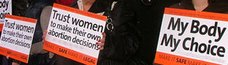
Spain prepares to fully legalise abortion
http://www.telegraph.co.uk/news/worldnews/europe/spain/4734734/Spain-prepares-to-fully-legalise-abortion.html
Spain is preparing to fully legalise abortion for the first time to allow women to have terminations on demand in the early stages of pregnancy.
By Fiona Govan in Madrid
Last Updated: 4:36PM GMT 20 Feb 2009
The move has put the Socialist government on a collision course with the Catholic Church which has argued the need "to restrict and not expand abortion" in Spain.
A parliamentary committee presented recommendations to Congress this week that included legalising early stage abortions, while gradually imposing more restrictions as pregnancies progress.
The proposals will form the basis of a draft bill to be presented to Parliament later this year that will tackle one of the traditionally Roman Catholic nation's final taboos and bring the abortion law in line with most other European countries.
The move is the latest in an ambitious programme of social change under Spanish prime minister Jose Luis Rodriguez Zapatero that has seen him clash repeatedly with the Roman Catholic Church.
Since coming to power in 2004 his socialist government has legalised gay marriage, eased divorce laws and dropped religious education from the curriculum in public schools, all measures which have deeply angered church leaders.
In Spain abortion was decriminalised in 1985 but it is offered only under restricted circumstances and rarely in a public hospital. Terminations are only allowed until the 12th week of pregnancy in cases of rape or until the 22nd week in cases of severe fetal malformation.
In early 2008, some 25 women and doctors were arrested in raids on abortion clinics in Madrid accused of falsifying doctors' certificates. The raids sparked a nationwide strike by the clinics, and forced the government to fast-track the new legislation.
Proponents of the new proposals say it is about treating women with respect, allowing them to make their own reproductive decisions rather than forcing them to seek a doctor's approval.
Carmen Monton, spokesman for the ruling Socialist party, said: "What we are talking about is for women not to face persecution when they decide about their own motherhood."
Earlier this month on a visit to Madrid, the Vatican Secretary of State met with representatives of the socialist government to oppose the softening of abortion laws.
Vatican deputy Tarcisio Bertonem said: "I tried to make them understand that it is necessary to restrict and not expand abortion."
Monsignor Martinez Camino, president of the Spanish Bishops Conference, has denounced the proposed law in strikingly political terms, saying it targeted the defenceless.
"The unborn don't vote," he said. "They don't organise." And he reiterated the Church's stance on those who have abortions or perform them. "They face automatic excommunication," he warned.
Wednesday, February 25, 2009


Monday, February 02, 2009
Czech Republic: New Bill on Abortion
Czech Republic: new bill on abortion.
Under current Czech law, unrestricted abortion is allowed until 12 weeks gestation, and with "medical indications" until 24 weeks. Fetuses diagnosed with serious abnormalities can be legally aborted at any gestational age. The only restrictions beyond these say that abortions must be spaced at least six months apart and the pregnant woman must be at least 16 years old, unless she has the permission of her parents. New bill further extending conditions for abortion, and liberalizing rules of assisted fertilization, sex change, sterilization and other specific treatments was unanimously approved by the Czech cabinet in December 2008. The European Union rules state that all participating member states should provide the same services and care to all EU citizens that local citizens receive. If the new bill is passed by the parliament, it will extend abortion privileges and other health services to all European Union citizens.
Under current Czech law, unrestricted abortion is allowed until 12 weeks gestation, and with "medical indications" until 24 weeks. Fetuses diagnosed with serious abnormalities can be legally aborted at any gestational age. The only restrictions beyond these say that abortions must be spaced at least six months apart and the pregnant woman must be at least 16 years old, unless she has the permission of her parents. New bill further extending conditions for abortion, and liberalizing rules of assisted fertilization, sex change, sterilization and other specific treatments was unanimously approved by the Czech cabinet in December 2008. The European Union rules state that all participating member states should provide the same services and care to all EU citizens that local citizens receive. If the new bill is passed by the parliament, it will extend abortion privileges and other health services to all European Union citizens.
Northern Ireland: Internet Boom in DIY Abortion Pills
Northern Ireland: Internet boom in DIY abortion pills
The Guardian February 1st.
Women in Northern Ireland are turning to the internet to buy £60 abortion pills because they cannot afford to travel to mainland Britain to terminate their pregnancies, it has been claimed.
Audrey Simpson, director of the Family Planning Association in Belfast, revealed that a rising number of women had contacted her to say they had suffered complications after taking the pills.
"These calls are increasing all the time," she said. "Travelling for an abortion is expensive by comparison."
Simpson said she was concerned that some women purchasing the pills, which should only be used up to the ninth week of pregnancy, had lied about the stage they were at on online questionnaires.
While the pills are legal to buy over the internet, campaigners fear that women may face a larger risk because they do not have a face-to-face consultation with a doctor. They also worry that women will not seek medical help if they suffer complications because they fear being arrested for inducing an abortion.
"Women in Northern Ireland ring us all the time asking if the sites selling the pills are reputable," said Simpson.
"There are women who have 'lied' about how far pregnant they are to get these pills. Yet if they suffer complications and go to their local A&E, doctors can report them for illegal conduct which can potentially land them with a hefty prison sentence."
Dawn Purvis, leader of the Progressive Unionist Party (PUP), the only party in Northern Ireland that is "pro-choice", described the online pills as a new "form of backstreet abortion".
"There have been cases documented around the world where women have died from sourcing bogus medication or taking more than is required," said Purvis.
"I know of women who have taken several doses to make sure it worked. One woman contacted me after she had suffered internal haemorrhaging. I am hearing more about these 'pills' at the moment with the recession in full swing. Money is short and it's mainly working-class women who can't afford to travel. Buying the pills off the net is an easy solution."
A report published last year by the International Journal of Gynaecology and Obstetrics attested that in Europe, to date, more than 1.5 million women have terminated their pregnancies with mifepristone and misoprostol. The combination of the two pills causes the non-surgical termination of a pregnancy and can be taken in the early stages.
As it stands, abortion is illegal in Northern Ireland, with the exception of one circumstance: where it can be proved that continuation of a pregnancy results in a woman's mental or physical health being in "grave" danger of "serious and permanent damage".
To date, this does not include a woman who becomes pregnant as a result of rape or incest.
It also doesn't include pregnancies which are terminated due to foetal abnormality, tests for which are freely available in Northern Ireland from the 12th week of pregnancy.
"Basically the case law in Northern Ireland is based on the Bourne ruling which dates back to 1939 and the prosecution of a doctor who performed an abortion for a suicidal 14-year-old who became pregnant from gang rape," explains Dawn Purvis.
"However, there is plenty of 'anecdotal' evidence that abortions are available here for middle-class clientele in private clinics."
According to Purvis, women who have later abortions in the UK or Europe are nearly always "working-class" women who can't get the money together in time.
"And if they do get the money, they can't afford to bring anyone with them, so do that journey alone," she added.
Although there are no "official" figures on abortion in Northern Ireland, last year 1,345 women who had abortions in clinics in England and Wales gave addresses in Northern Ireland.
The FPA pointed out that the number did not take account of women who travelled for abortions in Scotland or further afield to countries such as Belgium.
Induced abortion is one of the most common gynaecological procedures in the UK, with about 186,000 terminations performed annually in England and Wales and about 11,500 in Scotland.
"Women cannot avail of their rights under the law, while pro-life politicians deny the facts," says Goretti Horgan, spokesperson for Alliance for Choice.
"The vast majority of women I speak to are lone parents or women in poverty who cannot afford to have another child. They are devastated by this difficult decision and often feel suicidal."
But Unionist party MP Jeffrey Donaldson says the FPA and other organisations need to produce substantive evidence to support claims that more women are using the abortion pill.
"If there is greater use of this pill, it is because there are organisations in Northern Ireland which are promoting the use of this medicine which needs to be looked at by the law here," he said.
The director of Precious Life, Bernadette Smyth, said she was greatly disturbed that women were able to buy pills which can terminate a pregnancy from the web. "This is a horrendous type of abortion, which will traumatise many, many women. This is the equivalent of bringing backstreet illegal abortions to Northern Ireland," she said.
Source: The Guardian, 1 February 2009
The Guardian February 1st.
Women in Northern Ireland are turning to the internet to buy £60 abortion pills because they cannot afford to travel to mainland Britain to terminate their pregnancies, it has been claimed.
Audrey Simpson, director of the Family Planning Association in Belfast, revealed that a rising number of women had contacted her to say they had suffered complications after taking the pills.
"These calls are increasing all the time," she said. "Travelling for an abortion is expensive by comparison."
Simpson said she was concerned that some women purchasing the pills, which should only be used up to the ninth week of pregnancy, had lied about the stage they were at on online questionnaires.
While the pills are legal to buy over the internet, campaigners fear that women may face a larger risk because they do not have a face-to-face consultation with a doctor. They also worry that women will not seek medical help if they suffer complications because they fear being arrested for inducing an abortion.
"Women in Northern Ireland ring us all the time asking if the sites selling the pills are reputable," said Simpson.
"There are women who have 'lied' about how far pregnant they are to get these pills. Yet if they suffer complications and go to their local A&E, doctors can report them for illegal conduct which can potentially land them with a hefty prison sentence."
Dawn Purvis, leader of the Progressive Unionist Party (PUP), the only party in Northern Ireland that is "pro-choice", described the online pills as a new "form of backstreet abortion".
"There have been cases documented around the world where women have died from sourcing bogus medication or taking more than is required," said Purvis.
"I know of women who have taken several doses to make sure it worked. One woman contacted me after she had suffered internal haemorrhaging. I am hearing more about these 'pills' at the moment with the recession in full swing. Money is short and it's mainly working-class women who can't afford to travel. Buying the pills off the net is an easy solution."
A report published last year by the International Journal of Gynaecology and Obstetrics attested that in Europe, to date, more than 1.5 million women have terminated their pregnancies with mifepristone and misoprostol. The combination of the two pills causes the non-surgical termination of a pregnancy and can be taken in the early stages.
As it stands, abortion is illegal in Northern Ireland, with the exception of one circumstance: where it can be proved that continuation of a pregnancy results in a woman's mental or physical health being in "grave" danger of "serious and permanent damage".
To date, this does not include a woman who becomes pregnant as a result of rape or incest.
It also doesn't include pregnancies which are terminated due to foetal abnormality, tests for which are freely available in Northern Ireland from the 12th week of pregnancy.
"Basically the case law in Northern Ireland is based on the Bourne ruling which dates back to 1939 and the prosecution of a doctor who performed an abortion for a suicidal 14-year-old who became pregnant from gang rape," explains Dawn Purvis.
"However, there is plenty of 'anecdotal' evidence that abortions are available here for middle-class clientele in private clinics."
According to Purvis, women who have later abortions in the UK or Europe are nearly always "working-class" women who can't get the money together in time.
"And if they do get the money, they can't afford to bring anyone with them, so do that journey alone," she added.
Although there are no "official" figures on abortion in Northern Ireland, last year 1,345 women who had abortions in clinics in England and Wales gave addresses in Northern Ireland.
The FPA pointed out that the number did not take account of women who travelled for abortions in Scotland or further afield to countries such as Belgium.
Induced abortion is one of the most common gynaecological procedures in the UK, with about 186,000 terminations performed annually in England and Wales and about 11,500 in Scotland.
"Women cannot avail of their rights under the law, while pro-life politicians deny the facts," says Goretti Horgan, spokesperson for Alliance for Choice.
"The vast majority of women I speak to are lone parents or women in poverty who cannot afford to have another child. They are devastated by this difficult decision and often feel suicidal."
But Unionist party MP Jeffrey Donaldson says the FPA and other organisations need to produce substantive evidence to support claims that more women are using the abortion pill.
"If there is greater use of this pill, it is because there are organisations in Northern Ireland which are promoting the use of this medicine which needs to be looked at by the law here," he said.
The director of Precious Life, Bernadette Smyth, said she was greatly disturbed that women were able to buy pills which can terminate a pregnancy from the web. "This is a horrendous type of abortion, which will traumatise many, many women. This is the equivalent of bringing backstreet illegal abortions to Northern Ireland," she said.
Source: The Guardian, 1 February 2009
Tuesday, January 27, 2009
'Global Gag Rule' Lifted
'Global Gag Rule' Lifted
By Barbara Crossette The Nation
January 25, 2009
On Friday evening, a time favored by officials trying to avoid attention, President Barack Obama issued a statement reversing one of the most damaging policies ever visited on developing nations by Republican administrations. This was the "global gag rule," which forbade US government support for any organization that in any way fostered, provided or even advised women about abortion. It was a policy foisted on an unsuspecting world by the Reagan administration at, of all events, a United Nations conference on women and development held in Mexico City in 1984.
What became known as the "Mexico City policy" was always a political football. It was rescinded in 1993 by President Bill Clinton, then reimposed in 2001 by George W. Bush, who also proceeded to deal a second harsh blow to the world's poorest families by cutting off American assistance to the United Nations Population Fund, the largest global provider of family planning assistance. The reason, or excuse--rejected by the administration's own internal report--was that the Population Fund was linked to forced abortion practices in China. The fund has lost about $250 million in American aid since 2002.
Millions of women and their families were the direct victims of these shortsighted steps, taken in the name of people who called themselves "pro-family," but appeared to be woefully ignorant of the harm they caused in homes around the world. The International Planned Parenthood Federation, based in London, estimates that in the last eight years alone as much as $100 million in US aid was lost to its affiliates in 100 countries because of their refusal to accept an abortion ban. The federation estimates this lost aid could have prevented 36 million unintended pregnancies and 15 million abortions, often acts of desperation. More than 80,000 women and more than 2.5 million children might not have died.
Not surprisingly, the rate of unsafe abortions is highest in the poorest countries, where at least 200 million women cannot get contraceptives. The World Health Organization, which supports safe abortion as a tool of last resort, estimates that of 45 million abortions globally every year, 19 million take place under unsafe conditions, causing at least 68,000 deaths. Forty percent of those most dangerous abortions involve teens and women between the ages of 15 and 24. A woman in the developing world--primarily in Africa and parts of Asia--is at least 100 times more likely to die of a botched abortion than a woman in the industrial North.
Which raises the question why President Obama--and Secretary of State Hillary Clinton, once an outspoken champion of women's rights in the developing world--made so little of this policy reversal. Is abortion still too skittish a topic to talk about in public? Even when a presidential order signals a promising new approach to development aid?
President Obama also pledged to work with Congress to restore contributions to the Population Fund, known as UNFPA. "By resuming funding to UNFPA, the US will be joining 180 other donor nations working collaboratively to reduce poverty, improve the health of women and children, prevent HIV/AIDS and provide family planning assistance to women in 154 countries," his statement said.
Not lost on Thoraya Obaid, the courageous Saudi woman who is executive director of UNFPA, was President Obama's focus on poverty reduction as a byproduct of family planning, giving millions of the world's poorest women some of the same reproductive choices and life opportunities enjoyed in richer nations.
"President Obama's decision could not have come at a more critical time," Obaid said in a statement hours after the White House announcement. It was, she added, "an essential step towards creating a world where all women have the opportunity to participate as equal members of society." The rate of death from pregnancy and childbirth--99 percent of which occur in developing countries--has fallen just one per cent between 1990 and 2005 around the world, the UNFPA statement noted. "Every minute, a woman dies giving life, totaling up to 10 million women during a generation," it said.
UNFPA has argued tirelessly at the UN, where population growth is not a fashionable issue, that high fertility (mostly not a woman's choice) lowers per capita income, reduces education levels and consumes resources necessary to sustain healthy, productive lives. It also creates a generation of poorly educated, unemployable young people shorn of hope and open to recruitment by militant organizations of all kinds, threatening the stability of countries trying to make still-shaky democracies work.
Secretary of State Clinton, who has said she will focus on democracy and development, now has her mandate.
Steven Sinding, a former director general of the International Planned Parenthood Federation, a Columbia University professor and advisor to the World Bank, was working on family planning in the US government in 1984 when the gag rule was first announced in Mexico City, taking American officials on the scene by surprise.
Sinding has been campaigning ever since against this destructive policy, which for the IPPF alone, he said in an e-mail, "necessitated clinic closures, staff layoffs and, ultimately, curtailment of family planning services to hundreds of thousands, perhaps even millions, of women in developing countries.
He described President Obama's reversal of the order as something akin to "a glorious sunrise after a long and exceptionally dark night."
About Barbara Crossette
Barbara Crossette, United Nations correspondent for The Nation, is a former New York Times correspondent and bureau chief in Asia and at the UN.
She is the author of So Close to Heaven: The Vanishing Buddhist Kingdoms of the Himalayas, published by Alfred A. Knopf in 1995 and in paperback by Random House/Vintage Destinations in 1996, and a collection of travel essays about colonial resort towns that are still attracting visitors more than a century after their creation, The Great Hill Stations of Asia, published by Westview Press in 1998 and in paperback by Basic Books in 1999. In 2000, she wrote a survey of India and Indian-American relations, India: Old Civilization in a New World, for the Foreign Policy Association in New York. She is also the author of India Facing the 21st Century, published by Indiana University Press in 1993.
By Barbara Crossette The Nation
January 25, 2009
On Friday evening, a time favored by officials trying to avoid attention, President Barack Obama issued a statement reversing one of the most damaging policies ever visited on developing nations by Republican administrations. This was the "global gag rule," which forbade US government support for any organization that in any way fostered, provided or even advised women about abortion. It was a policy foisted on an unsuspecting world by the Reagan administration at, of all events, a United Nations conference on women and development held in Mexico City in 1984.
What became known as the "Mexico City policy" was always a political football. It was rescinded in 1993 by President Bill Clinton, then reimposed in 2001 by George W. Bush, who also proceeded to deal a second harsh blow to the world's poorest families by cutting off American assistance to the United Nations Population Fund, the largest global provider of family planning assistance. The reason, or excuse--rejected by the administration's own internal report--was that the Population Fund was linked to forced abortion practices in China. The fund has lost about $250 million in American aid since 2002.
Millions of women and their families were the direct victims of these shortsighted steps, taken in the name of people who called themselves "pro-family," but appeared to be woefully ignorant of the harm they caused in homes around the world. The International Planned Parenthood Federation, based in London, estimates that in the last eight years alone as much as $100 million in US aid was lost to its affiliates in 100 countries because of their refusal to accept an abortion ban. The federation estimates this lost aid could have prevented 36 million unintended pregnancies and 15 million abortions, often acts of desperation. More than 80,000 women and more than 2.5 million children might not have died.
Not surprisingly, the rate of unsafe abortions is highest in the poorest countries, where at least 200 million women cannot get contraceptives. The World Health Organization, which supports safe abortion as a tool of last resort, estimates that of 45 million abortions globally every year, 19 million take place under unsafe conditions, causing at least 68,000 deaths. Forty percent of those most dangerous abortions involve teens and women between the ages of 15 and 24. A woman in the developing world--primarily in Africa and parts of Asia--is at least 100 times more likely to die of a botched abortion than a woman in the industrial North.
Which raises the question why President Obama--and Secretary of State Hillary Clinton, once an outspoken champion of women's rights in the developing world--made so little of this policy reversal. Is abortion still too skittish a topic to talk about in public? Even when a presidential order signals a promising new approach to development aid?
President Obama also pledged to work with Congress to restore contributions to the Population Fund, known as UNFPA. "By resuming funding to UNFPA, the US will be joining 180 other donor nations working collaboratively to reduce poverty, improve the health of women and children, prevent HIV/AIDS and provide family planning assistance to women in 154 countries," his statement said.
Not lost on Thoraya Obaid, the courageous Saudi woman who is executive director of UNFPA, was President Obama's focus on poverty reduction as a byproduct of family planning, giving millions of the world's poorest women some of the same reproductive choices and life opportunities enjoyed in richer nations.
"President Obama's decision could not have come at a more critical time," Obaid said in a statement hours after the White House announcement. It was, she added, "an essential step towards creating a world where all women have the opportunity to participate as equal members of society." The rate of death from pregnancy and childbirth--99 percent of which occur in developing countries--has fallen just one per cent between 1990 and 2005 around the world, the UNFPA statement noted. "Every minute, a woman dies giving life, totaling up to 10 million women during a generation," it said.
UNFPA has argued tirelessly at the UN, where population growth is not a fashionable issue, that high fertility (mostly not a woman's choice) lowers per capita income, reduces education levels and consumes resources necessary to sustain healthy, productive lives. It also creates a generation of poorly educated, unemployable young people shorn of hope and open to recruitment by militant organizations of all kinds, threatening the stability of countries trying to make still-shaky democracies work.
Secretary of State Clinton, who has said she will focus on democracy and development, now has her mandate.
Steven Sinding, a former director general of the International Planned Parenthood Federation, a Columbia University professor and advisor to the World Bank, was working on family planning in the US government in 1984 when the gag rule was first announced in Mexico City, taking American officials on the scene by surprise.
Sinding has been campaigning ever since against this destructive policy, which for the IPPF alone, he said in an e-mail, "necessitated clinic closures, staff layoffs and, ultimately, curtailment of family planning services to hundreds of thousands, perhaps even millions, of women in developing countries.
He described President Obama's reversal of the order as something akin to "a glorious sunrise after a long and exceptionally dark night."
About Barbara Crossette
Barbara Crossette, United Nations correspondent for The Nation, is a former New York Times correspondent and bureau chief in Asia and at the UN.
She is the author of So Close to Heaven: The Vanishing Buddhist Kingdoms of the Himalayas, published by Alfred A. Knopf in 1995 and in paperback by Random House/Vintage Destinations in 1996, and a collection of travel essays about colonial resort towns that are still attracting visitors more than a century after their creation, The Great Hill Stations of Asia, published by Westview Press in 1998 and in paperback by Basic Books in 1999. In 2000, she wrote a survey of India and Indian-American relations, India: Old Civilization in a New World, for the Foreign Policy Association in New York. She is also the author of India Facing the 21st Century, published by Indiana University Press in 1993.
Vatican Attacks US Abortion Move
Vatican attacks US abortion move
BBC News January 25th 2009
The Vatican has condemned President Obama's move to restore US funding for family planning clinics abroad that give advice on or carry out abortions.
One Vatican official warned against the "arrogance" of those in power who think they can decide between life and death.
Another official said it dealt a blow to groups fighting against "the slaughter of the innocents".
The White House says the move aligns the US with other nations fighting poverty and promoting health care.
On Friday, Mr Obama ended a ban on giving US federal money to international groups that perform abortions or provide information about them.
Robust language
In an interview published in an Italian newspaper on Saturday, senior Vatican official Monsignor Rino Fisichella urged Mr Obama to listen to all voices in America without "the arrogance of those who, being in power, believe they can decide of life and death."
"If this is one of President Obama's first acts, I have to say, in all due respect, that we're heading quickly toward disappointment," Mr Fisichella, who heads the Vatican's Pontifical Academy for Life, told the Corriere della Sera.
Another Academy official, Monsignor Elio Sgreccia, said it had dealt a harsh blow to US Catholics and people across the world who are fighting against "the slaughter of the innocents".
The criticism from the Vatican adds to concerns from evangelical Protestant groups that the US decision could presage a wider dismantling of the legal limits of abortion.
Critics of the former funding ban had long argued that it hurt some of the poorest people in the world by denying money to groups that might support abortion, but also work on other aspects of reproductive health care or HIV/Aids.
The ban was first introduced in 1984 by President Ronald Reagan. It was rescinded by President Bill Clinton, before being reinstated by President George W Bush in 2001.
BBC News January 25th 2009
The Vatican has condemned President Obama's move to restore US funding for family planning clinics abroad that give advice on or carry out abortions.
One Vatican official warned against the "arrogance" of those in power who think they can decide between life and death.
Another official said it dealt a blow to groups fighting against "the slaughter of the innocents".
The White House says the move aligns the US with other nations fighting poverty and promoting health care.
On Friday, Mr Obama ended a ban on giving US federal money to international groups that perform abortions or provide information about them.
Robust language
In an interview published in an Italian newspaper on Saturday, senior Vatican official Monsignor Rino Fisichella urged Mr Obama to listen to all voices in America without "the arrogance of those who, being in power, believe they can decide of life and death."
"If this is one of President Obama's first acts, I have to say, in all due respect, that we're heading quickly toward disappointment," Mr Fisichella, who heads the Vatican's Pontifical Academy for Life, told the Corriere della Sera.
Another Academy official, Monsignor Elio Sgreccia, said it had dealt a harsh blow to US Catholics and people across the world who are fighting against "the slaughter of the innocents".
The criticism from the Vatican adds to concerns from evangelical Protestant groups that the US decision could presage a wider dismantling of the legal limits of abortion.
Critics of the former funding ban had long argued that it hurt some of the poorest people in the world by denying money to groups that might support abortion, but also work on other aspects of reproductive health care or HIV/Aids.
The ban was first introduced in 1984 by President Ronald Reagan. It was rescinded by President Bill Clinton, before being reinstated by President George W Bush in 2001.
Monday, January 26, 2009
Statement from President Obama, Secretary of Sate Hillary Clinton and UNFPA on Rescinding of 'Global Gag Rule'
THE WHITE HOUSE
Office of the Press Secretary
_________________________________________________________________
For Immediate Release January 23, 2009
Statement of President Barack Obama on Rescinding the Mexico City Policy
"It is clear that the provisions of the Mexico City Policy are unnecessarily broad and unwarranted under current law, and for the past eight years, they have undermined efforts to promote safe and effective voluntary family planning in developing countries. For these reasons, it is right for us to rescind this policy and restore critical efforts to protect and empower women and promote global economic development.
"For too long, international family planning assistance has been used as a political wedge issue, the subject of a back and forth debate that has served only to divide us. I have no desire to continue this stale and fruitless debate.
"It is time that we end the politicization of this issue. In the coming weeks, my Administration will initiate a fresh conversation on family planning, working to find areas of common ground to best meet the needs of women and families at home and around the world.
"I have directed my staff to reach out to those on all sides of this issue to achieve the goal of reducing unintended pregnancies. They will also work to promote safe motherhood, reduce maternal and infant mortality rates and increase educational and economic opportunities for women and girls.
"In addition, I look forward to working with Congress to restore U.S. financial support for the U.N. Population Fund. By resuming funding to UNFPA, the U.S. will be joining 180 other donor nations working collaboratively to reduce poverty, improve the health of women and children, prevent HIV/AIDS and provide family planning assistance to women in 154 countries,” said President Obama.
________________________
Memorandum for the Secretary of State
the Administrator of the United States Agency for International Development
Subject: Mexico City Policy and Assistance for Voluntary Population Planning
The Foreign Assistance Act of 1961 (22 U.S.C. 2151b(f)(1)), prohibits nongovernmental organizations (NGOs) that receive Federal funds from using those funds "to pay for the performance of abortions as a method of family planning, or to motivate or coerce any person to practice abortions." The August 1984 announcement by President Reagan of what has become known as the "Mexico City Policy" directed the United States Agency for International Development (USAID) to expand this limitation and withhold USAID funds from NGOs that use non-USAID funds to engage in a wide range of activities, including providing advice, counseling, or information regarding abortion, or lobbying a foreign government to legalize or make abortion available. The Mexico City Policy was in effect from 1985 until 1993, when it was rescinded by President Clinton. President George W. Bush reinstated the policy in 2001, implementing it through conditions in USAID grant awards, and subsequently extended the policy to "voluntary population planning" assistance provided by the Department of State.
These excessively broad conditions on grants and assistance awards are unwarranted. Moreover, they have undermined efforts to promote safe and effective voluntary family planning programs in foreign nations. Accordingly, I hereby revoke the Presidential memorandum of January 22, 2001, for the Administrator of USAID (Restoration of the Mexico City Policy), the Presidential memorandum of March 28, 2001, for the Administrator of USAID (Restoration of the Mexico City Policy), and the Presidential memorandum of August 29, 2003, for the Secretary of State (Assistance for Voluntary Population Planning). In addition, I direct the Secretary of State and the Administrator of USAID to take the following actions with respect to conditions in voluntary population planning assistance and USAID grants that were imposed pursuant to either the 2001 or 2003 memoranda and that are not required by the Foreign Assistance Act or any other law: (1) immediately waive such conditions in any current grants, and (2) notify current grantees, as soon as possible, that these conditions have been waived. I further direct that the Department of State and USAID immediately cease imposing these conditions in any future grants.
This memorandum is not intended to, and does not, create any right or benefit, substantive or procedural, enforceable at law or in equity by any party against the United States, its departments, agencies, or entities, its officers, employees, or agents, or any other person.
The Secretary of State is authorized and directed to publish this memorandum in the Federal Register.
BARACK OBAMA
THE WHITE HOUSE, January 23, 2009.
# # #
_____________________________
U.S. DEPARTMENT OF STATE
Office of the Spokesman
For Immediate Release January 23, 2009
2009/077
STATEMENT BY SECRETARY OF STATE HILLARY RODHAM CLINTON
Repeal of the Mexico City Policy
President Obama's repeal of the global gag rule, which has prevented women around the world from gaining access to essential information and healthcare services, is a welcomed and important step taken during the first days of the Administration.
For the past seven years, this policy has made it more difficult for women around the world to gain access to essential information and healthcare services. Rather than limiting women's ability to receive reproductive health services, we should be supporting programs that help women and their partners make decisions to ensure their health and the health of their families.
As I said in Beijing at the United Nations 4th World Conference on Women, women must not be denied the right to plan their own families. I look forward to working with the President, my colleagues in the Administration, and the NGO community to promote programs and policies that ensure women and girls have full access to health information and services.
# # #
______________________________
HQ/2009/4
23 January 2009
UNFPA WELCOMES RESTORATION OF U.S. FUNDING
UNITED NATIONS, New York, 23 January 2009- The United Nations Population
Fund (UNFPA) applauds today's statement from United States President
Barack Obama restoring U.S. funding for UNFPA's operations.
President Obama said: "I look forward to working with Congress to
restore U.S. financial support for the U.N. Population Fund. By resuming
funding to UNFPA, the U.S. will be joining 180 other donor nations
working collaboratively to reduce poverty, improve the health of women
and children, prevent HIV/AIDS and provide family planning assistance to
women in 154 countries."
UNFPA Executive Director, Thoraya Ahmed Obaid welcomes President Obama's
decision to restore funding and noted how quickly he addressed the
issue. "The President's actions send a strong message about his
leadership and his desire to support causes that will promote peace and
dignity, equality for women and girls and economic development in the
poorest regions of the world. And access to reproductive health is at
the core of all of these issues."
There is much to be done. More than halfway towards the 2015 target date
for the Millennium Development Goals, the goal that addresses improving
maternal and reproductive health has made the least progress and is the
most underfunded.
"We are confident that under the new President's direction, the U.S.
will resume its leadership in promoting and protecting women's
reproductive health and rights worldwide," said. Ms. Obaid. "This is an
essential step towards creating a world where all women have the
opportunity to participate as equal members of society."
Globally, the rate of death from pregnancy and childbirth has declined
just one percent between 1990 and 2005. Every minute a women loses her
life giving life, adding up to 10 million women over a generation.
Ninety-nine per cent of these deaths occur in developing countries,
particularly in Africa and Asia.
"President Obama's decision could not have come at a more critical
time," said Ms. Obaid. "If women are to stop dying in childbirth and if
reproductive health for all is to become a reality, we need increased
political and financial commitment at all levels to implement strategies
that we know will work. With the renewed US support to women and to
UNFPA, the odds of that happening are greatly improved."
Congressionally-approved funding for UNFPA has been withheld by the U.S.
Administration for the past seven years. During that time, the Fund has
not received a total of $244 million in U.S. funding. "Restoration of
funding will allow us to maintain recent gains during the current
financial crisis and provide support to women in some of the poorest
countries in the world," said Ms. Obaid. "Progress for all will not
happen without progress for women. This means working to promote, as an
international priority, the advancement of women's health, rights and
equality."
UNFPA also welcomes President Obama's decision to engage his
administration on family planning issues, restoring critical efforts to
protect and empower women. Access to voluntary family planning is one of
the most effective ways to prevent unintended pregnancies and reduce
abortions.
"UNFPA stands ready to work with President Obama, Secretary Clinton and
the American people to achieve our dream of helping women and girls in
the poorest countries reach their fullest potential. We welcome the
opportunity to work with the United States again as a full partner."
***
UNFPA, the United Nations Population Fund, is an international
development agency that promotes the right of every woman, man and child
to enjoy a life of health and equal opportunity. UNFPA supports
countries in using population data for policies and programmes to reduce
poverty and to ensure that every pregnancy is wanted, every birth is
safe, every young person is free of HIV/AIDS, and every girl and woman is treated with
dignity and respect. UNFPA -- because everyone counts.
Office of the Press Secretary
_________________________________________________________________
For Immediate Release January 23, 2009
Statement of President Barack Obama on Rescinding the Mexico City Policy
"It is clear that the provisions of the Mexico City Policy are unnecessarily broad and unwarranted under current law, and for the past eight years, they have undermined efforts to promote safe and effective voluntary family planning in developing countries. For these reasons, it is right for us to rescind this policy and restore critical efforts to protect and empower women and promote global economic development.
"For too long, international family planning assistance has been used as a political wedge issue, the subject of a back and forth debate that has served only to divide us. I have no desire to continue this stale and fruitless debate.
"It is time that we end the politicization of this issue. In the coming weeks, my Administration will initiate a fresh conversation on family planning, working to find areas of common ground to best meet the needs of women and families at home and around the world.
"I have directed my staff to reach out to those on all sides of this issue to achieve the goal of reducing unintended pregnancies. They will also work to promote safe motherhood, reduce maternal and infant mortality rates and increase educational and economic opportunities for women and girls.
"In addition, I look forward to working with Congress to restore U.S. financial support for the U.N. Population Fund. By resuming funding to UNFPA, the U.S. will be joining 180 other donor nations working collaboratively to reduce poverty, improve the health of women and children, prevent HIV/AIDS and provide family planning assistance to women in 154 countries,” said President Obama.
________________________
Memorandum for the Secretary of State
the Administrator of the United States Agency for International Development
Subject: Mexico City Policy and Assistance for Voluntary Population Planning
The Foreign Assistance Act of 1961 (22 U.S.C. 2151b(f)(1)), prohibits nongovernmental organizations (NGOs) that receive Federal funds from using those funds "to pay for the performance of abortions as a method of family planning, or to motivate or coerce any person to practice abortions." The August 1984 announcement by President Reagan of what has become known as the "Mexico City Policy" directed the United States Agency for International Development (USAID) to expand this limitation and withhold USAID funds from NGOs that use non-USAID funds to engage in a wide range of activities, including providing advice, counseling, or information regarding abortion, or lobbying a foreign government to legalize or make abortion available. The Mexico City Policy was in effect from 1985 until 1993, when it was rescinded by President Clinton. President George W. Bush reinstated the policy in 2001, implementing it through conditions in USAID grant awards, and subsequently extended the policy to "voluntary population planning" assistance provided by the Department of State.
These excessively broad conditions on grants and assistance awards are unwarranted. Moreover, they have undermined efforts to promote safe and effective voluntary family planning programs in foreign nations. Accordingly, I hereby revoke the Presidential memorandum of January 22, 2001, for the Administrator of USAID (Restoration of the Mexico City Policy), the Presidential memorandum of March 28, 2001, for the Administrator of USAID (Restoration of the Mexico City Policy), and the Presidential memorandum of August 29, 2003, for the Secretary of State (Assistance for Voluntary Population Planning). In addition, I direct the Secretary of State and the Administrator of USAID to take the following actions with respect to conditions in voluntary population planning assistance and USAID grants that were imposed pursuant to either the 2001 or 2003 memoranda and that are not required by the Foreign Assistance Act or any other law: (1) immediately waive such conditions in any current grants, and (2) notify current grantees, as soon as possible, that these conditions have been waived. I further direct that the Department of State and USAID immediately cease imposing these conditions in any future grants.
This memorandum is not intended to, and does not, create any right or benefit, substantive or procedural, enforceable at law or in equity by any party against the United States, its departments, agencies, or entities, its officers, employees, or agents, or any other person.
The Secretary of State is authorized and directed to publish this memorandum in the Federal Register.
BARACK OBAMA
THE WHITE HOUSE, January 23, 2009.
# # #
_____________________________
U.S. DEPARTMENT OF STATE
Office of the Spokesman
For Immediate Release January 23, 2009
2009/077
STATEMENT BY SECRETARY OF STATE HILLARY RODHAM CLINTON
Repeal of the Mexico City Policy
President Obama's repeal of the global gag rule, which has prevented women around the world from gaining access to essential information and healthcare services, is a welcomed and important step taken during the first days of the Administration.
For the past seven years, this policy has made it more difficult for women around the world to gain access to essential information and healthcare services. Rather than limiting women's ability to receive reproductive health services, we should be supporting programs that help women and their partners make decisions to ensure their health and the health of their families.
As I said in Beijing at the United Nations 4th World Conference on Women, women must not be denied the right to plan their own families. I look forward to working with the President, my colleagues in the Administration, and the NGO community to promote programs and policies that ensure women and girls have full access to health information and services.
# # #
______________________________
HQ/2009/4
23 January 2009
UNFPA WELCOMES RESTORATION OF U.S. FUNDING
UNITED NATIONS, New York, 23 January 2009- The United Nations Population
Fund (UNFPA) applauds today's statement from United States President
Barack Obama restoring U.S. funding for UNFPA's operations.
President Obama said: "I look forward to working with Congress to
restore U.S. financial support for the U.N. Population Fund. By resuming
funding to UNFPA, the U.S. will be joining 180 other donor nations
working collaboratively to reduce poverty, improve the health of women
and children, prevent HIV/AIDS and provide family planning assistance to
women in 154 countries."
UNFPA Executive Director, Thoraya Ahmed Obaid welcomes President Obama's
decision to restore funding and noted how quickly he addressed the
issue. "The President's actions send a strong message about his
leadership and his desire to support causes that will promote peace and
dignity, equality for women and girls and economic development in the
poorest regions of the world. And access to reproductive health is at
the core of all of these issues."
There is much to be done. More than halfway towards the 2015 target date
for the Millennium Development Goals, the goal that addresses improving
maternal and reproductive health has made the least progress and is the
most underfunded.
"We are confident that under the new President's direction, the U.S.
will resume its leadership in promoting and protecting women's
reproductive health and rights worldwide," said. Ms. Obaid. "This is an
essential step towards creating a world where all women have the
opportunity to participate as equal members of society."
Globally, the rate of death from pregnancy and childbirth has declined
just one percent between 1990 and 2005. Every minute a women loses her
life giving life, adding up to 10 million women over a generation.
Ninety-nine per cent of these deaths occur in developing countries,
particularly in Africa and Asia.
"President Obama's decision could not have come at a more critical
time," said Ms. Obaid. "If women are to stop dying in childbirth and if
reproductive health for all is to become a reality, we need increased
political and financial commitment at all levels to implement strategies
that we know will work. With the renewed US support to women and to
UNFPA, the odds of that happening are greatly improved."
Congressionally-approved funding for UNFPA has been withheld by the U.S.
Administration for the past seven years. During that time, the Fund has
not received a total of $244 million in U.S. funding. "Restoration of
funding will allow us to maintain recent gains during the current
financial crisis and provide support to women in some of the poorest
countries in the world," said Ms. Obaid. "Progress for all will not
happen without progress for women. This means working to promote, as an
international priority, the advancement of women's health, rights and
equality."
UNFPA also welcomes President Obama's decision to engage his
administration on family planning issues, restoring critical efforts to
protect and empower women. Access to voluntary family planning is one of
the most effective ways to prevent unintended pregnancies and reduce
abortions.
"UNFPA stands ready to work with President Obama, Secretary Clinton and
the American people to achieve our dream of helping women and girls in
the poorest countries reach their fullest potential. We welcome the
opportunity to work with the United States again as a full partner."
***
UNFPA, the United Nations Population Fund, is an international
development agency that promotes the right of every woman, man and child
to enjoy a life of health and equal opportunity. UNFPA supports
countries in using population data for policies and programmes to reduce
poverty and to ensure that every pregnancy is wanted, every birth is
safe, every young person is free of HIV/AIDS, and every girl and woman is treated with
dignity and respect. UNFPA -- because everyone counts.
From Guttmacher Institute: Obama Rescinds 'Global Gag Rule', Commits to Funding UNFPA
Obama Rescinds “Global Gag Rule,” Commits to Funding UNFPA
President Obama on January 23 affirmed his administration’s strong commitment to women’s health and international family planning assistance by rescinding the “global gag rule” and by committing the United States to restoring support for the United Nations Population Fund (UNFPA). The global gag rule—also known as the Mexico City policy—prohibited overseas organizations from receiving U.S. family planning assistance if they used their non-U.S. funds to provide abortion information, services or counseling, or engaged in any abortion rights advocacy.
Tragically, the policy may have only increased the need for abortions (most of them unsafe) by reducing access to family planning services in many developing countries. It also created more obstacles for some of the world’s poorest women seeking information about how to avoid unsafe abortions. The global gag rule was first imposed by President Reagan in 1984, rescinded by President Clinton in 1993 and then reinstated by President Bush in 2001.
The Bush administration and other anti–family planning administrations had also denied U.S. support to UNFPA—which works to reduce the need for abortion by promoting voluntary family planning in more than 150 poor countries. The Reagan, Bush I and Bush II administrations all blocked any U.S. contribution to UNFPA on the grounds that it indirectly supported coercive abortions in China, despite U.S. government findings clearing UNFPA of any involvement in coercive practices.
Congress has consistently appropriated funds for UNFPA since the United States helped to found the agency in 1969. Most recently, UNFPA received U.S. contributions during the Clinton administration and the first year of the Bush administration. The Bush administration reversed itself in 2002 and subsequently blocked about $244 million in funding over seven years.
There is overwhelming evidence that helping women avoid becoming pregnant too early, too late or too often benefits them and their children. Currently, 500 million women in the developing world are using some form of family planning, thereby preventing 187 million unintended pregnancies, 60 million unplanned births, 105 million induced abortions, 2.7 million infant deaths and 215,000 maternal deaths (which would leave 685,000 children motherless) each year.
However, another 200 million women throughout the developing world who would like to delay or limit their births lack access to contraceptives. Filling the unmet need for contraceptives would further reduce global rates of maternal mortality by 35% and would lower the overall number of abortions by 64%, many of which would have been unsafe abortions. More than 95% of abortions in Africa and Latin America are performed under unsafe circumstances, as are about 60% of abortions in Asia. Almost 70,000 women die each year from complications following unsafe abortions, and thousands more suffer serious, permanent injuries.
Despite the clear benefits of family planning for women worldwide, both the global gag rule and the refusal to fund UNFPA were part of a broader erosion of support for international family planning assistance under the Bush administration. The Obama administration’s reversal of both policies not only will strengthen the global fight against maternal and child mortality. It also is firmly in line with President Obama’s goal of finding common ground in the abortion debate by focusing on preventing unintended pregnancies—including through the provision of contraceptives—and thereby reducing the need for abortion.
However, even with these policy changes, direct U.S. funding for abortions overseas will continue to be prohibited under the Helms Amendment.
President Obama on January 23 affirmed his administration’s strong commitment to women’s health and international family planning assistance by rescinding the “global gag rule” and by committing the United States to restoring support for the United Nations Population Fund (UNFPA). The global gag rule—also known as the Mexico City policy—prohibited overseas organizations from receiving U.S. family planning assistance if they used their non-U.S. funds to provide abortion information, services or counseling, or engaged in any abortion rights advocacy.
Tragically, the policy may have only increased the need for abortions (most of them unsafe) by reducing access to family planning services in many developing countries. It also created more obstacles for some of the world’s poorest women seeking information about how to avoid unsafe abortions. The global gag rule was first imposed by President Reagan in 1984, rescinded by President Clinton in 1993 and then reinstated by President Bush in 2001.
The Bush administration and other anti–family planning administrations had also denied U.S. support to UNFPA—which works to reduce the need for abortion by promoting voluntary family planning in more than 150 poor countries. The Reagan, Bush I and Bush II administrations all blocked any U.S. contribution to UNFPA on the grounds that it indirectly supported coercive abortions in China, despite U.S. government findings clearing UNFPA of any involvement in coercive practices.
Congress has consistently appropriated funds for UNFPA since the United States helped to found the agency in 1969. Most recently, UNFPA received U.S. contributions during the Clinton administration and the first year of the Bush administration. The Bush administration reversed itself in 2002 and subsequently blocked about $244 million in funding over seven years.
There is overwhelming evidence that helping women avoid becoming pregnant too early, too late or too often benefits them and their children. Currently, 500 million women in the developing world are using some form of family planning, thereby preventing 187 million unintended pregnancies, 60 million unplanned births, 105 million induced abortions, 2.7 million infant deaths and 215,000 maternal deaths (which would leave 685,000 children motherless) each year.
However, another 200 million women throughout the developing world who would like to delay or limit their births lack access to contraceptives. Filling the unmet need for contraceptives would further reduce global rates of maternal mortality by 35% and would lower the overall number of abortions by 64%, many of which would have been unsafe abortions. More than 95% of abortions in Africa and Latin America are performed under unsafe circumstances, as are about 60% of abortions in Asia. Almost 70,000 women die each year from complications following unsafe abortions, and thousands more suffer serious, permanent injuries.
Despite the clear benefits of family planning for women worldwide, both the global gag rule and the refusal to fund UNFPA were part of a broader erosion of support for international family planning assistance under the Bush administration. The Obama administration’s reversal of both policies not only will strengthen the global fight against maternal and child mortality. It also is firmly in line with President Obama’s goal of finding common ground in the abortion debate by focusing on preventing unintended pregnancies—including through the provision of contraceptives—and thereby reducing the need for abortion.
However, even with these policy changes, direct U.S. funding for abortions overseas will continue to be prohibited under the Helms Amendment.
Wednesday, January 14, 2009
The Safe and Legal in Ireland Abortion Rights Campaign has joined Facebook
Please find us on Facebook and join us!
Thanks.
Thanks.
Irish Women Still Subjecting Themselves To DIY Abortions
This summary is not available. Please
click here to view the post.
Monday, January 05, 2009
For Privacy's Sake, Taking Risks to End Pregnancy
The New York Times January 5, 2009
For Privacy’s Sake, Taking Risks to End Pregnancy
By JENNIFER 8. LEE and CARA BUCKLEY
Amalia Dominguez was 18 and desperate and knew exactly what to ask for at the small, family-run pharmacy in the heart of Washington Heights, the thriving Dominican enclave in northern Manhattan. “I need to bring down my period,” she recalled saying in Spanish, using a euphemism that the pharmacist understood instantly.
It was 12 years ago, but the memory remains vivid: She was handed a packet of pills. They were small and white, $30 for 12. Ms. Dominguez, two or three months pregnant, went to a friend’s apartment and swallowed the pills one by one, washing them down with malta, a molasseslike extract sold in nearly every bodega in the neighborhood.
The cramps began several hours later, doubling Ms. Dominguez over, building and building until, eight and a half hours later, she locked herself in the bathroom and passed a lifeless fetus, which she flushed.
The pills were misoprostol, a prescription drug that is approved by the Food and Drug Administration for reducing gastric ulcers and that researchers say is commonly, though illegally, used within the Dominican community to induce abortion. Two new studies by reproductive-health providers suggest that improper use of such drugs is one of myriad methods, including questionable homemade potions, frequently employed in attempts to end pregnancies by women from fervently anti-abortion cultures despite the widespread availability of safe, legal and inexpensive abortions in clinics and hospitals.
One study surveyed 1,200 women, mostly Latinas, in New York, Boston and San Francisco and is expected to be released in the spring; the other, by Planned Parenthood, involved a series of focus groups with 32 Dominican women in New York and Santo Domingo. Together, they found reports of women mixing malted beverages with aspirin, salt or nutmeg; throwing themselves down stairs or having people punch them in the stomach; and drinking teas of avocado leaf, pine wood, oak bark and mamon fruit peel.
Interviews with several community leaders and individual women in Washington Heights echoed the findings, and revealed even more unconventional methods like “juice de jeans,” a noxious brew made by boiling denim hems.
“Some women prefer to have a more private experience with their abortion, which is certainly understandable,” said Dr. Daniel Grossman, an obstetrician with Ibis Reproductive Health in San Francisco, which joined Gynuity Health Projects in New York in conducting the larger study. “The things they mention are, ‘It is easier.’ It was recommended to them by a friend or a family member.”
Dr. Carolyn Westhoff, an obstetrician at NewYork-Presbyterian/Columbia University Medical Center, said the trend fits into a larger context of Dominicans seeking home remedies rather than the care of doctors or hospitals, partly because of a lack of insurance but mostly because of a lack of trust in the health care system. “This is not just a culture of self-inducted abortion,” she said. “This is a culture of going to the pharmacy and getting the medicine you need.”
Physicians say that women can obtain the pills either through pharmacies that are willing to bend the rules and provide the medicine without a prescription or by having the drugs shipped from overseas.
It is impossible to know how many women in New York or nationwide try to end their pregnancies themselves, but in the vibrant, socially conservative Dominican neighborhoods of Upper Manhattan, the various methods are passed like ancient cultural secrets. In a study of 610 women at three New York clinics in largely Dominican neighborhoods conducted eight years ago, 5 percent said they had taken misoprostol themselves, and 37 percent said they knew it was an abortion-inducing drug. Doctors and community leaders say they have not seen any signs of the phenomenon disappearing, which they find worrisome because of concerns about the drug’s effectiveness and potential side effects.
Sold under the brand name Cytotec, misoprostol is approved to induce abortion when taken with mifepristone, or RU-486; doctors also sometimes use it to induce labor, though it is not approved for that use. A spokesman for Pfizer, which manufacturers Cytotec, declined to comment beyond saying that the company does not support the off-label use of its products and noting that the label includes “F.D.A.’s strongest warning against use in women who are pregnant.”
That warning, in capital letters, also notes that the drug “can cause abortion.”
But it does not always do so, not least because notions of how best to use it vary from inserting several pills into the vagina to letting them dissolve under the tongue. The side effects can be serious, and include rupture of the uterus, severe bleeding and shock.
“We do worry because we don’t know where women are getting the instructions from,” said Jessica Gonzalez-Rojas of the National Latina Institute for Reproductive Health, which was also a partner on the Ibis study. “We imagine that there is misinformation on how to take it, which is why it could be hit or miss.”
In 2007 in Massachusetts, an 18-year-old Dominican immigrant named Amber Abreu took misoprostol in her 25th week of pregnancy and gave birth to a 1-pound baby girl who died four days later; a judge sentenced her in June to probation and ordered her into therapy. In South Carolina in February, a Mexican migrant farm worker, Gabriela Flores, pleaded guilty to illegally performing an abortion and was sentenced to 90 days in jail for taking misoprostol while four months pregnant in 2004. A Virginia man, Daniel Riase, is serving a five-year prison sentence after pleading guilty in 2007 to slipping the pills into his pregnant girlfriend’s glass of milk.
Researchers studying the phenomenon cite several factors that lead Dominican and other immigrant women to experiment with abortifacients: mistrust of the health-care system, fear of surgery, worry about deportation, concern about clinic protesters, cost and shame.
“It turns an abortion into a natural process and makes it look like a miscarriage,” said Dr. Mark Rosing, an obstetrician at St. Barnabas Hospital in the Bronx who led the 2000 study, which was published in the Journal of the American Medical Women’s Association. “For people who don’t have access to abortion for social reasons, financial reasons or immigration reasons, it doesn’t seem like this horrible thing.”
Ms. Dominguez, for her part, said she had no insurance or money to pay for an abortion, and could not fathom getting one for fear her mother would find out. One of her friends had spent $1,200 on an abortion that left her with a uterine infection, and another friend endured the procedure without anesthesia, she said. In addition, Washington Heights is a tightknit community where abortion — as well as birth control — is shunned; if Ms. Dominguez were spotted entering a clinic, rumors could fly.
“There are scary moments, and you got to have a friend right next to you,” said Ms. Dominguez, now 30 and a mother of four. “It’s cheap but dangerous. Certain people are more delicate than others. But afterwards, I felt relief.”
A friend of Ms. Dominguez’s said her stepsister took the pills last year because she was in the country illegally, and worried that a doctor might turn her in. “She was just scared,” the woman said, speaking on the condition that her name not be published to protect the stepsister’s privacy. “She had no papers, no insurance, no nothing.”
The woman went to a free clinic afterward to make sure the pills had worked (they had). Health care workers and other community leaders say such visits are how they discovered widespread illicit use of the drug as well as homemade potions.
Dr. Rosing said he learned about Cytotec during his residency at NewYork-Presbyterian/Columbia hospital in Washington Heights, where he saw a lot of Dominican immigrants with incomplete abortions in the emergency room. They spoke of taking the “star pill,” a nickname for the hexagonal shape of one form of misoprostol. He suspected “that has to be the tip of the iceberg,” he said, “and it was.”
The pills allow pregnant women a degree of denial over what is taking place. Like Ms. Dominguez, many women in the neighborhood talk about the need to bring on — or “down” — their periods, not abortion. Afterward, they might tell doctors or relatives they had lost the baby.
The Planned Parenthood study concluded that women in both nations “seemed to see inducing the termination of pregnancy, or abortions, as a part of the reality of their lives,” in a community where, as one interview subject put it, “we are all doctors.” The report noted that in a culture steeped in machismo, birth control is generally seen as the woman’s responsibility.
“If I introduce the condom into a relationship, I’m basically saying I’ve had somebody else, and I’ve not been faithful to you,” said Haydee Morales, a vice president at Planned Parenthood of New York.
Debralee Santos, program director at Casa Duarte, a community arts organization in Washington Heights, said that while she had never had reason to distrust medical professionals, she understood the apprehensions that kept other women from seeking them out. “I get it, I really do,” she said.
“It’s a community that, even as it comes of age, always relies on itself first,” explained Ms. Santos, who was born in the United States to immigrant parents. “Women, in particular, continue to help each other in ways that speak to tradition and solidarity.”
Ms. Dominguez, who volunteers at Casa Duarte and is known as Flaca, Spanish for skinny, did not want her name or photograph published at first. But after some thought, she decided to allow it so more people would learn about the trap many pregnant Dominican women feel they are in.
“It’s a health risk,” she said. “There’s a lot of girls in situations like that, and they’re overwhelmed.”
For Privacy’s Sake, Taking Risks to End Pregnancy
By JENNIFER 8. LEE and CARA BUCKLEY
Amalia Dominguez was 18 and desperate and knew exactly what to ask for at the small, family-run pharmacy in the heart of Washington Heights, the thriving Dominican enclave in northern Manhattan. “I need to bring down my period,” she recalled saying in Spanish, using a euphemism that the pharmacist understood instantly.
It was 12 years ago, but the memory remains vivid: She was handed a packet of pills. They were small and white, $30 for 12. Ms. Dominguez, two or three months pregnant, went to a friend’s apartment and swallowed the pills one by one, washing them down with malta, a molasseslike extract sold in nearly every bodega in the neighborhood.
The cramps began several hours later, doubling Ms. Dominguez over, building and building until, eight and a half hours later, she locked herself in the bathroom and passed a lifeless fetus, which she flushed.
The pills were misoprostol, a prescription drug that is approved by the Food and Drug Administration for reducing gastric ulcers and that researchers say is commonly, though illegally, used within the Dominican community to induce abortion. Two new studies by reproductive-health providers suggest that improper use of such drugs is one of myriad methods, including questionable homemade potions, frequently employed in attempts to end pregnancies by women from fervently anti-abortion cultures despite the widespread availability of safe, legal and inexpensive abortions in clinics and hospitals.
One study surveyed 1,200 women, mostly Latinas, in New York, Boston and San Francisco and is expected to be released in the spring; the other, by Planned Parenthood, involved a series of focus groups with 32 Dominican women in New York and Santo Domingo. Together, they found reports of women mixing malted beverages with aspirin, salt or nutmeg; throwing themselves down stairs or having people punch them in the stomach; and drinking teas of avocado leaf, pine wood, oak bark and mamon fruit peel.
Interviews with several community leaders and individual women in Washington Heights echoed the findings, and revealed even more unconventional methods like “juice de jeans,” a noxious brew made by boiling denim hems.
“Some women prefer to have a more private experience with their abortion, which is certainly understandable,” said Dr. Daniel Grossman, an obstetrician with Ibis Reproductive Health in San Francisco, which joined Gynuity Health Projects in New York in conducting the larger study. “The things they mention are, ‘It is easier.’ It was recommended to them by a friend or a family member.”
Dr. Carolyn Westhoff, an obstetrician at NewYork-Presbyterian/Columbia University Medical Center, said the trend fits into a larger context of Dominicans seeking home remedies rather than the care of doctors or hospitals, partly because of a lack of insurance but mostly because of a lack of trust in the health care system. “This is not just a culture of self-inducted abortion,” she said. “This is a culture of going to the pharmacy and getting the medicine you need.”
Physicians say that women can obtain the pills either through pharmacies that are willing to bend the rules and provide the medicine without a prescription or by having the drugs shipped from overseas.
It is impossible to know how many women in New York or nationwide try to end their pregnancies themselves, but in the vibrant, socially conservative Dominican neighborhoods of Upper Manhattan, the various methods are passed like ancient cultural secrets. In a study of 610 women at three New York clinics in largely Dominican neighborhoods conducted eight years ago, 5 percent said they had taken misoprostol themselves, and 37 percent said they knew it was an abortion-inducing drug. Doctors and community leaders say they have not seen any signs of the phenomenon disappearing, which they find worrisome because of concerns about the drug’s effectiveness and potential side effects.
Sold under the brand name Cytotec, misoprostol is approved to induce abortion when taken with mifepristone, or RU-486; doctors also sometimes use it to induce labor, though it is not approved for that use. A spokesman for Pfizer, which manufacturers Cytotec, declined to comment beyond saying that the company does not support the off-label use of its products and noting that the label includes “F.D.A.’s strongest warning against use in women who are pregnant.”
That warning, in capital letters, also notes that the drug “can cause abortion.”
But it does not always do so, not least because notions of how best to use it vary from inserting several pills into the vagina to letting them dissolve under the tongue. The side effects can be serious, and include rupture of the uterus, severe bleeding and shock.
“We do worry because we don’t know where women are getting the instructions from,” said Jessica Gonzalez-Rojas of the National Latina Institute for Reproductive Health, which was also a partner on the Ibis study. “We imagine that there is misinformation on how to take it, which is why it could be hit or miss.”
In 2007 in Massachusetts, an 18-year-old Dominican immigrant named Amber Abreu took misoprostol in her 25th week of pregnancy and gave birth to a 1-pound baby girl who died four days later; a judge sentenced her in June to probation and ordered her into therapy. In South Carolina in February, a Mexican migrant farm worker, Gabriela Flores, pleaded guilty to illegally performing an abortion and was sentenced to 90 days in jail for taking misoprostol while four months pregnant in 2004. A Virginia man, Daniel Riase, is serving a five-year prison sentence after pleading guilty in 2007 to slipping the pills into his pregnant girlfriend’s glass of milk.
Researchers studying the phenomenon cite several factors that lead Dominican and other immigrant women to experiment with abortifacients: mistrust of the health-care system, fear of surgery, worry about deportation, concern about clinic protesters, cost and shame.
“It turns an abortion into a natural process and makes it look like a miscarriage,” said Dr. Mark Rosing, an obstetrician at St. Barnabas Hospital in the Bronx who led the 2000 study, which was published in the Journal of the American Medical Women’s Association. “For people who don’t have access to abortion for social reasons, financial reasons or immigration reasons, it doesn’t seem like this horrible thing.”
Ms. Dominguez, for her part, said she had no insurance or money to pay for an abortion, and could not fathom getting one for fear her mother would find out. One of her friends had spent $1,200 on an abortion that left her with a uterine infection, and another friend endured the procedure without anesthesia, she said. In addition, Washington Heights is a tightknit community where abortion — as well as birth control — is shunned; if Ms. Dominguez were spotted entering a clinic, rumors could fly.
“There are scary moments, and you got to have a friend right next to you,” said Ms. Dominguez, now 30 and a mother of four. “It’s cheap but dangerous. Certain people are more delicate than others. But afterwards, I felt relief.”
A friend of Ms. Dominguez’s said her stepsister took the pills last year because she was in the country illegally, and worried that a doctor might turn her in. “She was just scared,” the woman said, speaking on the condition that her name not be published to protect the stepsister’s privacy. “She had no papers, no insurance, no nothing.”
The woman went to a free clinic afterward to make sure the pills had worked (they had). Health care workers and other community leaders say such visits are how they discovered widespread illicit use of the drug as well as homemade potions.
Dr. Rosing said he learned about Cytotec during his residency at NewYork-Presbyterian/Columbia hospital in Washington Heights, where he saw a lot of Dominican immigrants with incomplete abortions in the emergency room. They spoke of taking the “star pill,” a nickname for the hexagonal shape of one form of misoprostol. He suspected “that has to be the tip of the iceberg,” he said, “and it was.”
The pills allow pregnant women a degree of denial over what is taking place. Like Ms. Dominguez, many women in the neighborhood talk about the need to bring on — or “down” — their periods, not abortion. Afterward, they might tell doctors or relatives they had lost the baby.
The Planned Parenthood study concluded that women in both nations “seemed to see inducing the termination of pregnancy, or abortions, as a part of the reality of their lives,” in a community where, as one interview subject put it, “we are all doctors.” The report noted that in a culture steeped in machismo, birth control is generally seen as the woman’s responsibility.
“If I introduce the condom into a relationship, I’m basically saying I’ve had somebody else, and I’ve not been faithful to you,” said Haydee Morales, a vice president at Planned Parenthood of New York.
Debralee Santos, program director at Casa Duarte, a community arts organization in Washington Heights, said that while she had never had reason to distrust medical professionals, she understood the apprehensions that kept other women from seeking them out. “I get it, I really do,” she said.
“It’s a community that, even as it comes of age, always relies on itself first,” explained Ms. Santos, who was born in the United States to immigrant parents. “Women, in particular, continue to help each other in ways that speak to tradition and solidarity.”
Ms. Dominguez, who volunteers at Casa Duarte and is known as Flaca, Spanish for skinny, did not want her name or photograph published at first. But after some thought, she decided to allow it so more people would learn about the trap many pregnant Dominican women feel they are in.
“It’s a health risk,” she said. “There’s a lot of girls in situations like that, and they’re overwhelmed.”
The Huffington Post: On Abortion, Pro-Choice is the Compromise Position
From Sam Sedaei's blog, posted on December 22nd 2008.
http://www.huffingtonpost.com/sam-sedaei/on-abortion-pro-choice-is_b_152744.html
The Bush administration is scrambling to issue a number of anti-abortion rights executive orders before leaving office. This is of course just a tip of the iceberg when it comes to all the hostile actions that the current administration has taken to make choice and family planning harder for women and families throughout the country.
The mainstream media and politicians -- including President Elect Barack Obama -- have presented abortion as an issue on which the country is evenly divided between two camps -- pro-life and pro-choice -- and the only way to deal with the issue is to come up with a grand compromise. However, a thorough analysis of the two platforms demonstrates that the pro-choice stance is the compromise position and the next administration must not negotiate away abortion rights.
One can explore this reality by looking at the specific list of choice-related issues that the Obama administration will face, and why he must support the pro-choice stance on them. The questions that the next administration has to answer are as follows:
-Whether to reverse Bush's newly implemented "Right of Conscience" view.
-Whether to overturn regulations such as one that makes fetuses eligible for health-care coverage under the Children's Health Insurance Program.
-Whether to cut funding for sexual abstinence programs, and whether to increase funding for comprehensive sex education programs that include discussion of birth control.
-Whether to allow federal health plans to pay for abortions.
But at the heart of these questions and the Supreme Court's decision on Roe v. Wade that started this 3-decade long debate on abortion is a central question: Is a fetus a human being?
If it is, it must possess all the characteristics of a human being, not the least of which is independent biological viability. Merriam-Webster defines viable as "capable of existence and development as an independent unit." According to The Endowment for Human Development, by 21-22 weeks (5 months and one week) after fertilization, the fetus's lungs gain some ability to breathe air, and this is considered the age of viability as "survival outside of the womb becomes possible for some fetuses." However, the fetus's dependence on the umbilical cord continues well into the third trimester of the pregnancy. While there may be other elements on which one can rely to determine the viability of a fetus, the concept of independent viability remains the central characteristic of any living organism, including human beings.
Science clearly establishes that an unborn or unhatched vertebrate cannot be considered to be a human even after attaining the basic structural plan of its kind - hence the term "fetus" to refer to all vertebrates at this stage. However, there continue to be millions of American who -- because of their church's teachings, genuine belief or as an excuse to control women's health decisions - matter-of-factly claim that a fetus is a human being while relying on no scientific or empirical arguments.
But even if one allows for some subjective discretion in defining the point at which a fetus turns into a human, the pro-choice position (one taken by the Supreme Court during Roe v. Wade in 1973) presents itself not as the liberal position, but the compromise position. What's important to note about the ruling is that while it did not declare abortion unconstitutional or force the viewpoint of the anti-choice camp over the pro-choice camp, it also did not force anti-choice Americans to accept the biological and scientific definition of what constitutes a human being. The ruling rather allowed those who believe a fetus is a human being to keep their fetuses and carry their offspring and those who believe a fetus is not a human being to choose whether they are socially, economically and emotionally ready to have a child.
But that was not good enough for most ardent anti-choice advocates. Since 1973, they have organized themselves around the ultimate goal of overturning Roe v. Wade and force their nonscientific and subjective definition of human being on everyone else. But in the mean time, they have also done what they could to make getting abortion as difficult as possible for women. Their efforts have ranged from violent means -- including bombing abortion clinics and killing doctors that perform abortions (ironic since the criminals commit this in the name of saving "life") -- to lobbying state and federal governments to take legislative and executive action to limit the accessibility of abortion. They use sensational language in making their arguments - such as calling pro-choice citizens "murders" and showing graphic images of abortion procedures to appeal to people's emotions so they no longer have to argue their point based on logic.
So how should President Elect Obama address the questions above in the context of existing national debate on abortion? Let's review the questions in greater detail.
Should Obama reverse Bush's newly implemented "Right of Conscience" view?
In the eleventh hour of his lame duck presidency, George Bush is trying to establish a "Right of Conscience," allowing medical practitioners and staff to refuse to participate in any practice they object to on moral grounds, including abortion, birth control and other health care as well. But think about the implication of opening the door of having the doctors decide what operations to conduct and what not to conduct based on personal moral beliefs; where would it stop? What if a doctor decides that heart transplants are immoral? Should she be allowed to willfully allow the patient to die? What if a doctor believes delivering a child is immoral because the world is over-populated, or that as long as gays do not have the right to marry and adopt children, justice is best served by preventing everyone from having children? Would these anti-choice advocates be willing to accept the risk that this doctor may be the only doctor on call when they take their pregnant loved one to hospital? The fact is that anti-choice advocates only wish to defend a doctor's "right" to refuse service based on moral objections if those objections fall in line with their anti-choice agenda.
The United States is a country of laws. One cannot drive through a red light if one morally opposes traffic lights because the laws are not written only to protect she who must follow it, but protect others from her actions. For the same reason, doctors are not legislators and have no right to impose their subjective moral view on everyone else. If a physician believes that his career choice forces him to compromise his moral beliefs, they are free to pursue other career options. Or alternatively, he can try to lobby the Congress or the American public to change the laws he opposes. But those physicians who decide to remain in the field must be legally obligated to follow the laws, whether they like it or not. The "Right of Conscience" view is an action that President Elect Obama needs to reverse immediately after taking office.
Should Obama overturn regulations such as one that makes fetuses eligible for health-care coverage under the Children's Health Insurance Program?
In order for one to be a child, one has to be a human being, and human beings are biologically independent and viable organisms, which fetuses are not. Therefore based on the discussion above, a fetus cannot be considered a child, and therefore should not be eligible for coverage under federal health insurance programs. And it is quite ironic that the Bush administration is interested in simultaneously blocking the passage of Children's Health Insurance Program and advocate for coverage of fetuses under the program. President Elect Obama cannot allow anti-choice advocates to play politics with important programs and reignite the social culture wars of the past in order to make statements and advance their narrow agenda.
Men's Rights in Abortion
It is important to discuss one aspect of abortion that President Elect Obama must bring into the national dialogue, and that involves a situation in which the right of a man must be protected. Pro-choice advocates rightly point out that as long as a fetus is not biologically viable, the woman carrying the fetus must have the exclusive right to decide whether or not to carry her pregnancy. If both the man and woman agree on whether to have the baby, there is complication in the decision-making. If the man wants the baby but the woman does not, the man must respect the decision of the woman. But what if a married woman decides to have the baby after finding out about her pregnancy, but her husband does not? Should a man be forced to fulfill child support and maintenance obligations for the child as required under Family Law? While the right to decide whether or not to have a baby exclusively belongs to the woman, the man should have the legal right within the first few months of the woman's pregnancy to choose and declare whether or not he accepts the financial obligations as they are required of the father under Family Law.
Should Obama cut funding for sexual abstinence programs and increase funding for comprehensive sex education programs that include discussion of birth control?
The goal of sexual abstinence program is to educate young people about how to prevent unwanted pregnancy and avoid sexually transmitted diseases (STDs). For that reason, teachers cannot teach their students that abstinence is the only way to prevent unwanted pregnancy, because it is not. There are many ways to have control over whether and when to have a child, including contraception, safe sex practices, sexual orientation and abortion. While the most comprehensive research done on the impact of abstinence-only programs showed that they had no visible impact in terms of delaying a teenager's sexual activities, latest data shows that nearly $175 million of federal spending continue to go into these programs every year. In comparison, teen pregnancy in the United States continues to be twice that in many European countries that advocate comprehensive sex education. In the meantime, more than 8 out of 10 Americans support education of both abstinence and other methods to prevent unwanted pregnancy and STDs. As part of his short-term agenda, President Elect Obama must push for the channeling of nearly all abstinence-only education funding to comprehensive programs that have both the support of the American public and have proven to be more effective.
Should Obama allow federal health plans to pay for abortions?
Even President Clinton who supported the right to choose did not allow any federal funds to be used to cover abortion costs. His argument was that he did not want to use federal funds that had come not just from pro-choice citizens, but anti-choice ones as well, toward an operation that did not have the moral support of all citizens. While the argument sounds reasonable, one cannot help but wonder why Presidents who use these arguments do not apply the same logic to other policies of the federal government. It is safe to say that most of the tax-paying citizens in this country have a moral objection to the continuation of the Iraq War. So why should they be forced to continue to support this war through their taxes (which by the way is leading to the killing of actual human beings)? The notion that anti-choice citizens should have the right not to have their taxes used under state and federal programs for an operation that is as legal and legitimate as any has no logical justification. President Elect Obama must make sure that as long as abortion remains legal, women have access to it. But as for any other operation, limits should be placed to prevent abuse.
President Elect Obama has presented himself as a president ready to compromise on important issues. But as he proceeds through the first few months of his presidency, he cannot treat abortion as another issue on which to negotiate. Instead, he has a unique opportunity to use his political capital to fundamentally reframe the debate and permanently establish one important fact: abortion is as legal and legitimate of a medical operation as any, and the government needs to do what it can to help women get educated about it and have easy and safe access to it.
http://www.huffingtonpost.com/sam-sedaei/on-abortion-pro-choice-is_b_152744.html
The Bush administration is scrambling to issue a number of anti-abortion rights executive orders before leaving office. This is of course just a tip of the iceberg when it comes to all the hostile actions that the current administration has taken to make choice and family planning harder for women and families throughout the country.
The mainstream media and politicians -- including President Elect Barack Obama -- have presented abortion as an issue on which the country is evenly divided between two camps -- pro-life and pro-choice -- and the only way to deal with the issue is to come up with a grand compromise. However, a thorough analysis of the two platforms demonstrates that the pro-choice stance is the compromise position and the next administration must not negotiate away abortion rights.
One can explore this reality by looking at the specific list of choice-related issues that the Obama administration will face, and why he must support the pro-choice stance on them. The questions that the next administration has to answer are as follows:
-Whether to reverse Bush's newly implemented "Right of Conscience" view.
-Whether to overturn regulations such as one that makes fetuses eligible for health-care coverage under the Children's Health Insurance Program.
-Whether to cut funding for sexual abstinence programs, and whether to increase funding for comprehensive sex education programs that include discussion of birth control.
-Whether to allow federal health plans to pay for abortions.
But at the heart of these questions and the Supreme Court's decision on Roe v. Wade that started this 3-decade long debate on abortion is a central question: Is a fetus a human being?
If it is, it must possess all the characteristics of a human being, not the least of which is independent biological viability. Merriam-Webster defines viable as "capable of existence and development as an independent unit." According to The Endowment for Human Development, by 21-22 weeks (5 months and one week) after fertilization, the fetus's lungs gain some ability to breathe air, and this is considered the age of viability as "survival outside of the womb becomes possible for some fetuses." However, the fetus's dependence on the umbilical cord continues well into the third trimester of the pregnancy. While there may be other elements on which one can rely to determine the viability of a fetus, the concept of independent viability remains the central characteristic of any living organism, including human beings.
Science clearly establishes that an unborn or unhatched vertebrate cannot be considered to be a human even after attaining the basic structural plan of its kind - hence the term "fetus" to refer to all vertebrates at this stage. However, there continue to be millions of American who -- because of their church's teachings, genuine belief or as an excuse to control women's health decisions - matter-of-factly claim that a fetus is a human being while relying on no scientific or empirical arguments.
But even if one allows for some subjective discretion in defining the point at which a fetus turns into a human, the pro-choice position (one taken by the Supreme Court during Roe v. Wade in 1973) presents itself not as the liberal position, but the compromise position. What's important to note about the ruling is that while it did not declare abortion unconstitutional or force the viewpoint of the anti-choice camp over the pro-choice camp, it also did not force anti-choice Americans to accept the biological and scientific definition of what constitutes a human being. The ruling rather allowed those who believe a fetus is a human being to keep their fetuses and carry their offspring and those who believe a fetus is not a human being to choose whether they are socially, economically and emotionally ready to have a child.
But that was not good enough for most ardent anti-choice advocates. Since 1973, they have organized themselves around the ultimate goal of overturning Roe v. Wade and force their nonscientific and subjective definition of human being on everyone else. But in the mean time, they have also done what they could to make getting abortion as difficult as possible for women. Their efforts have ranged from violent means -- including bombing abortion clinics and killing doctors that perform abortions (ironic since the criminals commit this in the name of saving "life") -- to lobbying state and federal governments to take legislative and executive action to limit the accessibility of abortion. They use sensational language in making their arguments - such as calling pro-choice citizens "murders" and showing graphic images of abortion procedures to appeal to people's emotions so they no longer have to argue their point based on logic.
So how should President Elect Obama address the questions above in the context of existing national debate on abortion? Let's review the questions in greater detail.
Should Obama reverse Bush's newly implemented "Right of Conscience" view?
In the eleventh hour of his lame duck presidency, George Bush is trying to establish a "Right of Conscience," allowing medical practitioners and staff to refuse to participate in any practice they object to on moral grounds, including abortion, birth control and other health care as well. But think about the implication of opening the door of having the doctors decide what operations to conduct and what not to conduct based on personal moral beliefs; where would it stop? What if a doctor decides that heart transplants are immoral? Should she be allowed to willfully allow the patient to die? What if a doctor believes delivering a child is immoral because the world is over-populated, or that as long as gays do not have the right to marry and adopt children, justice is best served by preventing everyone from having children? Would these anti-choice advocates be willing to accept the risk that this doctor may be the only doctor on call when they take their pregnant loved one to hospital? The fact is that anti-choice advocates only wish to defend a doctor's "right" to refuse service based on moral objections if those objections fall in line with their anti-choice agenda.
The United States is a country of laws. One cannot drive through a red light if one morally opposes traffic lights because the laws are not written only to protect she who must follow it, but protect others from her actions. For the same reason, doctors are not legislators and have no right to impose their subjective moral view on everyone else. If a physician believes that his career choice forces him to compromise his moral beliefs, they are free to pursue other career options. Or alternatively, he can try to lobby the Congress or the American public to change the laws he opposes. But those physicians who decide to remain in the field must be legally obligated to follow the laws, whether they like it or not. The "Right of Conscience" view is an action that President Elect Obama needs to reverse immediately after taking office.
Should Obama overturn regulations such as one that makes fetuses eligible for health-care coverage under the Children's Health Insurance Program?
In order for one to be a child, one has to be a human being, and human beings are biologically independent and viable organisms, which fetuses are not. Therefore based on the discussion above, a fetus cannot be considered a child, and therefore should not be eligible for coverage under federal health insurance programs. And it is quite ironic that the Bush administration is interested in simultaneously blocking the passage of Children's Health Insurance Program and advocate for coverage of fetuses under the program. President Elect Obama cannot allow anti-choice advocates to play politics with important programs and reignite the social culture wars of the past in order to make statements and advance their narrow agenda.
Men's Rights in Abortion
It is important to discuss one aspect of abortion that President Elect Obama must bring into the national dialogue, and that involves a situation in which the right of a man must be protected. Pro-choice advocates rightly point out that as long as a fetus is not biologically viable, the woman carrying the fetus must have the exclusive right to decide whether or not to carry her pregnancy. If both the man and woman agree on whether to have the baby, there is complication in the decision-making. If the man wants the baby but the woman does not, the man must respect the decision of the woman. But what if a married woman decides to have the baby after finding out about her pregnancy, but her husband does not? Should a man be forced to fulfill child support and maintenance obligations for the child as required under Family Law? While the right to decide whether or not to have a baby exclusively belongs to the woman, the man should have the legal right within the first few months of the woman's pregnancy to choose and declare whether or not he accepts the financial obligations as they are required of the father under Family Law.
Should Obama cut funding for sexual abstinence programs and increase funding for comprehensive sex education programs that include discussion of birth control?
The goal of sexual abstinence program is to educate young people about how to prevent unwanted pregnancy and avoid sexually transmitted diseases (STDs). For that reason, teachers cannot teach their students that abstinence is the only way to prevent unwanted pregnancy, because it is not. There are many ways to have control over whether and when to have a child, including contraception, safe sex practices, sexual orientation and abortion. While the most comprehensive research done on the impact of abstinence-only programs showed that they had no visible impact in terms of delaying a teenager's sexual activities, latest data shows that nearly $175 million of federal spending continue to go into these programs every year. In comparison, teen pregnancy in the United States continues to be twice that in many European countries that advocate comprehensive sex education. In the meantime, more than 8 out of 10 Americans support education of both abstinence and other methods to prevent unwanted pregnancy and STDs. As part of his short-term agenda, President Elect Obama must push for the channeling of nearly all abstinence-only education funding to comprehensive programs that have both the support of the American public and have proven to be more effective.
Should Obama allow federal health plans to pay for abortions?
Even President Clinton who supported the right to choose did not allow any federal funds to be used to cover abortion costs. His argument was that he did not want to use federal funds that had come not just from pro-choice citizens, but anti-choice ones as well, toward an operation that did not have the moral support of all citizens. While the argument sounds reasonable, one cannot help but wonder why Presidents who use these arguments do not apply the same logic to other policies of the federal government. It is safe to say that most of the tax-paying citizens in this country have a moral objection to the continuation of the Iraq War. So why should they be forced to continue to support this war through their taxes (which by the way is leading to the killing of actual human beings)? The notion that anti-choice citizens should have the right not to have their taxes used under state and federal programs for an operation that is as legal and legitimate as any has no logical justification. President Elect Obama must make sure that as long as abortion remains legal, women have access to it. But as for any other operation, limits should be placed to prevent abuse.
President Elect Obama has presented himself as a president ready to compromise on important issues. But as he proceeds through the first few months of his presidency, he cannot treat abortion as another issue on which to negotiate. Instead, he has a unique opportunity to use his political capital to fundamentally reframe the debate and permanently establish one important fact: abortion is as legal and legitimate of a medical operation as any, and the government needs to do what it can to help women get educated about it and have easy and safe access to it.
Northern Irelands Record Abortion Figures Shock
Northern Ireland's record abortion figures shock
Friday, 2 January 2009 The Belfast Telegraph
A record number of women from Northern Ireland are opting to go to England and Wales to terminate a pregnancy, the Belfast Telegraph can reveal today.
Figures released by Health Minister Michael McGimpsey show that there were 1,343 abortions carried out in England and Wales where the woman gave a home address in Northern Ireland in 2007 — the majority of which would be regarded as illegal here.
According to the Department of Health statistics, 6,400 abortions were performed on women from Northern Ireland in hospitals in England and Wales between 2003 and 2007.
The latest figure was a rise of 48 on that for the overall 2006 tally while 179 more women went for abortions in 2007 compared to 2005.
However, it is feared that the number of women being forced to leave Northern Ireland for a termination is actually much higher as the figures do not include numbers of women travelling to Scotland or further afield for an abortion.
While abortion remains illegal in Northern Ireland, it can be carried out when a pregnancy causes a severe risk to the life of the mother and Mr McGimpsey has revealed that 99 such abortions were performed on women in Northern Ireland hospitals in 2007 — a rise of 36% from 2003.
The figures prompted a leading pro-life organisation to today call for the circumstances behind the terminations in Northern Ireland hospitals to be opened to public scrutiny.
Precious Life also said that the doctors who performed the 99 abortions in 2007 must be challenged about the legality of their actions and also called for police investigations into any believed to have been carried out illegally.
Director of the pro-life charity, Bernie Smyth, said: “These figures raise all sorts of further questions and we will be working to establish the answers in the New Year. A termination is illegal unless the life of the mother is at risk and there is a question as to whether these abortions were legal or illegal.
“It is a serious offence to take the life of an unborn child. We want to know why each and every one of these 99 abortions were carried out. I have been given information by someone with inside knowledge who said that an abortion was carried out at a hospital in Northern Ireland because the child was disabled.
“We want to know what happened to the bodies of these babies and whether death certificates were issued. If any of the abortions were illegal, the medical staff involved must be questioned by police and charged.”
The right of women in Northern Ireland to have a termination remains a controversial subject which threatened to collapse the Assembly earlier this year as a number of MPs from the mainland tabled a Parliamentary motion to bring legislation governing abortions in Northern Ireland into line with the rest of the UK.
Diane Abbott, one of the MPs who has campaigned to legalise abortion in Northern Ireland, said the figures released by Mr McGimpsey show there is a need for women to be able to access the same level of healthcare in Northern Ireland as the rest of the UK.
“The number of abortions and the number of women travelling from Northern Ireland to the British mainland for abortions continue to rise,” she said.
“This gives the lie to the claim by some politicians in the province that there is no demand for safe and legal abortion in Northern Ireland.
“In particular, I believe that women who travel from Northern Ireland to the British mainland for an abortion should not have to pay for the abortion. It is long overdue that this manifest unfairness was ended.”
Alliance MLA Anna Lo, a pro-choice campaigner, also said that the issue of legalising abortion in Northern Ireland is a matter of equality.
“Women who travel abroad for abortions are having to pay about £2,000 on top of travel and accommodation expenses so this is also a class, economic and social issue, and there are some women who can’t afford this option and go on to the internet to get tablets which cause a pregnancy to terminate, which can lead to medical complications,” she said.
Meanwhile, Dr Audrey Simpson, director of the Family Planning Association in Northern Ireland, said the figures prove there is a need for a Northern Ireland-based service whereby women can undergo an abortion without stigma or judgement.
“This highlights that fact that women in Northern Ireland will at certain stages in their life need to have an abortion and these women should be treated with respect and compassion,” she said.
“Politicians must recognise that women in Northern Ireland will always need abortions and they should fulfil their statutory obligation by legislating for easier access to abortions in Northern Ireland.”
Friday, 2 January 2009 The Belfast Telegraph
A record number of women from Northern Ireland are opting to go to England and Wales to terminate a pregnancy, the Belfast Telegraph can reveal today.
Figures released by Health Minister Michael McGimpsey show that there were 1,343 abortions carried out in England and Wales where the woman gave a home address in Northern Ireland in 2007 — the majority of which would be regarded as illegal here.
According to the Department of Health statistics, 6,400 abortions were performed on women from Northern Ireland in hospitals in England and Wales between 2003 and 2007.
The latest figure was a rise of 48 on that for the overall 2006 tally while 179 more women went for abortions in 2007 compared to 2005.
However, it is feared that the number of women being forced to leave Northern Ireland for a termination is actually much higher as the figures do not include numbers of women travelling to Scotland or further afield for an abortion.
While abortion remains illegal in Northern Ireland, it can be carried out when a pregnancy causes a severe risk to the life of the mother and Mr McGimpsey has revealed that 99 such abortions were performed on women in Northern Ireland hospitals in 2007 — a rise of 36% from 2003.
The figures prompted a leading pro-life organisation to today call for the circumstances behind the terminations in Northern Ireland hospitals to be opened to public scrutiny.
Precious Life also said that the doctors who performed the 99 abortions in 2007 must be challenged about the legality of their actions and also called for police investigations into any believed to have been carried out illegally.
Director of the pro-life charity, Bernie Smyth, said: “These figures raise all sorts of further questions and we will be working to establish the answers in the New Year. A termination is illegal unless the life of the mother is at risk and there is a question as to whether these abortions were legal or illegal.
“It is a serious offence to take the life of an unborn child. We want to know why each and every one of these 99 abortions were carried out. I have been given information by someone with inside knowledge who said that an abortion was carried out at a hospital in Northern Ireland because the child was disabled.
“We want to know what happened to the bodies of these babies and whether death certificates were issued. If any of the abortions were illegal, the medical staff involved must be questioned by police and charged.”
The right of women in Northern Ireland to have a termination remains a controversial subject which threatened to collapse the Assembly earlier this year as a number of MPs from the mainland tabled a Parliamentary motion to bring legislation governing abortions in Northern Ireland into line with the rest of the UK.
Diane Abbott, one of the MPs who has campaigned to legalise abortion in Northern Ireland, said the figures released by Mr McGimpsey show there is a need for women to be able to access the same level of healthcare in Northern Ireland as the rest of the UK.
“The number of abortions and the number of women travelling from Northern Ireland to the British mainland for abortions continue to rise,” she said.
“This gives the lie to the claim by some politicians in the province that there is no demand for safe and legal abortion in Northern Ireland.
“In particular, I believe that women who travel from Northern Ireland to the British mainland for an abortion should not have to pay for the abortion. It is long overdue that this manifest unfairness was ended.”
Alliance MLA Anna Lo, a pro-choice campaigner, also said that the issue of legalising abortion in Northern Ireland is a matter of equality.
“Women who travel abroad for abortions are having to pay about £2,000 on top of travel and accommodation expenses so this is also a class, economic and social issue, and there are some women who can’t afford this option and go on to the internet to get tablets which cause a pregnancy to terminate, which can lead to medical complications,” she said.
Meanwhile, Dr Audrey Simpson, director of the Family Planning Association in Northern Ireland, said the figures prove there is a need for a Northern Ireland-based service whereby women can undergo an abortion without stigma or judgement.
“This highlights that fact that women in Northern Ireland will at certain stages in their life need to have an abortion and these women should be treated with respect and compassion,” she said.
“Politicians must recognise that women in Northern Ireland will always need abortions and they should fulfil their statutory obligation by legislating for easier access to abortions in Northern Ireland.”
Tuesday, December 23, 2008
Czech Republic: Abortion Services Not 'Abortion Tourism' For EU Citizens
Published on RHRealityCheck.org (http://www.rhrealitycheck.org)
Czech Republic: Abortion Services Not "Abortion Tourism" for EU Citizens
By Anna Wilkowska-Landowska
Created Dec 23 2008 - 8:00am
Recently, the Czech Republic cabinet unanimously approved a new bill that would extend abortion privileges and other health services to all European Union (EU) citizens. Opponents of the bill claim that the new regulations will enable "abortion tourism" from the other European states where termination of pregnancy is significantly restricted.
The European Union rules state that all participating member states should provide the same services and care to all EU citizens that local citizens receive. Even so, the bill is strongly opposed by deputies of the Christian Democratic Union (KDU-CSL), a junior governing party, who have concerns the Czech Republic will become an "abortion tourism destination" for EU citizens. Christian Democratic Union ministers in the cabinet, who approved the bill, are strongly being pressured to withdraw the bill before it is submitted to the Parliament by deputy party members, according to Ceske Noviny newspaper [1]. As a reason for their opposition, the KDU MPs gave their "conscience objections" to the bill's provision enabling EU citizens to undergo abortion in the Czech Republic.
The bill is part of the crucial and controversial package of reform legislation promoted by Health Minister Tomas Julinek. Apart from abortion, the bill deals with rules of assisted fertilization, sex change, sterilization and other specific treatments.
The Christian Democrats have had long term reservations about the planned provisions on abortion. They have campaigned steadily in previous months against the abortion bill, as well as another that would loosen restrictions on in-vitro fertilization. The party had proposed abortion restriction legislation in April, which included a stricter time limit on health-related abortions and heightened consent requirements. The Christian Democrats proposed to limit abortions on "health grounds" to the 18th week of pregnancy and proposed to allow fathers to have a say in whether a child is aborted, although the father's opinion will not be a "veto." They also proposed to raise the age at which parental consent is required from 16 to 18 years old.
Under current Czech law, unrestricted abortion is allowed until 12 weeks gestation, and with "medical indications" until 24 weeks. Fetuses diagnosed with serious abnormalities can be legally aborted at any gestational age. Abortion was legalized under the communist regime in 1957. The only restrictions beyond these say that abortions must be spaced at least six months apart and the pregnant woman must be at least 16 years old, unless she has the permission of her parents.
The opponents also say the bill makes abortion rules excessively liberal, and that the Czech Republic might become an abortion tourism destination. The "abortion tourists" would most likely come from neighboring Poland, where abortion is permitted only in cases of rape, significant fetal abnormality, or the presence of a serious health threat to the mother. Abortion was made illegal in the country after the collapse of communism in 1993. Though coming to the Czech Republic for abortion care has been illegal until now according to Czech law, Polish women seeking abortion have traveled to the Czech Republic for the procedure.
It is important to add that in spite of very liberal abortion legislation, the number of abortions in the Czech Republic has been constantly dropping since the collapse of the communist regime in November 1989. In 1970 almost 148,000 children were born and 72,000 abortions were performed. In 2006, there were 25,400 abortions for a total population of 10,228,744 in the country. Last year, in 2007, over 114,000 children were born and 25,414 abortions performed.
"The reason for high abortions during communist times is that contraception was not available, and the abortion law was very permissive," said Radim Uzel, executive director of the Czech Family Planning Association.
Despite the Czech Republic having one of the lowest birth rates in the world - well below the replacement rate of 2.1, at 1.22 - the citizens of the Czech Republic continue to strongly favor abortion. A new public opinion poll conducted by the Public Opinion Research Center CVVM [2] among residents of the Czech Republic in June 2008 finds more people are inclined to favor keeping abortions legal. The poll found about 75 percent of Czech citizens want abortions to stay legal, an increase of about three percent from the poll conducted in 2007. Some 15 percent said abortions should be limited to only legitimate health reasons, another 6 percent said abortions should only be allowed if the mother's life is threatened and one percent want all abortions made illegal.
The Institute of Health Information and Statistics of the Czech Republic [3] reported that women who already have children were more likely to get an abortion. Some 35 percent of those obtaining abortions already have two children, for example. That figure is consistent with most other European countries.
Czech Republic: Abortion Services Not "Abortion Tourism" for EU Citizens
By Anna Wilkowska-Landowska
Created Dec 23 2008 - 8:00am
Recently, the Czech Republic cabinet unanimously approved a new bill that would extend abortion privileges and other health services to all European Union (EU) citizens. Opponents of the bill claim that the new regulations will enable "abortion tourism" from the other European states where termination of pregnancy is significantly restricted.
The European Union rules state that all participating member states should provide the same services and care to all EU citizens that local citizens receive. Even so, the bill is strongly opposed by deputies of the Christian Democratic Union (KDU-CSL), a junior governing party, who have concerns the Czech Republic will become an "abortion tourism destination" for EU citizens. Christian Democratic Union ministers in the cabinet, who approved the bill, are strongly being pressured to withdraw the bill before it is submitted to the Parliament by deputy party members, according to Ceske Noviny newspaper [1]. As a reason for their opposition, the KDU MPs gave their "conscience objections" to the bill's provision enabling EU citizens to undergo abortion in the Czech Republic.
The bill is part of the crucial and controversial package of reform legislation promoted by Health Minister Tomas Julinek. Apart from abortion, the bill deals with rules of assisted fertilization, sex change, sterilization and other specific treatments.
The Christian Democrats have had long term reservations about the planned provisions on abortion. They have campaigned steadily in previous months against the abortion bill, as well as another that would loosen restrictions on in-vitro fertilization. The party had proposed abortion restriction legislation in April, which included a stricter time limit on health-related abortions and heightened consent requirements. The Christian Democrats proposed to limit abortions on "health grounds" to the 18th week of pregnancy and proposed to allow fathers to have a say in whether a child is aborted, although the father's opinion will not be a "veto." They also proposed to raise the age at which parental consent is required from 16 to 18 years old.
Under current Czech law, unrestricted abortion is allowed until 12 weeks gestation, and with "medical indications" until 24 weeks. Fetuses diagnosed with serious abnormalities can be legally aborted at any gestational age. Abortion was legalized under the communist regime in 1957. The only restrictions beyond these say that abortions must be spaced at least six months apart and the pregnant woman must be at least 16 years old, unless she has the permission of her parents.
The opponents also say the bill makes abortion rules excessively liberal, and that the Czech Republic might become an abortion tourism destination. The "abortion tourists" would most likely come from neighboring Poland, where abortion is permitted only in cases of rape, significant fetal abnormality, or the presence of a serious health threat to the mother. Abortion was made illegal in the country after the collapse of communism in 1993. Though coming to the Czech Republic for abortion care has been illegal until now according to Czech law, Polish women seeking abortion have traveled to the Czech Republic for the procedure.
It is important to add that in spite of very liberal abortion legislation, the number of abortions in the Czech Republic has been constantly dropping since the collapse of the communist regime in November 1989. In 1970 almost 148,000 children were born and 72,000 abortions were performed. In 2006, there were 25,400 abortions for a total population of 10,228,744 in the country. Last year, in 2007, over 114,000 children were born and 25,414 abortions performed.
"The reason for high abortions during communist times is that contraception was not available, and the abortion law was very permissive," said Radim Uzel, executive director of the Czech Family Planning Association.
Despite the Czech Republic having one of the lowest birth rates in the world - well below the replacement rate of 2.1, at 1.22 - the citizens of the Czech Republic continue to strongly favor abortion. A new public opinion poll conducted by the Public Opinion Research Center CVVM [2] among residents of the Czech Republic in June 2008 finds more people are inclined to favor keeping abortions legal. The poll found about 75 percent of Czech citizens want abortions to stay legal, an increase of about three percent from the poll conducted in 2007. Some 15 percent said abortions should be limited to only legitimate health reasons, another 6 percent said abortions should only be allowed if the mother's life is threatened and one percent want all abortions made illegal.
The Institute of Health Information and Statistics of the Czech Republic [3] reported that women who already have children were more likely to get an abortion. Some 35 percent of those obtaining abortions already have two children, for example. That figure is consistent with most other European countries.
Wednesday, December 17, 2008
Adreinne Germain's Blog: Women's Rights Are Human Rights
Past Time for Change: Women's Rights Are Human Rights
Adrienne Germain on December 10th.
http://www.rhrealitycheck.org/blog/2008/12/09/past-time-change-securing-womens-health-and-rights
Adrienne Germain's blog
On its sixtieth anniversary, the Universal Declaration on Human Rights is still a distant dream for most of the world's girls and women. One in every three women in the world experiences violence in her lifetime just because she is a woman. In Africa, three million girls are at risk of female genital mutilation, and ten million girls worldwide face early and forced marriage each year.
While gender gaps in education have recently been closing, 70% of children not in school are girls, and sex discrimination pervades most other sectors. For example, only 16% of parliamentarians worldwide are women.
Nowhere are violations of women's human rights greater than in the health sector. Half a million women die and 10-15 million are permanently disabled each year from entirely preventable causes related to pregnancy and childbirth. In Sub-Saharan Africa, the lifetime risk of dying in childbirth is more than 300 times higher than in rich countries. The health impacts of poverty and injustice are not distant challenges: the United States ranks 41st in the world in maternal mortality, behind Latvia, Portugal, and Poland. In Sub-Saharan Africa, over 60 percent of adults, and 75 percent of young people, living with HIV/AIDS are female.
Eleanor Roosevelt, architect of the Universal Declaration on Human Rights, understood that such daily violations of the rights to life, dignity, and equality are the core human rights challenge. In 1958 she said,
"Where, after all, do universal human rights begin? In small places, close to home... the neighborhood... the school... the factory, farm, or office... Unless these rights have meaning there, they have little meaning anywhere."
But countries and the international system have only paid lip service to Eleanor Roosevelt's wisdom. Over a dozen United Nations agreements have elaborated in detail the human rights of women and actions required to protect them. In 1979 the Convention on the Elimination of the Discrimination Against Women (CEDAW), a legally binding treaty, took effect and has been ratified by all but eight of the world's governments, including, unfortunately, the United States.
In 1993, the World Conference on Human Rights again recognized the human rights of women and of the girl child and said that they are "priority objectives of the international community." Two years later, at the Fourth World Conference on Women, First Lady Hillary Rodham Clinton nonetheless felt compelled to point out once more that "Women's rights are human rights."
So what is the way forward?
Based on decades of international work, we know that there will be no global peace or security until we secure every woman's right to a just and healthy life. Only healthy women whose human rights are protected can be fully productive workers and effective participants in their country's political processes. Only when women are healthy and empowered can they raise and educate healthy children. These are imperative in their own right, and also the building blocks of stable societies and growing economies.
How do we get there?
President-elect Barack Obama has the unique opportunity, and the profound responsibility, to reestablish U.S. credibility and global leadership on human rights for all. The first step is to help strengthen the United Nations as a vehicle to hold governments accountable for human rights protection and for meeting unfulfilled commitments to girls and women. Second, the United States can once again lead the world in making access to comprehensive reproductive health services a reality for women and young people here in the United States and globally.
Only when women are able to exercise control over their bodies are they able to fully realize other human right such as access to education and employment, political participation and legal equality. Third, the new President should prioritize asking the Senate to ratify CEDAW. Finally, the United States, at home and abroad, can enable new generations to live the principles of the Universal Declaration on Human Rights. A key vehicle is comprehensive sexuality education, which teaches young people how to establish equality in relationships; respect the right to consent in both sex and marriage; and end sexual coercion and violence against women.
The next Administration will have the opportunity and the power to make these changes and to create a different kind of world for millions of girls and women, boys and men. It will take courage and vision to act boldly. The reward -- in lives saved and in our restored reputation as a global leader for social justice -- will be incalculable.
This article was first posted on The Huffington Post.
Adrienne Germain on December 10th.
http://www.rhrealitycheck.org/blog/2008/12/09/past-time-change-securing-womens-health-and-rights
Adrienne Germain's blog
On its sixtieth anniversary, the Universal Declaration on Human Rights is still a distant dream for most of the world's girls and women. One in every three women in the world experiences violence in her lifetime just because she is a woman. In Africa, three million girls are at risk of female genital mutilation, and ten million girls worldwide face early and forced marriage each year.
While gender gaps in education have recently been closing, 70% of children not in school are girls, and sex discrimination pervades most other sectors. For example, only 16% of parliamentarians worldwide are women.
Nowhere are violations of women's human rights greater than in the health sector. Half a million women die and 10-15 million are permanently disabled each year from entirely preventable causes related to pregnancy and childbirth. In Sub-Saharan Africa, the lifetime risk of dying in childbirth is more than 300 times higher than in rich countries. The health impacts of poverty and injustice are not distant challenges: the United States ranks 41st in the world in maternal mortality, behind Latvia, Portugal, and Poland. In Sub-Saharan Africa, over 60 percent of adults, and 75 percent of young people, living with HIV/AIDS are female.
Eleanor Roosevelt, architect of the Universal Declaration on Human Rights, understood that such daily violations of the rights to life, dignity, and equality are the core human rights challenge. In 1958 she said,
"Where, after all, do universal human rights begin? In small places, close to home... the neighborhood... the school... the factory, farm, or office... Unless these rights have meaning there, they have little meaning anywhere."
But countries and the international system have only paid lip service to Eleanor Roosevelt's wisdom. Over a dozen United Nations agreements have elaborated in detail the human rights of women and actions required to protect them. In 1979 the Convention on the Elimination of the Discrimination Against Women (CEDAW), a legally binding treaty, took effect and has been ratified by all but eight of the world's governments, including, unfortunately, the United States.
In 1993, the World Conference on Human Rights again recognized the human rights of women and of the girl child and said that they are "priority objectives of the international community." Two years later, at the Fourth World Conference on Women, First Lady Hillary Rodham Clinton nonetheless felt compelled to point out once more that "Women's rights are human rights."
So what is the way forward?
Based on decades of international work, we know that there will be no global peace or security until we secure every woman's right to a just and healthy life. Only healthy women whose human rights are protected can be fully productive workers and effective participants in their country's political processes. Only when women are healthy and empowered can they raise and educate healthy children. These are imperative in their own right, and also the building blocks of stable societies and growing economies.
How do we get there?
President-elect Barack Obama has the unique opportunity, and the profound responsibility, to reestablish U.S. credibility and global leadership on human rights for all. The first step is to help strengthen the United Nations as a vehicle to hold governments accountable for human rights protection and for meeting unfulfilled commitments to girls and women. Second, the United States can once again lead the world in making access to comprehensive reproductive health services a reality for women and young people here in the United States and globally.
Only when women are able to exercise control over their bodies are they able to fully realize other human right such as access to education and employment, political participation and legal equality. Third, the new President should prioritize asking the Senate to ratify CEDAW. Finally, the United States, at home and abroad, can enable new generations to live the principles of the Universal Declaration on Human Rights. A key vehicle is comprehensive sexuality education, which teaches young people how to establish equality in relationships; respect the right to consent in both sex and marriage; and end sexual coercion and violence against women.
The next Administration will have the opportunity and the power to make these changes and to create a different kind of world for millions of girls and women, boys and men. It will take courage and vision to act boldly. The reward -- in lives saved and in our restored reputation as a global leader for social justice -- will be incalculable.
This article was first posted on The Huffington Post.
Tuesday, December 09, 2008
Loretta Ross Blog: Re-enslaving African American Women
Re-enslaving African American Women
This article was originally published in On The Issues Magazine.com.
www.ontheissuesmagazine.com
http://www.ontheissuesmagazine.com/cafe2php?id=22
Loretta Ross on December 8, 2008 - 8:00am
Posting on rhrealitycheck.org
I have spoken on many campuses in the wake of the “Genocide Awareness Project,” which displays posters at colleges to create controversy among young people about Black abortion. Students are understandably confused when presented with seemingly fact-based information that claims that Black women are the scourge of the African American community. I provide accurate historical and contemporary information about Black women’s views on abortion.
African American women who care about reproductive justice know that the limited membership in the Black anti-abortion movement doesn’t represent our views and we are not fooled into thinking that they care about gender justice for women. In fact, if they had their way, we would be re-enslaved once again, based on our fertility.
But the Black anti-abortion movement needs to be taken seriously. The people involved in it carefully exploit religious values to make inroads into our communities. They poison the soil in which we must toil.
Carefully orchestrated campaigns by Black surrogates for the religious and political right not only oppose abortion, but they also organize on behalf of many other right wing causes, such as opposing stem cell research, supporting charter schools and opposing affirmative action.
Through clever positioning and photo-ops by the right wing, the Black anti-abortion movement appears stronger and more numerous than it actually is. Generously funded by a predominantly white anti-abortion movement desperate for Black representatives, the Black anti-abortion movement seeks to drive a wedge into the African American community.
They tell African American women that we are now responsible for the genocide of our own people. Talk about a “blame the victim” strategy! We are now accused of “lynching” our children in our wombs and practicing white supremacy on ourselves. Black women are again blamed for the social conditions in our communities and demonized by those who claim they only want to save our souls (and the souls of our unborn children). This is what lies on steroids look like.
Opposition Research Needed
Who are these people in the Black anti-abortion movement? This movement needs to be carefully studied through opposition research. Information on them, their connections to white anti-abortion groups and their sources of funding is scant.
Of course, the most famous of the Black anti-abortionists is Alveda King, niece of Dr. Martin Luther King, Jr. She is a Pastoral Associate, a member of the avid anti-abortion group Priests for Life, and Director of African American Outreach for the Gospel of Life Ministries. Because her father was Dr. King’s brother, Alveda is the leading voice for linking the anti-abortionists to the Civil Rights movement. This is despite the fact that both Martin Luther King and Coretta Scott King were strong supporters of family planning in general, and Planned Parenthood in particular. Alveda King, who lives in Atlanta, has also spoken out strongly against gay rights and in support of charter schools.
A widely known Black anti-abortion minister is Rev. Clenard H. Childress of New Jersey, founder of the BlackGenocide.org project and website. He is the president of the Northeast Chapter of Life Education and Resource Network (L.E.A.R.N.), established in 1993. He claims that the “high rate of abortion has decimated the Black family and destroyed Black neighborhoods to the detriment of society at large.” He led protests at the 2008 NAACP convention in Cincinnati and has accused the organization of practicing racism against Black children. He is also on the board of the Center for Bio-Ethical Reform that circulates the Genocide Awareness Project.
Alan Keyes, perennial presidential candidate, is also well known in anti-abortion circles. Keyes first came to national attention when President Reagan appointed him as adviser to Maureen Reagan (daughter of the president), as she led the official U.S. delegation to the UN World Conference for Women in Kenya in 1985. At this meeting, the U.S. affirmed its support for the infamous 1984 “Mexico City” policy that banned U.S. funds from supporting abortion worldwide. Keyes helped lead the anti-abortion protests at the 2008 Democratic National Convention in Denver, and is a favorite of the right for his fierce extreme views on a number of issues.
There are a handful of other Black spokespeople for the anti-abortion movement. The point is not how many there are, but the disproportionate impact they have. They have created the false impression that if only Black people were warned that abortion is genocide, women would stop having them in order to preserve the Black race, either voluntarily or pressured by the men in their lives.
The Sexism They Sell
The sexism in their viewpoints is mind-boggling. To them, Black women are the poor dupes of the abortion rights movement, lacking agency and decision-making of our own. In fact, this is a reassertion of Black male supremacy over the self-determination of women. It doesn’t matter whether it is from the lips of a man or a woman. It is about re-enslaving Black women by making us breeders for someone else’s cause.
I am reminded of the comments of Shirley Chisholm, the first Black woman in Congress, who dismissed the genocide argument when asked to discuss her views on abortion and birth control:
To label family planning and legal abortion programs “genocide” is male rhetoric, for male ears. It falls flat to female listeners and to thoughtful male ones. Women know, and so do many men, that two or three children who are wanted, prepared for, reared amid love and stability, and educated to the limit of their ability will mean more for the future of the Black and brown races from which they come than any number of neglected, hungry, ill-housed and ill-clothed youngsters.
We need our leading African American women’s and Civil Rights organizations to speak out more strongly in support of reproductive justice. We need to organize young people to resist the misinformation directed at them by these groups. Many of our campuses are unaware of the activities of the Black anti-abortionists until they show up, usually invited by a white anti-abortion group.
But mostly, we need to let the world know that they do not speak for Black women. As my mother would say, “they might be our color, but they are not our kind.”
http://www.rhrealitycheck.org/blog/2008/12/04/reenslaving-african-american-women#comment-11986
This article was originally published in On The Issues Magazine.com.
www.ontheissuesmagazine.com
http://www.ontheissuesmagazine.com/cafe2php?id=22
Loretta Ross on December 8, 2008 - 8:00am
Posting on rhrealitycheck.org
I have spoken on many campuses in the wake of the “Genocide Awareness Project,” which displays posters at colleges to create controversy among young people about Black abortion. Students are understandably confused when presented with seemingly fact-based information that claims that Black women are the scourge of the African American community. I provide accurate historical and contemporary information about Black women’s views on abortion.
African American women who care about reproductive justice know that the limited membership in the Black anti-abortion movement doesn’t represent our views and we are not fooled into thinking that they care about gender justice for women. In fact, if they had their way, we would be re-enslaved once again, based on our fertility.
But the Black anti-abortion movement needs to be taken seriously. The people involved in it carefully exploit religious values to make inroads into our communities. They poison the soil in which we must toil.
Carefully orchestrated campaigns by Black surrogates for the religious and political right not only oppose abortion, but they also organize on behalf of many other right wing causes, such as opposing stem cell research, supporting charter schools and opposing affirmative action.
Through clever positioning and photo-ops by the right wing, the Black anti-abortion movement appears stronger and more numerous than it actually is. Generously funded by a predominantly white anti-abortion movement desperate for Black representatives, the Black anti-abortion movement seeks to drive a wedge into the African American community.
They tell African American women that we are now responsible for the genocide of our own people. Talk about a “blame the victim” strategy! We are now accused of “lynching” our children in our wombs and practicing white supremacy on ourselves. Black women are again blamed for the social conditions in our communities and demonized by those who claim they only want to save our souls (and the souls of our unborn children). This is what lies on steroids look like.
Opposition Research Needed
Who are these people in the Black anti-abortion movement? This movement needs to be carefully studied through opposition research. Information on them, their connections to white anti-abortion groups and their sources of funding is scant.
Of course, the most famous of the Black anti-abortionists is Alveda King, niece of Dr. Martin Luther King, Jr. She is a Pastoral Associate, a member of the avid anti-abortion group Priests for Life, and Director of African American Outreach for the Gospel of Life Ministries. Because her father was Dr. King’s brother, Alveda is the leading voice for linking the anti-abortionists to the Civil Rights movement. This is despite the fact that both Martin Luther King and Coretta Scott King were strong supporters of family planning in general, and Planned Parenthood in particular. Alveda King, who lives in Atlanta, has also spoken out strongly against gay rights and in support of charter schools.
A widely known Black anti-abortion minister is Rev. Clenard H. Childress of New Jersey, founder of the BlackGenocide.org project and website. He is the president of the Northeast Chapter of Life Education and Resource Network (L.E.A.R.N.), established in 1993. He claims that the “high rate of abortion has decimated the Black family and destroyed Black neighborhoods to the detriment of society at large.” He led protests at the 2008 NAACP convention in Cincinnati and has accused the organization of practicing racism against Black children. He is also on the board of the Center for Bio-Ethical Reform that circulates the Genocide Awareness Project.
Alan Keyes, perennial presidential candidate, is also well known in anti-abortion circles. Keyes first came to national attention when President Reagan appointed him as adviser to Maureen Reagan (daughter of the president), as she led the official U.S. delegation to the UN World Conference for Women in Kenya in 1985. At this meeting, the U.S. affirmed its support for the infamous 1984 “Mexico City” policy that banned U.S. funds from supporting abortion worldwide. Keyes helped lead the anti-abortion protests at the 2008 Democratic National Convention in Denver, and is a favorite of the right for his fierce extreme views on a number of issues.
There are a handful of other Black spokespeople for the anti-abortion movement. The point is not how many there are, but the disproportionate impact they have. They have created the false impression that if only Black people were warned that abortion is genocide, women would stop having them in order to preserve the Black race, either voluntarily or pressured by the men in their lives.
The Sexism They Sell
The sexism in their viewpoints is mind-boggling. To them, Black women are the poor dupes of the abortion rights movement, lacking agency and decision-making of our own. In fact, this is a reassertion of Black male supremacy over the self-determination of women. It doesn’t matter whether it is from the lips of a man or a woman. It is about re-enslaving Black women by making us breeders for someone else’s cause.
I am reminded of the comments of Shirley Chisholm, the first Black woman in Congress, who dismissed the genocide argument when asked to discuss her views on abortion and birth control:
To label family planning and legal abortion programs “genocide” is male rhetoric, for male ears. It falls flat to female listeners and to thoughtful male ones. Women know, and so do many men, that two or three children who are wanted, prepared for, reared amid love and stability, and educated to the limit of their ability will mean more for the future of the Black and brown races from which they come than any number of neglected, hungry, ill-housed and ill-clothed youngsters.
We need our leading African American women’s and Civil Rights organizations to speak out more strongly in support of reproductive justice. We need to organize young people to resist the misinformation directed at them by these groups. Many of our campuses are unaware of the activities of the Black anti-abortionists until they show up, usually invited by a white anti-abortion group.
But mostly, we need to let the world know that they do not speak for Black women. As my mother would say, “they might be our color, but they are not our kind.”
http://www.rhrealitycheck.org/blog/2008/12/04/reenslaving-african-american-women#comment-11986
Friday, December 05, 2008
From www.abortionreview.org: A Depressingly Narrow Debate
5 December 2008
Comment: A depressingly narrow debate
http://www.abortionreview.org/index.php/site/article/459/
The ‘yes it does / no it doesn’t’ reaction to claims that abortion damages mental health distracts from the more useful and difficult questions about women’s experience. By Jennie Bristow.
The publication of some new studies examining the possibility of a link between abortion and mental health has sparked a predictable media debate about whether abortion causes mental illness, and whether women seeking abortion should be ‘informed’ that the procedure might make them depressed.
A study by Professor David Fergusson and colleagues from the University of Otago, published in the British Journal of Psychiatry, claims that women who had abortions had rates of mental health problems that were almost 30% higher than in the other women in the study. A second study in the same journal, by Kaeleen Dingle and colleagues at the University of Queensland, Australia, shows that women who lose a baby by the age of 21 – either through an abortion or a miscarriage – are three times more likely to develop a drug or alcohol problem than others. These studies led to headlines proclaiming ‘Abortions linked to mental illness’ (Daily Telegraph, UK); ‘Abortions may cause drug, alcohol addiction’ (Times of India); ‘NZ research uncovers abortion and mental health link’ (New Zealand Herald); and ‘Call for mental health support after abortion’ (Irish Times).
On the other side, a systematic review of 21 high-quality studies involving more than 150,000 women, conducted by Dr Robert Blum and a team at Johns Hopkins University in Baltimore, USA, and published in the journal Contraception, found no significant differences in long-term mental health between women who choose to abort a pregnancy and other women. ‘The best quality studies indicate no significant differences in long-term mental health between women in the United States who choose to terminate a pregnancy and those who do not,’ they wrote, noting that ‘studies with the most flawed methodology consistently found negative mental health consequences of abortion.’ ‘Abortion not seen linked with depression’, reported Reuters on 4 December.
The ongoing debate about whether abortion is or is not associated with mental health problems has triggered several major reviews: most recently, by the American Psychological Association (APA). New studies attract over-stated, and often contradictory, news headlines, depending on the particular newspaper’s stance on abortion. Attempting to untangle the science of it all could leave even experts rather confused. But for this reason, we need to step back from the claims and counter-claims about this issue, and ask: What is really being said here?
Claims and counter-claims
On the science front, the balance of opinion seems to be a cautious recognition that some women who have abortions may suffer some mental health problems, such as depression, anxiety or self-harm. However, the evidence does not show that the abortion itself causes these problems: rather, these problems are likely to be a continuation of pre-existing mental health problems that the woman has suffered. Furthermore, those women who may experience serious mental health problems are a minority of those who have undergone abortion.
These are the conclusions reached by the APA, and by the British Royal College of Obstetricians and Gynaecologists in its 2004 guidance. It is worth noting that they are also the conclusions broadly reached by Fergusson and his team. Fergusson’s work on abortion and mental health is often used by the anti-abortion lobby in an attempt to strengthen the argument that women need to be protected from abortion. A 2006 study that he published in the Journal of Child Psychology and Psychiatry prompted a group of 15 British obstetricians to write to The Times (London), demanding that the RCOG revisits its guidance and arguing that ‘doctors have a duty to advise about long-term adverse psychological consequences of abortion.’ The APA’s recent review devotes a significant section to examining this 2006 study, and noting where its results should be treated with caution.
However, despite the alarmist headlines that greeted Fergusson’s new study, published this week, the conclusions and findings of his team were measured. They concluded that the overall effects of abortion on mental health were small, and that exposure to abortion accounted for 1.5-5.5 per cent of the overall rate of mental disorder in the group of women studied. Furthermore, they stated:
‘[T]he results do not support strong pro-life positions that claim that abortion has large and devastating effects on the mental health of women. Neither do the results support strong pro-choice positions that imply that abortion is without any mental health effects. In general, the results lead to a middle-of-the-road position that, for some women, abortion is likely to be a stressful and traumatic life event which places those exposed to it at modestly increased risk of a range of common mental health problems.’
Psychiatrists will continue to debate the precise nature of such ‘common mental health problems’, their relationship with abortion, and the number of women who may be affected. As Margaret Oates, consultant perinatal psychiatrist with Nottinghamshire Healthcare Trust, has suggested in a commentary on the 2008 Fergusson study, it is unlikely that even these specialists will ever agree.
Abortion and the Syndrome Society
However, it is undoubtedly the case that abortion can be experienced by some women as a highly stressful and difficult life event, which happens in the context of other problems in their lives. Relationship breakdown, financial and other practical pressures, problems with alcohol or drugs, and ambivalence about whether they want to have a baby or not – we know that these are factors in some women’s decision to have an abortion, all of which can be intensely experienced in a very negative way. This is not the case for all women – for many, the issue is a more practical one of being pregnant when they do not want to be, and the predominant emotion following abortion is relief. But for some, abortion can be experienced as one more bad thing happening in an already bad set of circumstances.
Furthermore, we live in a cultural context where people routinely use the word ‘depressing’ to describe negative feelings or upheavals in their lives, whether that be moving house, having a baby, experiencing trouble at work, or splitting up with a partner. Whether people are actually suffering from depression as a result of these things or whether they simply feel they are is in many ways a moot point: the fact is that they feel they are depressed, that they experience these events as causing mental health difficulties, and they expect that they will receive a particular kind of recognition and support for their problems.
In this way, the category ‘mental health problems’ has expanded to encompass the way that people feel about all manner of difficult life events. It would be highly peculiar if abortion, and all the reasons leading to why women have abortions, were immune to this trend. A woman who has had an abortion may well feel very miserable, even ‘depressed’, and dwell on her decision for some time to come; she may require extra care and support. Abortion providers recognise this, which is why they are very careful to ensure that a woman seeking an abortion is sure about her decision, and why emotional support is offered afterwards as part of the package of care.
It is in many ways unfortunate that discussions about how women experience abortions, and what providers can do to help manage the negative emotions in some of their clients, tend to be clouded by the ‘abortion and mental health’ debate, which has politicised and polarised this issue. As Dr Ellie Lee, author of the important critique Abortion, Motherhood and Mental Health, recently wrote on Abortion Review, the history of the debate about the mental health effects of abortion is a political one. It arises from persistent attempts by the anti-abortion lobby to ‘de-moralise’ claims about the problem of abortion, by using science (or pseudo-science) to argue that abortion has negative effects upon women’s health.
This means that, as Roger Blum’s team argues, ‘[s]cientists are … conducting research to answer politically motivated questions’. The anti-abortion lobby thinks that if a scientific study can prove that abortion causes depression, it will have won an argument; in countering such claims, the pro-choice lobby can sometimes come across as denying the reality of some women’s struggle with abortion. This is not a helpful situation for women seeking abortion, and nor it is a useful framework for the abortion debate. As Margaret Oates argues, ‘abortion is not a psychiatric but a moral, ethical and legal issue’. It is one which should be debated, not in the laboratory, but out in the world.
Jennie Bristow is editor of Abortion Review
Comment: A depressingly narrow debate
http://www.abortionreview.org/index.php/site/article/459/
The ‘yes it does / no it doesn’t’ reaction to claims that abortion damages mental health distracts from the more useful and difficult questions about women’s experience. By Jennie Bristow.
The publication of some new studies examining the possibility of a link between abortion and mental health has sparked a predictable media debate about whether abortion causes mental illness, and whether women seeking abortion should be ‘informed’ that the procedure might make them depressed.
A study by Professor David Fergusson and colleagues from the University of Otago, published in the British Journal of Psychiatry, claims that women who had abortions had rates of mental health problems that were almost 30% higher than in the other women in the study. A second study in the same journal, by Kaeleen Dingle and colleagues at the University of Queensland, Australia, shows that women who lose a baby by the age of 21 – either through an abortion or a miscarriage – are three times more likely to develop a drug or alcohol problem than others. These studies led to headlines proclaiming ‘Abortions linked to mental illness’ (Daily Telegraph, UK); ‘Abortions may cause drug, alcohol addiction’ (Times of India); ‘NZ research uncovers abortion and mental health link’ (New Zealand Herald); and ‘Call for mental health support after abortion’ (Irish Times).
On the other side, a systematic review of 21 high-quality studies involving more than 150,000 women, conducted by Dr Robert Blum and a team at Johns Hopkins University in Baltimore, USA, and published in the journal Contraception, found no significant differences in long-term mental health between women who choose to abort a pregnancy and other women. ‘The best quality studies indicate no significant differences in long-term mental health between women in the United States who choose to terminate a pregnancy and those who do not,’ they wrote, noting that ‘studies with the most flawed methodology consistently found negative mental health consequences of abortion.’ ‘Abortion not seen linked with depression’, reported Reuters on 4 December.
The ongoing debate about whether abortion is or is not associated with mental health problems has triggered several major reviews: most recently, by the American Psychological Association (APA). New studies attract over-stated, and often contradictory, news headlines, depending on the particular newspaper’s stance on abortion. Attempting to untangle the science of it all could leave even experts rather confused. But for this reason, we need to step back from the claims and counter-claims about this issue, and ask: What is really being said here?
Claims and counter-claims
On the science front, the balance of opinion seems to be a cautious recognition that some women who have abortions may suffer some mental health problems, such as depression, anxiety or self-harm. However, the evidence does not show that the abortion itself causes these problems: rather, these problems are likely to be a continuation of pre-existing mental health problems that the woman has suffered. Furthermore, those women who may experience serious mental health problems are a minority of those who have undergone abortion.
These are the conclusions reached by the APA, and by the British Royal College of Obstetricians and Gynaecologists in its 2004 guidance. It is worth noting that they are also the conclusions broadly reached by Fergusson and his team. Fergusson’s work on abortion and mental health is often used by the anti-abortion lobby in an attempt to strengthen the argument that women need to be protected from abortion. A 2006 study that he published in the Journal of Child Psychology and Psychiatry prompted a group of 15 British obstetricians to write to The Times (London), demanding that the RCOG revisits its guidance and arguing that ‘doctors have a duty to advise about long-term adverse psychological consequences of abortion.’ The APA’s recent review devotes a significant section to examining this 2006 study, and noting where its results should be treated with caution.
However, despite the alarmist headlines that greeted Fergusson’s new study, published this week, the conclusions and findings of his team were measured. They concluded that the overall effects of abortion on mental health were small, and that exposure to abortion accounted for 1.5-5.5 per cent of the overall rate of mental disorder in the group of women studied. Furthermore, they stated:
‘[T]he results do not support strong pro-life positions that claim that abortion has large and devastating effects on the mental health of women. Neither do the results support strong pro-choice positions that imply that abortion is without any mental health effects. In general, the results lead to a middle-of-the-road position that, for some women, abortion is likely to be a stressful and traumatic life event which places those exposed to it at modestly increased risk of a range of common mental health problems.’
Psychiatrists will continue to debate the precise nature of such ‘common mental health problems’, their relationship with abortion, and the number of women who may be affected. As Margaret Oates, consultant perinatal psychiatrist with Nottinghamshire Healthcare Trust, has suggested in a commentary on the 2008 Fergusson study, it is unlikely that even these specialists will ever agree.
Abortion and the Syndrome Society
However, it is undoubtedly the case that abortion can be experienced by some women as a highly stressful and difficult life event, which happens in the context of other problems in their lives. Relationship breakdown, financial and other practical pressures, problems with alcohol or drugs, and ambivalence about whether they want to have a baby or not – we know that these are factors in some women’s decision to have an abortion, all of which can be intensely experienced in a very negative way. This is not the case for all women – for many, the issue is a more practical one of being pregnant when they do not want to be, and the predominant emotion following abortion is relief. But for some, abortion can be experienced as one more bad thing happening in an already bad set of circumstances.
Furthermore, we live in a cultural context where people routinely use the word ‘depressing’ to describe negative feelings or upheavals in their lives, whether that be moving house, having a baby, experiencing trouble at work, or splitting up with a partner. Whether people are actually suffering from depression as a result of these things or whether they simply feel they are is in many ways a moot point: the fact is that they feel they are depressed, that they experience these events as causing mental health difficulties, and they expect that they will receive a particular kind of recognition and support for their problems.
In this way, the category ‘mental health problems’ has expanded to encompass the way that people feel about all manner of difficult life events. It would be highly peculiar if abortion, and all the reasons leading to why women have abortions, were immune to this trend. A woman who has had an abortion may well feel very miserable, even ‘depressed’, and dwell on her decision for some time to come; she may require extra care and support. Abortion providers recognise this, which is why they are very careful to ensure that a woman seeking an abortion is sure about her decision, and why emotional support is offered afterwards as part of the package of care.
It is in many ways unfortunate that discussions about how women experience abortions, and what providers can do to help manage the negative emotions in some of their clients, tend to be clouded by the ‘abortion and mental health’ debate, which has politicised and polarised this issue. As Dr Ellie Lee, author of the important critique Abortion, Motherhood and Mental Health, recently wrote on Abortion Review, the history of the debate about the mental health effects of abortion is a political one. It arises from persistent attempts by the anti-abortion lobby to ‘de-moralise’ claims about the problem of abortion, by using science (or pseudo-science) to argue that abortion has negative effects upon women’s health.
This means that, as Roger Blum’s team argues, ‘[s]cientists are … conducting research to answer politically motivated questions’. The anti-abortion lobby thinks that if a scientific study can prove that abortion causes depression, it will have won an argument; in countering such claims, the pro-choice lobby can sometimes come across as denying the reality of some women’s struggle with abortion. This is not a helpful situation for women seeking abortion, and nor it is a useful framework for the abortion debate. As Margaret Oates argues, ‘abortion is not a psychiatric but a moral, ethical and legal issue’. It is one which should be debated, not in the laboratory, but out in the world.
Jennie Bristow is editor of Abortion Review
Wednesday, December 03, 2008
CEDAW and Ireland: Concluding Observations on Abortion, 1989/1999/2005
CEDAW and Concluding Observations on Abortion, Ireland, 1989/1999/2005.
IRELAND CEDAW A/44/38 (1989)
Concluding Observations of the Committee on the Elimination of Discrimination Against Women:
The Committee considered the initial report of Ireland (CEDAW/C/5/Add.47) at its 135th and 140th meetings, on 22 and 24 February 1989 (CEDAW/C/SR.135 and 140).
89. In the area of health, more information was requested on the degree of access to contraceptives for women under the age of 18 in the light of the rising incidence of teenage pregnancies, generally. It was asked why a prescription was required for contraceptives. Statistics, if available, were requested on the number of Irish women who had had clandestine abortions (in Ireland or abroad). It was also asked whether the fact that abortion was illegal was not considered by the Government to be contrary to the objectives of equality of opportunity and self-determination enshrined in the Convention. Exact data were requested on deaths resulting from illegal abortions and it was asked whether any action had been taken to stem the increase in deaths. Further, the Committee wanted to know if there was a strong movement from feminist groups with regard to legalizing abortion and if anything was being done to change the law. The Committee also wished to know whether abortion in the case of rape was illegal and whether there were any legal consequences for persons in that situation.
State Party(Ireland) reply:
123. The representative responded to the questions in the area of health. On the subject of abortion, he explained that Irish law did not distinguish between clandestine and other abortions. Abortion had been illegal since 1860 and the provision had been upheld by a referendum held in Ireland in 1983. A number of women’s groups had played a prominent role in lobbying for abortion rights during the debate preceding the referendum but the feminist movement was not united on the issue.
Police authorities had not reported any incidences of clandestine abortion in Ireland and it was believed not to occur as Irish women could avail themselves of legal and safe abortion facilities in the United Kingdom. On the question of the demand for abortion, the number of women who had given an address in the Ireland and who had availed themselves of an abortion in the United Kingdom in 1987 was reported to be 3,700, but it was considered that that figure might be low due to under-reporting. In answer to the question of whether the absence of abortion rights meant that many women would have to function as single parents with the attendant economic difficulties, the representative informed the Committee of the special weekly unmarried mother’s allowance, which was available subject to a means test.
Concluding Observations of the Committee on the Elimination of Discrimination Against Women : Ireland. 25/06/99.
A/54/38,paras.161-201. (Concluding Observations/Comments)
Convention Abbreviation: CEDAW
Committee on the Elimination of Discrimination against Women
Twenty-first session 7–25 June 1999
Principal areas of concern and recommendations:
180. The Committee notes that although Ireland is a secular State, the influence of the Church is strongly felt not only in attitudes and stereotypes but also in official State policy.
In particular, women's right to health, including reproductive health, is compromised by this influence. The Committee notes that Ireland did not enter a reservation to article 12 upon ratification of the Convention. The Committee recommends implementation of this article in full.
185. While noting with appreciation the existence of a Plan for Women's Health, 1997-1999, and the establishment of a Women's Health Council, as well as the wide availability of various programmes to improve women's health, the Committee is concerned that, with very limited exceptions, abortion remains illegal in Ireland. Women who wish to terminate their pregnancies need to travel abroad. This creates hardship for vulnerable groups, such as female asylum seekers who cannot leave the territory of the State.
Committee on the Elimination of Discrimination against Women (CEDAW)
Thirty-third session 5-22 July 2005
Concluding comments: Ireland
1. The Committee considered Ireland’s combined fourth and fifth periodic report (CEDAW/C/IRL/4-5) at its 693rd and 694th meetings, on 13 July 2005.
Introduction by the State party(Ireland)
7. Steps had been taken to integrate a gender dimension into the health service and to make it responsive to the particular needs of women. Additional funding had been provided for family planning and pregnancy counselling services. The Crisis Pregnancy Agency had been set up in 2001. Extensive national dialogue had occurred on the issue of abortion, with five separate referendums held on three separate occasions. The representative noted that the Government had no plans to put forward further proposals at the present time.
Principal areas of concern and recommendations of CEDAW Committee:
38. While acknowledging positive developments in the implementation of article 12 of the Convention, in particular the Strategy to Address the Issue of Crisis Pregnancy (2003) that addresses information, education and advice on contraceptive services, the Committee reiterates its concern about the consequences of the very restrictive abortion laws under which abortion is prohibited except where it is established as a matter of probability that there is a real and substantial risk to the life of the mother that can be averted only by the termination of her pregnancy.
39. The Committee urges the State party to continue to facilitate a national dialogue on women’s right to reproductive health, including on the very restrictive abortion laws. It also urges the State party to further strengthen family planning services, ensuring their availability to all women and men, young adults and teenagers.
Ireland is due to be examined under CEDAW in 2009. An NGO Shadow Report is being prepared and is coordinated by the Irish Women’s Human Rights Alliance.
IRELAND CEDAW A/44/38 (1989)
Concluding Observations of the Committee on the Elimination of Discrimination Against Women:
The Committee considered the initial report of Ireland (CEDAW/C/5/Add.47) at its 135th and 140th meetings, on 22 and 24 February 1989 (CEDAW/C/SR.135 and 140).
89. In the area of health, more information was requested on the degree of access to contraceptives for women under the age of 18 in the light of the rising incidence of teenage pregnancies, generally. It was asked why a prescription was required for contraceptives. Statistics, if available, were requested on the number of Irish women who had had clandestine abortions (in Ireland or abroad). It was also asked whether the fact that abortion was illegal was not considered by the Government to be contrary to the objectives of equality of opportunity and self-determination enshrined in the Convention. Exact data were requested on deaths resulting from illegal abortions and it was asked whether any action had been taken to stem the increase in deaths. Further, the Committee wanted to know if there was a strong movement from feminist groups with regard to legalizing abortion and if anything was being done to change the law. The Committee also wished to know whether abortion in the case of rape was illegal and whether there were any legal consequences for persons in that situation.
State Party(Ireland) reply:
123. The representative responded to the questions in the area of health. On the subject of abortion, he explained that Irish law did not distinguish between clandestine and other abortions. Abortion had been illegal since 1860 and the provision had been upheld by a referendum held in Ireland in 1983. A number of women’s groups had played a prominent role in lobbying for abortion rights during the debate preceding the referendum but the feminist movement was not united on the issue.
Police authorities had not reported any incidences of clandestine abortion in Ireland and it was believed not to occur as Irish women could avail themselves of legal and safe abortion facilities in the United Kingdom. On the question of the demand for abortion, the number of women who had given an address in the Ireland and who had availed themselves of an abortion in the United Kingdom in 1987 was reported to be 3,700, but it was considered that that figure might be low due to under-reporting. In answer to the question of whether the absence of abortion rights meant that many women would have to function as single parents with the attendant economic difficulties, the representative informed the Committee of the special weekly unmarried mother’s allowance, which was available subject to a means test.
Concluding Observations of the Committee on the Elimination of Discrimination Against Women : Ireland. 25/06/99.
A/54/38,paras.161-201. (Concluding Observations/Comments)
Convention Abbreviation: CEDAW
Committee on the Elimination of Discrimination against Women
Twenty-first session 7–25 June 1999
Principal areas of concern and recommendations:
180. The Committee notes that although Ireland is a secular State, the influence of the Church is strongly felt not only in attitudes and stereotypes but also in official State policy.
In particular, women's right to health, including reproductive health, is compromised by this influence. The Committee notes that Ireland did not enter a reservation to article 12 upon ratification of the Convention. The Committee recommends implementation of this article in full.
185. While noting with appreciation the existence of a Plan for Women's Health, 1997-1999, and the establishment of a Women's Health Council, as well as the wide availability of various programmes to improve women's health, the Committee is concerned that, with very limited exceptions, abortion remains illegal in Ireland. Women who wish to terminate their pregnancies need to travel abroad. This creates hardship for vulnerable groups, such as female asylum seekers who cannot leave the territory of the State.
Committee on the Elimination of Discrimination against Women (CEDAW)
Thirty-third session 5-22 July 2005
Concluding comments: Ireland
1. The Committee considered Ireland’s combined fourth and fifth periodic report (CEDAW/C/IRL/4-5) at its 693rd and 694th meetings, on 13 July 2005.
Introduction by the State party(Ireland)
7. Steps had been taken to integrate a gender dimension into the health service and to make it responsive to the particular needs of women. Additional funding had been provided for family planning and pregnancy counselling services. The Crisis Pregnancy Agency had been set up in 2001. Extensive national dialogue had occurred on the issue of abortion, with five separate referendums held on three separate occasions. The representative noted that the Government had no plans to put forward further proposals at the present time.
Principal areas of concern and recommendations of CEDAW Committee:
38. While acknowledging positive developments in the implementation of article 12 of the Convention, in particular the Strategy to Address the Issue of Crisis Pregnancy (2003) that addresses information, education and advice on contraceptive services, the Committee reiterates its concern about the consequences of the very restrictive abortion laws under which abortion is prohibited except where it is established as a matter of probability that there is a real and substantial risk to the life of the mother that can be averted only by the termination of her pregnancy.
39. The Committee urges the State party to continue to facilitate a national dialogue on women’s right to reproductive health, including on the very restrictive abortion laws. It also urges the State party to further strengthen family planning services, ensuring their availability to all women and men, young adults and teenagers.
Ireland is due to be examined under CEDAW in 2009. An NGO Shadow Report is being prepared and is coordinated by the Irish Women’s Human Rights Alliance.
Subscribe to:
Posts (Atom)