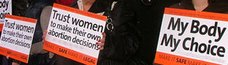
· Move to extend abortion provision to North withdrawn
DAN KEENAN, Northern News Editor, The Irish Times.
AN AMENDMENT to controversial legislation aimed at extending abortion provision to Northern Ireland has been withdrawn at Westminster.
Liberal Democrat MP Evan Harris had tabled an amendment to the Human Fertilisation and Embryology Bill currently being debated in the Commons.
The measure would have extended the 1967 Abortion Act to Northern Ireland where there is no legislative provision for abortion.
The withdrawal of the amendment was welcomed yesterday by the Association of Catholic Lawyers of Ireland. Barrister Johanna Higgins said: “I am delighted to see that the pro-abortion lobby in Westminster has backed off from its threat to try and get the Abortion Act extended to the North of Ireland, which would have meant, among other things, the legalisation of abortion to full term for disabled babies.”
All four main political parties in Stormont, at the request of the all-party Pro-Life Group, co-signed a letter which was sent to all Westminster politicians opposing plans to extend the Abortion Act.
On Friday, the leaders of the four main churches in Ireland wrote to each Westminster MP calling for the Northern Ireland Assembly to be given primacy on the question of abortion legislation.
There is a strong anti-abortion majority at Stormont.
Leading anti-abortion groups also co-signed a letter which was sent to all politicians in Britain opposing the plans to extend the Act.
The move was criticised by the Alliance For Change, a pressure group seeking abortion legislation for Northern Ireland; by the Family Planning Association and by the editorially independent Church of Ireland Gazette. It argued that church leaders should not press legislators on how to vote on any issue.
Tuesday, May 20, 2008


New Survey of British Women's Attitudes to Abortion Published Today
New survey of British women’s attitudes to abortion published today
Sixty-one per cent of British women of child bearing age say there are circumstances in which they think a woman should have the right to access an abortion between 20 and 24 weeks.
When presented with a list of potential circumstances (see below), six out of 10 (61%) British women aged 18-49 say there are certain situations in which they think a woman should have the right to access an abortion between 20 and 24 weeks, according to findings from an independent survey carried out by Ipsos MORI on behalf of Marie Stopes International.
The potential circumstances listed were:
The foetus is diagnosed with severe abnormalities
She was raped
The pregnancy places her own health at risk
She has an abusive partner
She was delayed by her doctor
She did not realised earlier that she was pregnant
She is young and has been in denial of pregnancy signs
Her partner has left her during the pregnancy
Other
Only four percent of respondents both supported a woman’s right of access to an abortion yet also felt there were no grounds for abortion between 20 and 24 weeks: An outcome unlikely to be welcomed by those – including Nadine Dorries, MP - who seek to remove the right to abortion between 20 and 24 weeks under any circumstances.
19% answered that they disagreed that, in general, all women should have the right of access to an abortion, 57% agreed and 24% were neutral, or answered that they did not know or preferred not to answer.
The survey of 1,032 British women is released to coincide with today’s vote on the Human Fertilisation and Embryology Bill in the House of Commons, which includes a number of amendments seeking to reduce the limit for abortions from 24 weeks to as low as 12 weeks.
Marie Stopes International strongly urges MPs to give their full support to British women and vote to retain the 24 week limit for abortion when they cast their free vote on the amendments later today.
“The danger is that some MPs may abstain, rather than engage in this difficult and emotive issue,” said Anne Quesney, Head of Advocacy at Marie Stopes International, the UK’s largest independent provider of abortion services.
“But an abstention is tantamount to a vote for a reduction, which will deny some of the most vulnerable women access to a desperately needed service.
“Later abortions are extremely rare, less than two per cent of the total. As a society we should be supporting women through this difficult time, rather than forcing them into motherhood against their will, making them seek out illegal or unsafe practices or travel abroad to access later abortion services.
“The entire medical establishment and all recent scientific and medical research have endorsed the call to retain the 24 week limit on abortion. Now we have a similar clear endorsement from those who will be most adversely affected by any reduction in the limit – women themselves.”
Sixty-one per cent of British women of child bearing age say there are circumstances in which they think a woman should have the right to access an abortion between 20 and 24 weeks.
When presented with a list of potential circumstances (see below), six out of 10 (61%) British women aged 18-49 say there are certain situations in which they think a woman should have the right to access an abortion between 20 and 24 weeks, according to findings from an independent survey carried out by Ipsos MORI on behalf of Marie Stopes International.
The potential circumstances listed were:
The foetus is diagnosed with severe abnormalities
She was raped
The pregnancy places her own health at risk
She has an abusive partner
She was delayed by her doctor
She did not realised earlier that she was pregnant
She is young and has been in denial of pregnancy signs
Her partner has left her during the pregnancy
Other
Only four percent of respondents both supported a woman’s right of access to an abortion yet also felt there were no grounds for abortion between 20 and 24 weeks: An outcome unlikely to be welcomed by those – including Nadine Dorries, MP - who seek to remove the right to abortion between 20 and 24 weeks under any circumstances.
19% answered that they disagreed that, in general, all women should have the right of access to an abortion, 57% agreed and 24% were neutral, or answered that they did not know or preferred not to answer.
The survey of 1,032 British women is released to coincide with today’s vote on the Human Fertilisation and Embryology Bill in the House of Commons, which includes a number of amendments seeking to reduce the limit for abortions from 24 weeks to as low as 12 weeks.
Marie Stopes International strongly urges MPs to give their full support to British women and vote to retain the 24 week limit for abortion when they cast their free vote on the amendments later today.
“The danger is that some MPs may abstain, rather than engage in this difficult and emotive issue,” said Anne Quesney, Head of Advocacy at Marie Stopes International, the UK’s largest independent provider of abortion services.
“But an abstention is tantamount to a vote for a reduction, which will deny some of the most vulnerable women access to a desperately needed service.
“Later abortions are extremely rare, less than two per cent of the total. As a society we should be supporting women through this difficult time, rather than forcing them into motherhood against their will, making them seek out illegal or unsafe practices or travel abroad to access later abortion services.
“The entire medical establishment and all recent scientific and medical research have endorsed the call to retain the 24 week limit on abortion. Now we have a similar clear endorsement from those who will be most adversely affected by any reduction in the limit – women themselves.”
Catholics Call on MPs to Retain Current Time Limit on Abortion
Catholics Call on MPs to Retain Current Time Limit on Abortion
"British Catholics do not agree with the bishops on abortion"
London-In considering how to vote in the debate on the Human Fertilisation and Embryology Bill, Catholics for Choice president Jon O'Brien called on MPs to oppose any attempts to reduce the time limit at which abortions may be performed. Addressing Catholic MPs, who may feel pressured by the Catholic hierarchy to vote to restrict access to abortion, Mr. O'Brien urged them to remember that Catholic teaching about the primacy of conscience holds that an individual must follow his or her conscience-even if it is in conflict with church teaching. In addition, O'Brien noted that Catholic teaching on conscience requires at least tolerance if not respect for other people's decisions.
In a statement, Mr. O'Brien said, "All parliamentarians, Catholic or not, are free to follow their own consciences, and to support policies that allow all people to make informed, conscientious decisions about their lives and their families."
In a letter from Mr. O'Brien to Members of Parliament, he wrote,
"Polls of Catholics around the world show that the bishops represent a minority view among Catholics on reproductive health matters. Last November, a CFC poll by YouGov showed that a plurality of British Catholics do not agree with the bishops on abortion. A third more Catholics agreed than disagreed with the statements: 'It should be legal for a woman to have an abortion when she has an unwanted pregnancy' and 'Catholic bishops concentrate too much of their attention on abortion when there are other issues that also require their attention.' Similarly, recent CFC polls in the United States, Mexico and Bolivia have found that majorities of Catholics support a woman's right to access abortion, as do other polls of Catholics in Canada, France, Germany and Spain."
A weighted, representative poll of UK faith groups taken by YouGov for Catholics for Choice in November 2007 showed definitive support for a woman's right to have an abortion in cases of unwanted pregnancy.
Mr. O'Brien said the results of the poll "demonstrate that British people, of all faiths and none, trust women and families to make their own decisions when it comes to the choice to terminate a pregnancy or bring a child into the world. Despite what the Catholic hierarchy would like the public to believe, a plurality of British Catholics has chosen to ignore their divisive rhetoric, and instead follow their consciences when it comes to supporting access to abortion. They aren't looking for bishops to lecture them, or for politicians to tie people's hands."
He continued, "Catholic theologians have disagreed from the beginning of church history on when in pregnancy the foetus becomes a person. While the church has favoured different opinions on this subject at different times in history, none has ever been declared infallible."
Catholic theologian Sheila Briggs concurred. "The Catholic hierarchy in recent decades has never allowed a free theological debate on abortion and has punished those Catholic theologians who have dissented from the official teaching. The hierarchy's teaching on abortion is theologically unsafe because it rests on coercion and not on a consensus emerging from the use of sound moral reason."
Jon O'Brien cited two reasons to leave the time limit for abortion at 24 weeks:
The potentially deleterious impact on women's health that would result from a reduction in the time limit.
The lack of scientific data to indicate such a reduction is necessary or would be beneficial.
"Neither the Royal College of Obstetricians and Gynaecologists nor the British Medical Association believes that a case can be made for reducing the time limit for abortion. Parliament should respect those views in considering this important matter," he concluded.
[All figures, unless otherwise stated, are from YouGov Plc. Total sample size was 1,983 adults. Fieldwork was undertaken between 14th and 16th November 2007. The survey was carried out online. The figures have been weighted and are representative of all GB adults aged 18+.]
-end-
Catholics for Choice (CFC) shapes and advances sexual and reproductive ethics that are based on justice, reflect a commitment to women's well being, and respect and affirm the moral capacity of women and men to make decisions about their lives. Through discourse, education, and advocacy, CFC works in the US and internationally to infuse these values into public policy, community life, feminist analysis and Catholic social thinking and teaching.
"British Catholics do not agree with the bishops on abortion"
London-In considering how to vote in the debate on the Human Fertilisation and Embryology Bill, Catholics for Choice president Jon O'Brien called on MPs to oppose any attempts to reduce the time limit at which abortions may be performed. Addressing Catholic MPs, who may feel pressured by the Catholic hierarchy to vote to restrict access to abortion, Mr. O'Brien urged them to remember that Catholic teaching about the primacy of conscience holds that an individual must follow his or her conscience-even if it is in conflict with church teaching. In addition, O'Brien noted that Catholic teaching on conscience requires at least tolerance if not respect for other people's decisions.
In a statement, Mr. O'Brien said, "All parliamentarians, Catholic or not, are free to follow their own consciences, and to support policies that allow all people to make informed, conscientious decisions about their lives and their families."
In a letter from Mr. O'Brien to Members of Parliament, he wrote,
"Polls of Catholics around the world show that the bishops represent a minority view among Catholics on reproductive health matters. Last November, a CFC poll by YouGov showed that a plurality of British Catholics do not agree with the bishops on abortion. A third more Catholics agreed than disagreed with the statements: 'It should be legal for a woman to have an abortion when she has an unwanted pregnancy' and 'Catholic bishops concentrate too much of their attention on abortion when there are other issues that also require their attention.' Similarly, recent CFC polls in the United States, Mexico and Bolivia have found that majorities of Catholics support a woman's right to access abortion, as do other polls of Catholics in Canada, France, Germany and Spain."
A weighted, representative poll of UK faith groups taken by YouGov for Catholics for Choice in November 2007 showed definitive support for a woman's right to have an abortion in cases of unwanted pregnancy.
Mr. O'Brien said the results of the poll "demonstrate that British people, of all faiths and none, trust women and families to make their own decisions when it comes to the choice to terminate a pregnancy or bring a child into the world. Despite what the Catholic hierarchy would like the public to believe, a plurality of British Catholics has chosen to ignore their divisive rhetoric, and instead follow their consciences when it comes to supporting access to abortion. They aren't looking for bishops to lecture them, or for politicians to tie people's hands."
He continued, "Catholic theologians have disagreed from the beginning of church history on when in pregnancy the foetus becomes a person. While the church has favoured different opinions on this subject at different times in history, none has ever been declared infallible."
Catholic theologian Sheila Briggs concurred. "The Catholic hierarchy in recent decades has never allowed a free theological debate on abortion and has punished those Catholic theologians who have dissented from the official teaching. The hierarchy's teaching on abortion is theologically unsafe because it rests on coercion and not on a consensus emerging from the use of sound moral reason."
Jon O'Brien cited two reasons to leave the time limit for abortion at 24 weeks:
The potentially deleterious impact on women's health that would result from a reduction in the time limit.
The lack of scientific data to indicate such a reduction is necessary or would be beneficial.
"Neither the Royal College of Obstetricians and Gynaecologists nor the British Medical Association believes that a case can be made for reducing the time limit for abortion. Parliament should respect those views in considering this important matter," he concluded.
[All figures, unless otherwise stated, are from YouGov Plc. Total sample size was 1,983 adults. Fieldwork was undertaken between 14th and 16th November 2007. The survey was carried out online. The figures have been weighted and are representative of all GB adults aged 18+.]
-end-
Catholics for Choice (CFC) shapes and advances sexual and reproductive ethics that are based on justice, reflect a commitment to women's well being, and respect and affirm the moral capacity of women and men to make decisions about their lives. Through discourse, education, and advocacy, CFC works in the US and internationally to infuse these values into public policy, community life, feminist analysis and Catholic social thinking and teaching.
Law Change Would Affect Irish Seeking Abortions
Sunday Business Post
Sunday May 18th 2008
o Law change would affect Irish seeking abortions
by Susan Mitchell
Proposals to reform abortion laws in Britain could have major repercussions for the more than 6,000 Irish women who travel to Britain for terminations each year, according to the Irish Family Planning Association (IFPA).
An alliance of pro-life MPs, traditionalists and Catholic backbenchers want to reduce the time limit at which it is legal to have an abortion from 24 to 22weeks or less. Niall Behan, chief executive of the IFPA, said that any reduction in the time limit would have the greatest impact on women carrying foetuses with severe or fatal abnormalities.
Behan said that most women who decided to terminate their pregnancies did so before 20 weeks gestation, but that severe and fatal foetal abnormalities were often not detected until 18 or 19weeks into a pregnancy.
‘‘In those circumstances, women often have a further scan or a check to look at the options that may be available,’’ Behan said.
‘‘Any reduction in the time limit would only give a woman, or indeed a couple, a one-week window to make a decision. More time is needed under those circumstances and I would have grave fears that decisions would be rushed.”
Behan said that asylum seekers living in Ireland could also be affected, as he had come across a number of cases in which asylum seekers had difficulties securing papers to travel to Britain, meaning that they also presented relatively late for a termination.
Anti-abortion activists argue that Britain has an excessively late cut-off point for abortion. Two-thirds of EU countries have a time limit lower than the British one, with some banning abortion after 12 weeks’ gestation.
Abortion reform forms part of the Human Fertilisation and Embryology Bill, which is due to be discussed in detail by British politicians tomorrow and Tuesday.
Those MPs in favour of restricting abortion are planning to table amendments that would fix the time limit at anything between 13 and 22 weeks. Pro-life MPs will also attempt to introduce ‘‘informed consent’’ legislation, which has been implemented in 26 other countries around the world. This means that women seeking a termination would be advised to reflect on their decision and given information about the potential risks.
Gordon Brown, the British prime minister, has said that he will vote against any proposals to reduce the 24-week limit.
However, Brown has been forced to grant a free vote on many of the measures, after being faced with a rebellion by dozens of MPs and at least three cabinet members. That means they do not have to vote in accordance with party lines.
The bill also includes measures that will allow the creation of hybrid human-animal embryos and the use of embryo screening to produce so-called ‘saviour siblings’.
Sunday May 18th 2008
o Law change would affect Irish seeking abortions
by Susan Mitchell
Proposals to reform abortion laws in Britain could have major repercussions for the more than 6,000 Irish women who travel to Britain for terminations each year, according to the Irish Family Planning Association (IFPA).
An alliance of pro-life MPs, traditionalists and Catholic backbenchers want to reduce the time limit at which it is legal to have an abortion from 24 to 22weeks or less. Niall Behan, chief executive of the IFPA, said that any reduction in the time limit would have the greatest impact on women carrying foetuses with severe or fatal abnormalities.
Behan said that most women who decided to terminate their pregnancies did so before 20 weeks gestation, but that severe and fatal foetal abnormalities were often not detected until 18 or 19weeks into a pregnancy.
‘‘In those circumstances, women often have a further scan or a check to look at the options that may be available,’’ Behan said.
‘‘Any reduction in the time limit would only give a woman, or indeed a couple, a one-week window to make a decision. More time is needed under those circumstances and I would have grave fears that decisions would be rushed.”
Behan said that asylum seekers living in Ireland could also be affected, as he had come across a number of cases in which asylum seekers had difficulties securing papers to travel to Britain, meaning that they also presented relatively late for a termination.
Anti-abortion activists argue that Britain has an excessively late cut-off point for abortion. Two-thirds of EU countries have a time limit lower than the British one, with some banning abortion after 12 weeks’ gestation.
Abortion reform forms part of the Human Fertilisation and Embryology Bill, which is due to be discussed in detail by British politicians tomorrow and Tuesday.
Those MPs in favour of restricting abortion are planning to table amendments that would fix the time limit at anything between 13 and 22 weeks. Pro-life MPs will also attempt to introduce ‘‘informed consent’’ legislation, which has been implemented in 26 other countries around the world. This means that women seeking a termination would be advised to reflect on their decision and given information about the potential risks.
Gordon Brown, the British prime minister, has said that he will vote against any proposals to reduce the 24-week limit.
However, Brown has been forced to grant a free vote on many of the measures, after being faced with a rebellion by dozens of MPs and at least three cabinet members. That means they do not have to vote in accordance with party lines.
The bill also includes measures that will allow the creation of hybrid human-animal embryos and the use of embryo screening to produce so-called ‘saviour siblings’.
Thursday, May 15, 2008
VOICE FOR CHOICE- the coalition to defend and extend women's choice on abortion Letter to Members of British Parliament
13 May 2008
Dear Member of Parliament,
Re: Human Fertilisation and Embryology Bill – abortion amendments
I write on behalf of the members of Voice for Choice and the twenty-four undersigned organisations, with an urgent request for your support on an issue of great importance to women, especially young women. As you may know, some Members of Parliament have announced their intentions to put amendments to the 1967 Abortion Act so as to make abortion harder for women to obtain. These efforts, to be made via the Human Fertilisation and Embryology Bill, are particularly aimed at lowering the existing abortion time limit of up to 24 weeks of pregnancy on most grounds.
Only 1.45% of all abortions in this country take place at 20 to 24 weeks of pregnancy. Why are these abortions late? Some women experience delays in referral. Some learn of serious fetal abnormality. For most, the reasons for late presentation are a combination of not realising they are pregnant, uncertainty about what to do, continuing bleeding which they think is their period, fear of parents’ or partner's reaction, denial that they are pregnant, serious changes in personal circumstances, acute problems such as domestic violence, and not knowing where to seek help. These women are disproportionately likely to be adolescents or other vulnerable women.
Lowering the legal time limit for abortion would punish the women who could no longer access a safe abortion at 20 to 24 weeks of pregnancy, but it would not reduce the need for late abortions. In countries where the upper time limit for abortion is lower than in Britain, women are forced to travel abroad for abortion care or seek illegal services at great emotional and financial cost. We call on you to prevent this hardship being imposed on women here.
The proposed anti-abortion amendment is largely based on claims of changes to fetal viability. However, even for those who believe that women’s rights to abortion should be linked to the gestational age at which extremely premature babies can survive, the medical and scientific evidence from the recently highlighted Epicure 2 study and peer reviewed work by researchers at the University of Leicester (the ‘Trent study’ published in the British Medical Journal last week) is unequivocal. The findings show that survival rates for premature babies born below 24 weeks of pregnancy have not improved since the Abortion Act was last amended in 1990.
The UK Government, House of Commons Science and Technology Committee and the UK’s medical, nursing and scientific professional bodies have examined the evidence, and all agree that there is no compelling evidence to support lowering the abortion time limit.
Please do not compromise – support women in the UK by voting in support of the current 24-week legal time limit on abortion.
Yours sincerely,
Marge Berer
Chair, Voice for Choice / Editor, Reproductive Health Matters
on behalf of Voice for Choice members:
Louise Hutchins, Campaign Coordinator, Abortion Rights
Jane Fisher, Director, Antenatal Results and Choices
Ann Furedi, Chief Executive, BPAS (British Pregnancy Advisory Service)
Simon Blake, Chief Executive, Brook
Wendy Savage, Coordinator, Doctors for a Woman’s Choice on Abortion
Lisa Hallgarten, Acting Director, Education for Choice
Julie Bentley, Chief Executive, fpa
Dana Hovig, Chief Executive, Marie Stopes International
Ellie Lee, Co-ordinator, Pro-Choice Forum
and also on behalf of:
Niall Behan, Chief Executive Officer, Irish Family Planning Association
Irene Donadio, Spokesperson, International Planned Parenthood Federation, Europe
Christian Fiala, President, FIAPAC (International Federation of European Abortion and Contraception Providers)
Jon O’Brien, President, Catholics for Choice
Rabbi Danny Rich, Chief Executive, Liberal Judaism
Hanne Stinson, Chief Executive, British Humanist Association
Susan Crane, Director of Operations, Women’s Health Concern
Davina James-Hanman, Director, Greater London Domestic Violence Project
Katherine Rake, Director, Fawcett Society
Lee Eggleston, Trustee, Rape Crisis (England and Wales)
Catherine Forde, Spokesperson, Safe and Legal in Ireland
Mary Muldowney, Spokesperson, Alliance for Choice
Sinead Ahern, Spokesperson, Choice Ireland
Sandra McAvoy, Spokesperson, Cork Women’s Right to Choose Group
Dear Member of Parliament,
Re: Human Fertilisation and Embryology Bill – abortion amendments
I write on behalf of the members of Voice for Choice and the twenty-four undersigned organisations, with an urgent request for your support on an issue of great importance to women, especially young women. As you may know, some Members of Parliament have announced their intentions to put amendments to the 1967 Abortion Act so as to make abortion harder for women to obtain. These efforts, to be made via the Human Fertilisation and Embryology Bill, are particularly aimed at lowering the existing abortion time limit of up to 24 weeks of pregnancy on most grounds.
Only 1.45% of all abortions in this country take place at 20 to 24 weeks of pregnancy. Why are these abortions late? Some women experience delays in referral. Some learn of serious fetal abnormality. For most, the reasons for late presentation are a combination of not realising they are pregnant, uncertainty about what to do, continuing bleeding which they think is their period, fear of parents’ or partner's reaction, denial that they are pregnant, serious changes in personal circumstances, acute problems such as domestic violence, and not knowing where to seek help. These women are disproportionately likely to be adolescents or other vulnerable women.
Lowering the legal time limit for abortion would punish the women who could no longer access a safe abortion at 20 to 24 weeks of pregnancy, but it would not reduce the need for late abortions. In countries where the upper time limit for abortion is lower than in Britain, women are forced to travel abroad for abortion care or seek illegal services at great emotional and financial cost. We call on you to prevent this hardship being imposed on women here.
The proposed anti-abortion amendment is largely based on claims of changes to fetal viability. However, even for those who believe that women’s rights to abortion should be linked to the gestational age at which extremely premature babies can survive, the medical and scientific evidence from the recently highlighted Epicure 2 study and peer reviewed work by researchers at the University of Leicester (the ‘Trent study’ published in the British Medical Journal last week) is unequivocal. The findings show that survival rates for premature babies born below 24 weeks of pregnancy have not improved since the Abortion Act was last amended in 1990.
The UK Government, House of Commons Science and Technology Committee and the UK’s medical, nursing and scientific professional bodies have examined the evidence, and all agree that there is no compelling evidence to support lowering the abortion time limit.
Please do not compromise – support women in the UK by voting in support of the current 24-week legal time limit on abortion.
Yours sincerely,
Marge Berer
Chair, Voice for Choice / Editor, Reproductive Health Matters
on behalf of Voice for Choice members:
Louise Hutchins, Campaign Coordinator, Abortion Rights
Jane Fisher, Director, Antenatal Results and Choices
Ann Furedi, Chief Executive, BPAS (British Pregnancy Advisory Service)
Simon Blake, Chief Executive, Brook
Wendy Savage, Coordinator, Doctors for a Woman’s Choice on Abortion
Lisa Hallgarten, Acting Director, Education for Choice
Julie Bentley, Chief Executive, fpa
Dana Hovig, Chief Executive, Marie Stopes International
Ellie Lee, Co-ordinator, Pro-Choice Forum
and also on behalf of:
Niall Behan, Chief Executive Officer, Irish Family Planning Association
Irene Donadio, Spokesperson, International Planned Parenthood Federation, Europe
Christian Fiala, President, FIAPAC (International Federation of European Abortion and Contraception Providers)
Jon O’Brien, President, Catholics for Choice
Rabbi Danny Rich, Chief Executive, Liberal Judaism
Hanne Stinson, Chief Executive, British Humanist Association
Susan Crane, Director of Operations, Women’s Health Concern
Davina James-Hanman, Director, Greater London Domestic Violence Project
Katherine Rake, Director, Fawcett Society
Lee Eggleston, Trustee, Rape Crisis (England and Wales)
Catherine Forde, Spokesperson, Safe and Legal in Ireland
Mary Muldowney, Spokesperson, Alliance for Choice
Sinead Ahern, Spokesperson, Choice Ireland
Sandra McAvoy, Spokesperson, Cork Women’s Right to Choose Group
Abortion Review Update
Thursday 15 May 2008
- - - - - - - - - - - - - - - - - - - - - - - - - - - - - - http://www.abortionreview.org
NEW ON ABORTION REVIEW
- 1. CASE STUDIES SHOW WOMEN'S NEED FOR 24-WEEK LIMIT
MPs will vote on amendments to the legal gestational limit for abortion on Tuesday 20 May, as part of the discussion on the Human Fertilisation and Embryology Bill. A case-note analysis of all women requesting abortion at BPAS clinics between 22 and 24 weeks' gestation provides compelling evidence for retaining the 24-week time limit.
http://www.abortionreview.org/index.php/site/article/341/
- - - - - - - - - - - - - - - - - - -
- 2. TWENTY-FOUR REASONS FOR 24 WEEKS
Tory MP Nadine Dorries has unveiled 20 reasons why the upper time limit for abortion should be lowered to 20 weeks' gestation. Jennie Bristow, editor of Abortion Review, gives 24 reasons why it should stay as it is.
http://www.abortionreview.org/index.php/site/article/340/
- - - - - - - - - - - - - - - - - - -
- 3. CLAIMS ABOUT FETAL VIABILITY COULD 'MISLEAD' PARENTS, SAYS PRIMAROLO
A reduction in the legal limit for abortion from 24 weeks would give false hope to the parents of severely premature infants, the Health Minister has
told The Times (London).
http://www.abortionreview.org/index.php/site/article/339/
- - - - - - - - - - - - - - - - - - -
- 3. NEW RESEARCH ON BABY SURVIVAL RATES STOKES ABORTION LIMIT ROW
Survival rates for babies born before 24 weeks are extremely low and getting no better in spite of medical advances, according to an authoritative study in the British Medical Journal.
http://www.abortionreview.org/index.php/site/article/338/
- - - - - - - - - - - - - - - - - - -
- 4. DOCTORS CALL TO RETAIN LEGAL TIME LIMIT FOR ABORTION
Responding to research showing no improvement in fetal viability, the British Medical Association argues that there is 'no scientific justification' for lowering the 24-week limit.
http://www.abortionreview.org/index.php/site/article/335/
- - - - - - - - - - - - - - - - - - -
- 5. NEW STUDY FINDS WIDENING EMA PROVISION IS SAFE AND EFFECTIVE
A consultation is to be launched over whether to relax rules on the settings where Early Medical Abortion can be carried out, ministers say.
http://www.abortionreview.org/index.php/site/article/328/
- - - - - - - - - - - - - - - - - - -
- 6. BPAS CONFERENCE: THE FUTURE OF ABORTION
'The Future of Abortion: Controversies and Care' is a major international conference on the latest abortion and contraception policy and best practice issues, held at the QEII Conference Centre in Westminster, Central London,
25-26 June 2008.
For more information, and to book your place, please visit the conference
website:
http://www.futureofabortion.org/
- - - - - - - - - - - - - - - - - - -
- 7. 1967 ABORTION ACT
For news relating to the British abortion law, and the progress of the Human Fertilisation and Embryology Bill, see Abortion Review's dedicated section on the 1967 Abortion Act:
http://www.abortionreview.org/index.php/site/C15/
- - - - - - - - - - - - - - - - - - -
- 8. MEDICAL UPDATE
To see what's new in the medical press, visit Abortion Review's 'Medical Update' section:
http://www.abortionreview.org/index.php/site/C7/
- - - - - - - - - - - - - - - - - - -
Abortion Review is a journal produced for BPAS, the leading provider of abortion services in the UK. http://www.bpas.org
- - - - - - - - - - - - - - - - - - - - - - - - - - - - - - http://www.abortionreview.org
NEW ON ABORTION REVIEW
- 1. CASE STUDIES SHOW WOMEN'S NEED FOR 24-WEEK LIMIT
MPs will vote on amendments to the legal gestational limit for abortion on Tuesday 20 May, as part of the discussion on the Human Fertilisation and Embryology Bill. A case-note analysis of all women requesting abortion at BPAS clinics between 22 and 24 weeks' gestation provides compelling evidence for retaining the 24-week time limit.
http://www.abortionreview.org/index.php/site/article/341/
- - - - - - - - - - - - - - - - - - -
- 2. TWENTY-FOUR REASONS FOR 24 WEEKS
Tory MP Nadine Dorries has unveiled 20 reasons why the upper time limit for abortion should be lowered to 20 weeks' gestation. Jennie Bristow, editor of Abortion Review, gives 24 reasons why it should stay as it is.
http://www.abortionreview.org/index.php/site/article/340/
- - - - - - - - - - - - - - - - - - -
- 3. CLAIMS ABOUT FETAL VIABILITY COULD 'MISLEAD' PARENTS, SAYS PRIMAROLO
A reduction in the legal limit for abortion from 24 weeks would give false hope to the parents of severely premature infants, the Health Minister has
told The Times (London).
http://www.abortionreview.org/index.php/site/article/339/
- - - - - - - - - - - - - - - - - - -
- 3. NEW RESEARCH ON BABY SURVIVAL RATES STOKES ABORTION LIMIT ROW
Survival rates for babies born before 24 weeks are extremely low and getting no better in spite of medical advances, according to an authoritative study in the British Medical Journal.
http://www.abortionreview.org/index.php/site/article/338/
- - - - - - - - - - - - - - - - - - -
- 4. DOCTORS CALL TO RETAIN LEGAL TIME LIMIT FOR ABORTION
Responding to research showing no improvement in fetal viability, the British Medical Association argues that there is 'no scientific justification' for lowering the 24-week limit.
http://www.abortionreview.org/index.php/site/article/335/
- - - - - - - - - - - - - - - - - - -
- 5. NEW STUDY FINDS WIDENING EMA PROVISION IS SAFE AND EFFECTIVE
A consultation is to be launched over whether to relax rules on the settings where Early Medical Abortion can be carried out, ministers say.
http://www.abortionreview.org/index.php/site/article/328/
- - - - - - - - - - - - - - - - - - -
- 6. BPAS CONFERENCE: THE FUTURE OF ABORTION
'The Future of Abortion: Controversies and Care' is a major international conference on the latest abortion and contraception policy and best practice issues, held at the QEII Conference Centre in Westminster, Central London,
25-26 June 2008.
For more information, and to book your place, please visit the conference
website:
http://www.futureofabortion.org/
- - - - - - - - - - - - - - - - - - -
- 7. 1967 ABORTION ACT
For news relating to the British abortion law, and the progress of the Human Fertilisation and Embryology Bill, see Abortion Review's dedicated section on the 1967 Abortion Act:
http://www.abortionreview.org/index.php/site/C15/
- - - - - - - - - - - - - - - - - - -
- 8. MEDICAL UPDATE
To see what's new in the medical press, visit Abortion Review's 'Medical Update' section:
http://www.abortionreview.org/index.php/site/C7/
- - - - - - - - - - - - - - - - - - -
Abortion Review is a journal produced for BPAS, the leading provider of abortion services in the UK. http://www.bpas.org
Wednesday, May 14, 2008
IFPA welcome Council of Europe Commissioner for Human Rights Report on Europe
Statement by the Irish Family Planning Association
The IFPA welcomes Commissioner for Human Rights comments on abortion
- Release date : 30th April 2008
In his report published today the Council of Europe Commissioner for Human Rights has recommended that the Irish Government clarify the circumstances in which abortions can legally be carried out in Ireland. He recommends that this done through statutory law in line with domestic jurisprudence.
Reacting to this an IFPA Spokesperson said, “The Commissioner is the latest in a long line of human rights experts to call for a clarification of the legal status of abortion in Ireland. Irish abortion laws needlessly puts the health and well being of thousands of Irish women at risk. A change in our abortion laws are well over due”.
The IFPA believes that safe and legal abortion services should be available in Ireland.
Ends.
Notes
Invited by the Irish Government, Mr Thomas Hammarberg the EC Commissioner for Human Rights conducted an official visit to Ireland from 26th to 30th November 2007. His report identifies opportunities for improving the protection and promotion of human rights in Ireland.
The text of his report is available at http://www.coe.int/t/commissioner/WCD/visitreportsbycountry_en.asp#
Excerpts relating to abortion:
78. In relation to sexual and reproductive rights, it should be noted that since 1983 under the Irish Constitution the “right of the unborn” is guaranteed “with due regard to the equal right to life of the mother”. No legal definition or case law exists as to whether the "unborn" refers to the foetus at the point of viability, from the moment of conception or at some other point during pregnancy. Since the 1992 Supreme Court judgment in the X case, abortion is legal if the life of the woman is in danger. However, despite criticism of the constitutional provision in the judgement, there is still no legislation in place implementing the judgment and, consequently, no legal certainty when a physician may legally perform a life-saving abortion. In practice, abortion is largely unavailable in Ireland in almost all circumstances. Some NGOs argue that the legal limbo leads to a situation which disproportionately favours the interest of the foetus over the rights of pregnant women, thereby jeopardising women’s health and well-being and resulting in abortions performed illegally or abroad.During the visit, the Irish authorities informed the Commissioner that there were currently no plans to legislate for abortion on the grounds of the ‘X’ case.
79. Some civil society representatives advocate that access to abortion services should be granted to all women in the country, particularly when a woman's health is at risk, she is pregnant as a result of rape or incest or there is evidence of severe foetal anomaly. There have also been calls to hold a referendum to offer the voters an opportunity to remove from the Constitution the 1983 Amendment and to clarify the language with regard to the ‘unborn’. Moreover, NGOs have underlined that certain vulnerable women, especially young and migrant women, have particular difficulties in accessing abortion services abroad. These concerns are illustrated by the case of 17 year-old Miss D from April 2007. When Miss D, who was placed in the care of the state by virtue of an interim care order, learned that she was carrying an anencephalic foetus, a fatal condition whereby a large part of the skull and the brain is missing, she wished to terminate her pregnancy but was prevented from travelling until a High Court decision allowed her to leave the country.
80. The Commissioner is concerned that despite the already existing case law allowing for abortion under limited circumstances, no legislation is in place to ensure this happening in practice. This leads to serious consequences in each individual case but especially in such cases in which vulnerable women such as minors and migrants are concerned. In this context, he recalls the European Court’s judgment against Poland in which a violation of Article 8, the effective respect for private life, was found due to defective domestic abortion legislation. He urges the Irish authorities and the legislator to ensure that legislation is enacted to resolve this problem and that adequate medical services are provided in Ireland to carry out legal abortions in line with the jurisprudence of the Supreme Court.
Recommendation
19. Clarify the scope of legal abortions through statutory law in line with domestic jurisprudence and provide for adequate services for carrying out such abortions in Ireland.
Response of the Irish Government
The Government is satisfied that any medical treatment necessary to safeguard a woman’s life during pregnancy is available in Ireland. It has no plans to bring forward further constitutional or legislative proposals in relation to abortion.
The IFPA welcomes Commissioner for Human Rights comments on abortion
- Release date : 30th April 2008
In his report published today the Council of Europe Commissioner for Human Rights has recommended that the Irish Government clarify the circumstances in which abortions can legally be carried out in Ireland. He recommends that this done through statutory law in line with domestic jurisprudence.
Reacting to this an IFPA Spokesperson said, “The Commissioner is the latest in a long line of human rights experts to call for a clarification of the legal status of abortion in Ireland. Irish abortion laws needlessly puts the health and well being of thousands of Irish women at risk. A change in our abortion laws are well over due”.
The IFPA believes that safe and legal abortion services should be available in Ireland.
Ends.
Notes
Invited by the Irish Government, Mr Thomas Hammarberg the EC Commissioner for Human Rights conducted an official visit to Ireland from 26th to 30th November 2007. His report identifies opportunities for improving the protection and promotion of human rights in Ireland.
The text of his report is available at http://www.coe.int/t/commissioner/WCD/visitreportsbycountry_en.asp#
Excerpts relating to abortion:
78. In relation to sexual and reproductive rights, it should be noted that since 1983 under the Irish Constitution the “right of the unborn” is guaranteed “with due regard to the equal right to life of the mother”. No legal definition or case law exists as to whether the "unborn" refers to the foetus at the point of viability, from the moment of conception or at some other point during pregnancy. Since the 1992 Supreme Court judgment in the X case, abortion is legal if the life of the woman is in danger. However, despite criticism of the constitutional provision in the judgement, there is still no legislation in place implementing the judgment and, consequently, no legal certainty when a physician may legally perform a life-saving abortion. In practice, abortion is largely unavailable in Ireland in almost all circumstances. Some NGOs argue that the legal limbo leads to a situation which disproportionately favours the interest of the foetus over the rights of pregnant women, thereby jeopardising women’s health and well-being and resulting in abortions performed illegally or abroad.During the visit, the Irish authorities informed the Commissioner that there were currently no plans to legislate for abortion on the grounds of the ‘X’ case.
79. Some civil society representatives advocate that access to abortion services should be granted to all women in the country, particularly when a woman's health is at risk, she is pregnant as a result of rape or incest or there is evidence of severe foetal anomaly. There have also been calls to hold a referendum to offer the voters an opportunity to remove from the Constitution the 1983 Amendment and to clarify the language with regard to the ‘unborn’. Moreover, NGOs have underlined that certain vulnerable women, especially young and migrant women, have particular difficulties in accessing abortion services abroad. These concerns are illustrated by the case of 17 year-old Miss D from April 2007. When Miss D, who was placed in the care of the state by virtue of an interim care order, learned that she was carrying an anencephalic foetus, a fatal condition whereby a large part of the skull and the brain is missing, she wished to terminate her pregnancy but was prevented from travelling until a High Court decision allowed her to leave the country.
80. The Commissioner is concerned that despite the already existing case law allowing for abortion under limited circumstances, no legislation is in place to ensure this happening in practice. This leads to serious consequences in each individual case but especially in such cases in which vulnerable women such as minors and migrants are concerned. In this context, he recalls the European Court’s judgment against Poland in which a violation of Article 8, the effective respect for private life, was found due to defective domestic abortion legislation. He urges the Irish authorities and the legislator to ensure that legislation is enacted to resolve this problem and that adequate medical services are provided in Ireland to carry out legal abortions in line with the jurisprudence of the Supreme Court.
Recommendation
19. Clarify the scope of legal abortions through statutory law in line with domestic jurisprudence and provide for adequate services for carrying out such abortions in Ireland.
Response of the Irish Government
The Government is satisfied that any medical treatment necessary to safeguard a woman’s life during pregnancy is available in Ireland. It has no plans to bring forward further constitutional or legislative proposals in relation to abortion.
Thursday, April 17, 2008
Council of Europe Adopts resolution on Abortion- Irish Media Reaction
Council of Europe calls on Ireland to legislate for abortion
CARL O'BRIEN, Social Affairs Correspondent THE IRISH TIMES April 17th 2008
THE COUNCIL of Europe's parliamentary assembly has called on member states including Ireland to legalise abortion, despite opposition from a number of members including Fianna Fáil Senator Terry Leyden.
However, the vote has no binding effect as the council - which is an advisory body to 47 European member states - is not part of the European Union.
The assembly adopted a resolution calling on member states to decriminalise abortion and to guarantee women's rights to access to safe and legal abortion by 102 votes to 69 after a four-hour debate.
The parliamentarians said abortion should be avoided as far as possible and "in no circumstances be regarded as a family planning method". They said a total ban would not result in fewer abortions, leading instead to traumatic clandestine abortions and abortion "tourism".
At present the law permits abortion to save the life of the mother in almost all Council of Europe member states. It is also permitted subject to certain other reasons or within a specified time-frame in most countries, with the exception of Ireland, Andorra, Malta, Monaco and Poland, according to Council of Europe officials.
In the resolution, the parliamentarians said medical and psychological care, as well as suitable financial cover, should be offered to women seeking abortions, and conditions which restricted access to safe abortion should be lifted.
They also called for school pupils to receive "compulsory age-appropriate, gender-sensitive education on sex and relationships" in order to avoid unwanted pregnancies or abortions.
Mr Leyden said he was disappointed at the outcome. "I campaigned vigorously against the report and gathered a certain amount of support in the last few days. It is inappropriate for the Council of Europe to explicitly call on member states to decriminalise abortion as it takes no account of the differing historical, constitutional and policy positions of countries such as Ireland, where we have very strong protection for the unborn child."
Mr Leyden said other members of the Irish delegation, including Senator Cecilia Keaveney (Fianna Fáil) and Pat Breen TD (Fine Gael) voted against the resolution, as did delegates from Malta, Poland and Andorra. Joe Costello TD (Labour) abstained and said any decision on abortion should be left to member states themselves.
Mr Leyden, meanwhile, said it was important to emphasise that the vote had no legal jurisdiction in the Republic.
Pressure growing to make abortion legal here after Europe resolution
By Dearbhail McDonald and Allison Bray THE IRISH INDEPENDENT
Thursday April 17 2008
Political pressure on Ireland to decriminalise abortion is likely to increase after Europe's human rights watchdog passed a resolution yesterday calling for it to be legalised.
Ireland, Malta and Poland were singled out by the Parliamentary Assembly of the Council of Europe for their failure to decriminalise abortion and allow termination of unwanted pregnancies subject to "reasonable" time limits.
The Labour Party's Joe Costello abstained but other Irish delegates voted against the resolution based on a report which they said failed to respect national laws on abortion, and is not binding on Ireland.
However, observers said resolutions passed at the Strasbourg Assembly can lead to international political pressure being applied to the Irish Government on the issue.
Despite Ireland's objections to the decriminalisation of abortion, the controversial resolution was passed by the Parliamentary Assembly of the Council of Europe (PACE).
The resolution was based on a report which Irish Senator Terry Leyden claimed was "partisan and one-sided".
"We are disappointed with the result, but in an Irish context it is meaningless," said Pat Breen, the Fine Gael TD who led the Irish delegation.
The parliamentary assembly resolutions can be considered by the European Court of Human Rights whose decisions are binding on member states that have ratified the European Convention of Human Rights.
Pro-choice activist Senator Ivana Bacik said that while the vote is not legally binding, it could have both political and social repercussions.
"It adds to international political pressure but, more importantly, public opinion is changing in favour of decriminalisation," she said.
Anti-abortion campaigners said the resolution is flawed.
Dr Ruth Cullen of the Pro-Life Campaign said: "Many of the arguments put forward by council members promoting abortion are jaded and grossly out of touch with the most recent research," she said.
Before last night's vote, senior officials from PACE criticised the Irish Government's refusal to decriminalise abortion, thus "encouraging abortion tourism". It also criticised having a provision in our criminal code which states that women who abort their unborn foetuses can be jailed for life.
· Abortion laws under pressure from Council of Europe - Ann Cahill, Europe Correspondent THE IRISH EXAMINER Thursday April 17th 2008
IRELAND has come under pressure from the Council of Europe to stop criminalising women who have abortions and allow them access to the procedure.
An Irish woman can be jailed for life if she has an abortion in Ireland, but, if she can afford to travel, she can legally get one abroad, the council was told.
A report before the human rights body, of which the Government is a member, was supported by a range of Irish groups that hope it will help change the current law that forbids abortion unless the woman’s life is in danger.
Catherine Forde, a lawyer with the Irish Family Planning Association, told the council: “Women pregnant as a result of rape and incest and women carrying a foetus that cannot live must scurry like criminals to foreign jurisdictions to have an abortion.”
Christine McCafferty, a council member from Britain and one of the report’s authors, said Ireland’s laws meant women had to resort to what she called abortion tourism.
“Irish women have good reproductive health and low maternal mortality rates but this is because their women are dependent on safe abortions they get abroad, including in the UK,” she said.
The parliamentarians from 47 European countries said abortion should be avoided as far as possible and in no circumstances be regarded as a family-planning method.
“But a total ban does not result in fewer abortions, leading instead to traumatic clandestine abortions and abortion tourism.”
They said medical and psychological care, as well as suitable financial cover, should be offered to women seeking abortions, and conditions that restrict access to safe abortion within reasonable time limits should be lifted.
Senator Terry Leydon, Fianna Fáil, a member of the Council of Europe, said the report was flawed in that it assumed not allowing abortion resulted in high levels of maternal deaths and back-street abortion. Its proposals would be against the will of the majority of people in a number of member states, he added.
A letter from the Irish Family Planning Association and other groups to the council said the figure of 7,000 from Ireland having abortions in Britain underestimated the numbers as some may give false addresses in Britain or travel to other countries like Belgium and the Netherlands.
CARL O'BRIEN, Social Affairs Correspondent THE IRISH TIMES April 17th 2008
THE COUNCIL of Europe's parliamentary assembly has called on member states including Ireland to legalise abortion, despite opposition from a number of members including Fianna Fáil Senator Terry Leyden.
However, the vote has no binding effect as the council - which is an advisory body to 47 European member states - is not part of the European Union.
The assembly adopted a resolution calling on member states to decriminalise abortion and to guarantee women's rights to access to safe and legal abortion by 102 votes to 69 after a four-hour debate.
The parliamentarians said abortion should be avoided as far as possible and "in no circumstances be regarded as a family planning method". They said a total ban would not result in fewer abortions, leading instead to traumatic clandestine abortions and abortion "tourism".
At present the law permits abortion to save the life of the mother in almost all Council of Europe member states. It is also permitted subject to certain other reasons or within a specified time-frame in most countries, with the exception of Ireland, Andorra, Malta, Monaco and Poland, according to Council of Europe officials.
In the resolution, the parliamentarians said medical and psychological care, as well as suitable financial cover, should be offered to women seeking abortions, and conditions which restricted access to safe abortion should be lifted.
They also called for school pupils to receive "compulsory age-appropriate, gender-sensitive education on sex and relationships" in order to avoid unwanted pregnancies or abortions.
Mr Leyden said he was disappointed at the outcome. "I campaigned vigorously against the report and gathered a certain amount of support in the last few days. It is inappropriate for the Council of Europe to explicitly call on member states to decriminalise abortion as it takes no account of the differing historical, constitutional and policy positions of countries such as Ireland, where we have very strong protection for the unborn child."
Mr Leyden said other members of the Irish delegation, including Senator Cecilia Keaveney (Fianna Fáil) and Pat Breen TD (Fine Gael) voted against the resolution, as did delegates from Malta, Poland and Andorra. Joe Costello TD (Labour) abstained and said any decision on abortion should be left to member states themselves.
Mr Leyden, meanwhile, said it was important to emphasise that the vote had no legal jurisdiction in the Republic.
Pressure growing to make abortion legal here after Europe resolution
By Dearbhail McDonald and Allison Bray THE IRISH INDEPENDENT
Thursday April 17 2008
Political pressure on Ireland to decriminalise abortion is likely to increase after Europe's human rights watchdog passed a resolution yesterday calling for it to be legalised.
Ireland, Malta and Poland were singled out by the Parliamentary Assembly of the Council of Europe for their failure to decriminalise abortion and allow termination of unwanted pregnancies subject to "reasonable" time limits.
The Labour Party's Joe Costello abstained but other Irish delegates voted against the resolution based on a report which they said failed to respect national laws on abortion, and is not binding on Ireland.
However, observers said resolutions passed at the Strasbourg Assembly can lead to international political pressure being applied to the Irish Government on the issue.
Despite Ireland's objections to the decriminalisation of abortion, the controversial resolution was passed by the Parliamentary Assembly of the Council of Europe (PACE).
The resolution was based on a report which Irish Senator Terry Leyden claimed was "partisan and one-sided".
"We are disappointed with the result, but in an Irish context it is meaningless," said Pat Breen, the Fine Gael TD who led the Irish delegation.
The parliamentary assembly resolutions can be considered by the European Court of Human Rights whose decisions are binding on member states that have ratified the European Convention of Human Rights.
Pro-choice activist Senator Ivana Bacik said that while the vote is not legally binding, it could have both political and social repercussions.
"It adds to international political pressure but, more importantly, public opinion is changing in favour of decriminalisation," she said.
Anti-abortion campaigners said the resolution is flawed.
Dr Ruth Cullen of the Pro-Life Campaign said: "Many of the arguments put forward by council members promoting abortion are jaded and grossly out of touch with the most recent research," she said.
Before last night's vote, senior officials from PACE criticised the Irish Government's refusal to decriminalise abortion, thus "encouraging abortion tourism". It also criticised having a provision in our criminal code which states that women who abort their unborn foetuses can be jailed for life.
· Abortion laws under pressure from Council of Europe - Ann Cahill, Europe Correspondent THE IRISH EXAMINER Thursday April 17th 2008
IRELAND has come under pressure from the Council of Europe to stop criminalising women who have abortions and allow them access to the procedure.
An Irish woman can be jailed for life if she has an abortion in Ireland, but, if she can afford to travel, she can legally get one abroad, the council was told.
A report before the human rights body, of which the Government is a member, was supported by a range of Irish groups that hope it will help change the current law that forbids abortion unless the woman’s life is in danger.
Catherine Forde, a lawyer with the Irish Family Planning Association, told the council: “Women pregnant as a result of rape and incest and women carrying a foetus that cannot live must scurry like criminals to foreign jurisdictions to have an abortion.”
Christine McCafferty, a council member from Britain and one of the report’s authors, said Ireland’s laws meant women had to resort to what she called abortion tourism.
“Irish women have good reproductive health and low maternal mortality rates but this is because their women are dependent on safe abortions they get abroad, including in the UK,” she said.
The parliamentarians from 47 European countries said abortion should be avoided as far as possible and in no circumstances be regarded as a family-planning method.
“But a total ban does not result in fewer abortions, leading instead to traumatic clandestine abortions and abortion tourism.”
They said medical and psychological care, as well as suitable financial cover, should be offered to women seeking abortions, and conditions that restrict access to safe abortion within reasonable time limits should be lifted.
Senator Terry Leydon, Fianna Fáil, a member of the Council of Europe, said the report was flawed in that it assumed not allowing abortion resulted in high levels of maternal deaths and back-street abortion. Its proposals would be against the will of the majority of people in a number of member states, he added.
A letter from the Irish Family Planning Association and other groups to the council said the figure of 7,000 from Ireland having abortions in Britain underestimated the numbers as some may give false addresses in Britain or travel to other countries like Belgium and the Netherlands.
Council of Europe Adopts resolution on Abortion
http://assembly.coe.int/ASP/Press/StopPressView.asp?ID=2033
Council of Europe member states should guarantee ‘right to access to a safe and legal abortion’, says PACE
16.04.2008 – The Parliamentary Assembly of the Council of Europe (PACE) today called on the organisation’s member states to decriminalise abortion, within reasonable gestational limits, if they have not already done so, and to guarantee womens’ “right to access to a safe and legal abortion”.
The Assembly – which brings together national parliamentarians from 47 European countries, representing 800 million Europeans – adopted the resolution by 102 votes to 69 after a four-hour debate and deciding on 72 amendments.
The parliamentarians said that abortion should be avoided as far as possible and “in no circumstances be regarded as a family planning method” but that a total ban did not result in fewer abortions, leading instead to traumatic clandestine abortions and abortion “tourism”.
The law permits abortion to save the life of the mother in practically all Council of Europe member states, the Assembly pointed out. In the majority of European countries it is also permitted for other reasons or within a certain timeframe, with the exception of Andorra, Ireland, Malta, Monaco and Poland, according to report author Gisela Wurm (Austria, SOC).
In the resolution the parliamentarians said medical and psychological care, as well as suitable financial cover, should be offered to women seeking abortions, and conditions which restricted access to safe abortion should be lifted.
They also called for school pupils to receive “compulsory age-appropriate, gender-sensitive education on sex and relationships” in order to avoid unwanted pregnancies, and therefore abortions.
Council of Europe member states should guarantee ‘right to access to a safe and legal abortion’, says PACE
16.04.2008 – The Parliamentary Assembly of the Council of Europe (PACE) today called on the organisation’s member states to decriminalise abortion, within reasonable gestational limits, if they have not already done so, and to guarantee womens’ “right to access to a safe and legal abortion”.
The Assembly – which brings together national parliamentarians from 47 European countries, representing 800 million Europeans – adopted the resolution by 102 votes to 69 after a four-hour debate and deciding on 72 amendments.
The parliamentarians said that abortion should be avoided as far as possible and “in no circumstances be regarded as a family planning method” but that a total ban did not result in fewer abortions, leading instead to traumatic clandestine abortions and abortion “tourism”.
The law permits abortion to save the life of the mother in practically all Council of Europe member states, the Assembly pointed out. In the majority of European countries it is also permitted for other reasons or within a certain timeframe, with the exception of Andorra, Ireland, Malta, Monaco and Poland, according to report author Gisela Wurm (Austria, SOC).
In the resolution the parliamentarians said medical and psychological care, as well as suitable financial cover, should be offered to women seeking abortions, and conditions which restricted access to safe abortion should be lifted.
They also called for school pupils to receive “compulsory age-appropriate, gender-sensitive education on sex and relationships” in order to avoid unwanted pregnancies, and therefore abortions.
Letter from Irish Civil Society NGO Coalition to Council of Europe
Members of the Parliamentary Assembly
Parliamentary Assembly
Council of Europe
Avenue de l'Europe
F-67075 Strasbourg Cedex
This letter is in English, French and Spanish.
April 14th, 2008
We, the undersigned, are writing to urge you to support the resolution on access to safe and legal abortion in Europe drafted by the Committee on Equal Opportunities for Women and Men. As drafted, the resolution clearly addresses three key concerns with regard to the full enjoyment of the human rights of women in Ireland:
- the need to decriminalise abortion everywhere;
- the need to ensure that when women do have abortions, those abortions are safe and that women also receive quality post-abortion care, consistent with their right to the highest attainable standard of health; and
- the need to implement health strategies to reduce the number of crisis pregnancies and therefore abortions through education, access to information, effective access to contraceptive methods, and foster a climate of equality and informed choice.
As NGOs working in Ireland, we have witnessed the harm caused by laws that deny access to abortion services on the island of Ireland. Laws such as those in Ireland that criminalise abortion are particularly noxious because they are so ineffective, yet have such a profoundly harmful effect on so many women. Women living in Ireland regularly obtain abortion services elsewhere in Europe, albeit at a greater risk to their health and well-being.
The law in Ireland allows for abortion when the life of the woman is in danger. In practice, however, abortion is unavailable in Ireland in almost all circumstances due to ambiguity about when a physician may legally perform a life-saving operation. The law also fails to make any provision for a woman who is pregnant as a result of rape or incest, experiencing severe foetal abnormality, or at risk of permanent bodily harm such as blindness, diabetes, kidney or heart disease.
The Irish Supreme Court in the Republic of Ireland has rightly criticized the constitutional provision for its lack of guidelines for life-saving abortions and its failure to consider the woman's circumstances. The State has repeatedly neglected to offer implementing legislation or to propose a referendum to allow access to abortion. Justice Mc Carthy, a Supreme Court Judge in Attorney General v X noted in 1992,
“What are pregnant women to do? What are the parents of a pregnant girl under age to do? What are the medical profession to do? They have no guidelines save what may be gleaned from the judgments in this case. What additional considerations are there? Is the victim of rape, statutory or otherwise, or the victim of incest, finding herself pregnant, to be assessed in a manner different from others?”
Official figures show that over 7,000 women per year travel to England for abortions from the island of Ireland. This figure is based upon the number of women providing Irish addresses (from the Republic and Northern Ireland) and vastly undercounts the actual number of women travelling, some of whom may give false addresses in England or travel to other countries like Belgium and the Netherlands.
We have observed that the Government in the Republic of Ireland facilitates access to abortion abroad by providing some women with funds or documents necessary for travel. However, migrant women often face delay, considerable bureaucratic hurdles, and a loss of privacy while obtaining permission to travel. On occasion the State has denied women permission or the necessary papers to travel abroad for an abortion, or has delayed to the point when a women’s pregnancy has advanced too far to obtain a legal abortion. In recent years health care providers have found evidence of a return to illegal, unsafe abortion not seen since the early 1950's. Such illegal activity has been seen mainly among an immigrant population who face greater restrictions on travel and often lack funds.
On a daily basis our organisations witness how a woman's age, her emotional state, and her other life circumstances affect her decision whether to carry a pregnancy to term and her ability to do so. Yet the laws restricting abortion disregard all such factors.
Pregnant women with a foetal abnormality face an added burden. These women often have wanted pregnancies and are extremely distressed. A woman, who is treated in an abortion clinic abroad or by an illegal provider, is unable to access vital genetic analysis of foetal remains to determine implications for future pregnancies. We are aware that some women attempt to bring foetal remains back to Ireland for genetic testing or to bury the foetus in a family gravesite in Ireland. Due to a combination of stigma and a lack of information, these women sometimes smuggle the remains home after an abortion abroad.
As the resolution points out, far more effective, humane, and less discriminatory means exist to reduce the number of crisis pregnancies. These include: provision of adequate pre-natal care and parenting care, availability of contraception to allow for spacing of children, and adequate social support for impoverished families.
In the Republic of Ireland, the Irish people have never been given the option of voting to show their support for legalisation of abortion. In 1992 and 2002, referenda proposals offering only the option of narrowing abortion access were rejected by voters.
Substantial opinion polling data suggests that the majority of the population favours greater access to abortion in the Republic of Ireland. In sharp contrast to the Irish Government's support for the current near-total ban on abortion, a national survey of the population (ages 18 - 45), conducted by the State's Crisis Pregnancy Agency in
2003, found that 51% thought that a woman "should always have a choice to have an abortion, regardless of the circumstances, a further 39% felt that there should be choice in certain circumstances.
In June 2007 another national opinion poll found that the Irish public agreed with a pregnancy being terminated in Ireland in the following circumstances;
· 69% of the when a pregnant woman’s life is at risk because of the threat of
suicide,
· 75% when the foetus cannot survive outside the womb,
· 82% when the pregnancy seriously endangers the woman’s life,
· 73% when the pregnancy is the result of sexual abuse by a family member,
· 69% when the pregnancy is the result of rape,
· 56% where there is evidence that the child will be profoundly deformed
physically or mentally.
We are aware that there also exists a European consensus in favour of legalised abortion. Several European states include abortion services in their national health care plans and state medical school training. Ireland's extreme law is outside this consensus.
In 1992, the European Court of Human Rights, addressing Ireland's ban on abortion information, recognised that abortion services and information are crucial to a woman's health and well-being. We believe that laws such as those in Ireland that severely restrict abortion are so flawed and unfair to women that they cannot be acceptable in democratic societies. Moreover, even if the majority opinion did support a ban on abortion, such beliefs inadequately justify such an enormous infringement of the rights of a disenfranchised minority.
A challenge to Ireland's ban on abortion brought by three women who had been forced to travel to England to obtain abortion services necessary to protect their health and well-being is now pending before the European Court of Human Rights and known as ABC v Ireland. Likewise, the ban on abortion in Northern Ireland has been the subject of judicial inquiry. See Family Planning Association in Northern Ireland v. Minister for Health 2004.
We believe that abortion is an intimate aspect of private life, intricately linked with a woman's sexual rights, the right to control her own body, and the liberty and security of her person. These values are unacceptably infringed upon by the forced continuation of pregnancy.
The full body of international law and the authoritative interpretations of this law as provided by international and regional bodies compel the conclusion that, in order for women and girls to exercise and enjoy their human rights fully, a number of conditions related to reproductive and sexual health policy and law must be present:
- abortion must be decriminalised;
- sex education and full, accurate, scientifically based information on contraception must be readily available; and
- contraceptive methods must be affordable and accessible.
We believe the resolution drafted by the Committee on Equal Opportunities for Women and Men reaffirms these principles, and therefore urge you to support it without amendments. We look forward to hearing from you on this important matter, and would be more than happy to provide supplementary information and documentation at your request.
Banúlacht
Family Planning Association in Northern Ireland
Irish Family Planning Association
National Women’s Council of Ireland
One Family
The Dublin Well Woman Centre
Women’s Aid
Dublin le 14 avril 2008.
Nous les soussignés, vous écrivons pour vous demander d'apporter votre soutien à la résolution pour l'accès à l'avortement sure et légale en Europe préparé par la Committée des Opportunités égales pour les femmes et les hommes (Equal Opportunities for Women and Men). Comme il est indiqué dans le projet, la résolution s'adresse clairement à trois points clés en ce qui concerne la pleine jouissance des droits de l'homme des femmes en Irlande.
-la nécessité de décriminaliser l'avortement partout
-la nécessité de s'assurer que lorsque des femmes ont des avortements, les avortements sont sûres, que les femmes reçoivent également des soins médicaux post-avortement, auxquelles elles droit, de la plus haute qualité possible et
-la nécessité de mettre en place des stratégies de santé afin de réduire le nombre de grossesses de crise et de cette manière réduire les avortements par l'éducation, l'accès à l'information, accès effectif à des méthodes de contraception, et de créer un climat de choix informé.
En tant que ONG (NGO) travaillant en Irlande, nous avons été témoins du mal causé par des lois refusant l'accès à des services d'avortement sur l'ile de l'Irlande. Des lois telles que celles en Irlande qui criminalisent l'avortement sont particulièrement scélérates car elles sont si inefficaces et pourtant ayant un effet si profondément dommageable pour tant de femmes. Des femmes vivant en Irlande obtiennent régulièrement des services d'avortement ailleurs en Europe bien que, à un risque plus grand pour leur santé. La loi en Irlande autorise l'avortement lorsque la vie de la femme est en danger. Dans la pratique cependant l'avortement est en réalité impossible en Irlande dans presque tous les cas étant donné l'ambiguité sur quand le chirurgien peut légalement faire une opération pour sauver une vie. La loi ne fait pas non plus de prévisions pour une femme qui est enceinte par suite d'un viol, ou par inceste, de grands anomalies du foetus ou qui risque d'important dommages corporels permanents comme la cécité, la diabète, maladies des reins ou du cœur.
La cour Suprême en Irlande a, comme il se doit, critiqué le prévision constitutionnel pour l'absence de renseignements sur les avortements pour sauver la vie et son manque de prendre en compte la situation de la femme. L'Etat a d'une manière répété, négligé de proposer de mettre en place une législation ou de proposer un référendum qui donnerait accès à l'avortement. M le Juge McCarthy, juge à la cour Suprême dans le cas ATTORNEY GENERAL v X a noté en 1992 que doit faire les femmes enceints ?que doivent faire les parents d'une jeune fille mineure enceinte?, que doivent faire les médecins? Ils n'ont aucun indication a part ce qui peut être deviné du jugement de ce cas. Quelles autres considérations existent? La victime d'un viol, statutory ou autre, ou la victime d'inceste qui se trouve enceinte, doit elle être traitée d'une manière différente des autres?
Les chiffres officiels montrent que plus de 7.000 femmes par an quittent l'Irlande à destination de la Grande Bretagne pour des avortements. Ces chiffres sont basés sur des femmes qui donnent une adresse en Irlande (de la république et l'Irlande et d'Irlande du Nord) et sont très largement inférieures au nombre total de femmes qui voyagent, certaines des quelles donnent probablement de fausses adresses en Angleterre, ou qui vont dans d'autres payes tels que la Belgique ou le Pays Bas.
Nous avons observé que le gouvernement en République d'Irlande facilite l'accès à l'avortement à l'étranger en donnant à certain es femmes de l'argent ou les documents nécessaires pour faire le voyage. Cependant, les femmes migrantes sont souvent confrontées à des délais, à bien d'obstacles bureaucratiques et d'une atteinte à sa vie privée dans le procédure d'obtenir l'autorisation de voyager. Il est arrivé que l'Etat a privé des femmes de l'autorisation de voyager ou des documents nécessaires afin de voyager à l'étranger pour un avortement, ou de retarder les procédures à un point tel où il était trop tard en raison d'une grossesse trop avancée de faire une interruption légale de grossesse. Au cours des années récentes les personnes responsables de soins de santé ont constatés un retour à des procédures d'avortement illégales et dangereux pour la santé qui n'ont pas été constaté depuis les années 1950. De telles pratiques illégales sont constatées principalement dans une population d'immigrants qui rencontrent des restrictions pour voyager et qui souvent n'ont pas d'argent.
D'une manière quotidien nos organisations voient comment l'âge, son état émotionnelle ou d'autres circonstances de sa vie affectent les décisions d'une femme de poursuivre sa grossesse à son terme ou pas, et sa possibilité de le faire. Pourtant les lois restrictives sur l'avortement ne prennent pas en compte de telles situations.
Des femmes ayant un foetus anormal ont un fardeau supplémentaire. Ces femmes ont souvent des grossesses désirées et elles sont très stressées. Une femme qui se fait avortée à l'étranger ou par un avorteur illégale, n'a pas accès à une analyse genetique vitale des restes du foetus afin d'évaluer les implications pour des grossesses futures. Nous sommes au courant que certaines femmes essaient de rapatrier les restes de foetus en Irlande pour des tests génetiques ou pour inhumer le foetus dans un cimetière de famille en Irlande. A cause, d'une part du stigma, et d'autre part d'une manque d'informations , parfois ces femmes rapatrient illégalement es restes de foetus en Irlande après un avortement à l'étranger.
Comme il est indiqué dans la résolution, il existent des méthodes bien plus efficaces, plus humaines et moins discriminatoires pour réduire le nombre des grossesses de crise. Ceux-ci comprennent : la mise en place de soins pré-nataux suffisants, ainsi que des soins parental, l'accès à lacontraception afin d'espacer les naissances, ainsi qu'un soutient social pour les familles sans ressources.
En République d'Irlande, les personnes n'ont jamais eu l'occasion de s'exprimer par vote pour montrer leur approbation pour une législation sur l'avortement. En 1992 et encore en 2003 le référendum donnant seulement l'option de réduire l'accès à l'avortement ont été rejeté par l'électorat.
D'après de nombreux sondages il s'avère que la majorité de la population souhaiterait un plus grand accès à l'avortement en République d'Irlande. En contraste flagrant avec le support du gouvernement irlandais pour la situation actuelle d'accès presque nul à l'avortement, un sondage national de la population (age 18-45) conduite par la State's Crisis Pregnancy Agency en 2003, a démontré que 51pc était de l'opinion qu'une femme devrait toujours avoir le droit d'avoir un avortement, peut importe les circonstances, un autre 39pc était de l'opinion qu'il devrait exister un choix dans certains circonstances.
En juin 2007 un autre sondage d'opinion a démontré que le public irlandais était d'accord pour un avortement en Irlande dans les circonstances suivantes :
-69pc lorsque la vie de la femme enceinte est en danger par crainte d'un suicide
-75pc lorsque le foetus ne survivrait pas en dehors de l'utérus
-82pc lorsque la grossesse mette en grave danger la vie de la femme
-73pc lorsque la grossesse est le résultat d'abus sexuel part un membre de la famille
-69pc lorsque la grossesse est le résultat d'un viol
-56pc lorsque qu'il est démontré que le foetus est profondément déformé physiquement et mentalement.
Nous sommes conscients qu'il existe également en Europe un consensus en faveur de l'avortement légalisé. Plusieurs pays d'Europe ont des services d'avortement dans leur programmes de santé nationale ainsi que des écoles nationales d'enseignement médicale. La loi extrême irlandaise est en dehors de ce consensus.
En 1992 la Cour des Droits de l'Homme d'Europe, évoquant l'interdiction irlandaise d'information sur l'avortement a reconnu que des services et de l'information sur l'avortement sont cruciaux au bien être et à la santé de la femme.. Nous pensons que des lois telles que celles en vigueur en Irlande qui sont si restrictives sur l'avortement sont tellement défectueuses et injustes pour les femmes qu'elles ne peuvent pas être acceptées dans des sociétés démocratiques. De plus, même si la majorité de l'opinion acceptait une interdiction sur l'avortement, de tels opinions ne justifient pas un tel violation énorme des droits d'une minorité silencieuse (sans voix).
Un challenge par trois femmes aux lois irlandaises sur l'interdiction de l'avortement qui ont été forcées de se rendre en Angleterre pour un avortement nécessaire pour protéger leur santé est en attente d'audition devant le Cour Européenne des Droits de l'Homme sous le nom de ABC v Ireland. Pareillement, l'interdiction d'avortement en Irlande du Nord a été le sujet qu'une enquête judiciaire – voir Family Planning Association of Northern Ireland v Minister for Health 2004.
Nous pensons que l'avortement est un aspect intime de la vie privée, inextricablement lié aux droits sexuels d'une femme, au droit de contrôler son corps et à la liberté et à la sécurité de sa personne. Ces droits sont violés d'une manière inacceptable par la poursuite forcée d'une grossesse.
Toutes les lois internationales ainsi que leur interprétation par les autorités compétentes ainsi qu'il est prévue par des agences internationales et régionales conduisent à la conclusion que, afin que les femmes et les jeunes filles puissent exercer et jouir leurs droits entièrement, un certain nombre de conditions relatives à la politique de la santé de reproduction et sexuelle et la loi doivent être présents :
-l'avortement doit être décriminalisé
-une éducation complète, précise, basée sur des renseignements scientifiques de contraception doivent être aisement disponibles et
-des méthodes de contraception doivent être à un prix raisonnable et être accèssibles.
Nous croyons que la résolution préparé par la Committee on Equal Opportunities for Women and Men réaffirment ces principes et nous vous demandons en conséquence de lui donner votre accord sans amendements. Nous attendons de vos nouvelles sur cette question importante, et nous serons heureux de vous fournir tous autres renseignements et documentation que vous souhaiteriez.
Nous vous prions d'agréer, l'expression de nos sentiments les meilleurs.
Banúlacht
Family Planning Association in Northern Ireland
Irish Family Planning Association
National Women’s Council of Ireland
One Family
The Dublin Well Woman Centre
Women’s Aid
Miembros de la Asamblea Parlamentaria
Asamblea Parlamentaria
Consejo de Europa
Avenue de l'Europe
F-67075 Strasbourg Cedex
14 de abril de 2008
Por medio de la presente, nosotros, los suscritos, los instamos a apoyar la resolución sobre el acceso a los servicios de aborto seguro y legal en Europa, la cual fue elaborada por el Comité sobre la Igualdad de Oportunidades entre Mujeres y Hombres. Tal y como aparece redactada, la resolución claramente trata los tres puntos más importantes relacionados con el gozo completo de los derechos humanos de las mujeres en Irlanda:
- la necesidad de despenalizar el aborto en todas partes;
- la necesidad de garantizar que cuando las mujeres tengan abortos, esos abortos sean seguros y que las mujeres también reciban atención postaborto de calidad, de acuerdo con su derecho al más alto nivel posible de salud; y
- la necesidad de aplicar estrategias de salud para reducir el número de embarazos en crisis y, por ende, el número de abortos mediante la educación, el acceso a información y el acceso eficaz a métodos anticonceptivos, y fomentar un clima de igualdad y decisiones informadas.
En calidad de empleados de una ONG que trabaja en Irlanda, hemos presenciado los daños causados por leyes que niegan el acceso a los servicios de aborto en la isla de Irlanda. Leyes como las de Irlanda que penalizan al aborto son particularmente nocivas porque son muy ineficaces y, sin embargo, tienen un profundo efecto perjudicial en tantas mujeres. Las mujeres que viven en Irlanda obtienen con regularidad servicios de aborto en otras partes de Europa, a pesar de que corren un riesgo más elevado para su salud y su bienestar.
La ley de Irlanda permite el aborto cuando la vida de la mujer corre peligro. En la práctica, sin embargo, en casi todas las circunstancias no hay servicios de aborto disponibles en Irlanda debido a la ambigüedad respecto a cuándo un médico puede efectuar legalmente una cirugía que salva vidas. La ley tampoco especifica disposiciones para una mujer que queda embarazada como resultado de violación o incesto, una mujer que presenta grave anormalidad fetal, o una mujer que corre riesgo de daños corporales permanentes como ceguera, diabetes, enfermedad renal o cardiopatía.
La Suprema Corte de la República de Irlanda ha criticado justamente la disposición constitucional por su falta de directrices respecto a abortos que salven vidas y por no tener en cuenta las circunstancias de la mujer. El Estado ha fallado repetidas veces en ofrecer implementar legislación o proponer un referéndum para permitir el acceso al aborto. El Juez McCarthy, juez de la Suprema Corte, señaló en 1992, en Ministro de Justicia contra X:
“¿Qué deben hacer las mujeres embarazadas? ¿Qué deben hacer los padres de una niña embarazada menor de edad? ¿Qué debe hacer la profesión médica? No tienen ningunas directrices salvo lo que se puede deducir de los fallos en este caso. ¿Qué otros factores deben tomarse en consideración? ¿Acaso la víctima de violación, ya sea menor de edad o no, o la víctima de incesto, que queda embarazada, deben ser evaluadas de una manera diferente a las demás?”
Las cifras oficiales muestran que más de 7,000 mujeres viajan cada año a Inglaterra desde la isla de Irlanda en búsqueda de servicios de aborto. Esta cifra se basa en el número de mujeres que proporcionan direcciones irlandesas (de la República y de Irlanda Septentrional), y no en el verdadero y más elevado número de mujeres que viajan, algunas de las cuales dan falsas direcciones en Inglaterra o viajan a otros países como Bélgica y los Países Bajos.
Hemos observado que el Gobierno en la República de Irlanda facilita el acceso al aborto en el extranjero proporcionando a algunas mujeres los fondos o documentos necesarios para viajar. No obstante, cuando intentan obtener permiso para viajar, las mujeres a menudo se enfrentan con demoras, considerables obstáculos burocráticos y la pérdida de privacidad. De vez en cuando, el Estado niega a las mujeres permiso o los documentos necesarios para viajar al extranjero para tener un aborto, o aplaza el proceso hasta el punto en que el embarazo es demasiado avanzado para obtener un aborto legal. En años recientes, los prestadores de servicios de salud han encontrado pruebas de un retorno a la práctica de aborto inseguro e ilegal, que no se había visto desde principios de la década de 1950. Esta actividad ilegal se ha observado principalmente entre la población de inmigrantes, quienes afrontan más restricciones para viajar y con frecuencia carecen de los medios financieros para ello.
Nuestras organizaciones presencian a diario casos en que la edad, el estado psicológico y demás circunstancias de una mujer afectan su decisión de llevar su embarazo a término o no, y su capacidad para hacerlo. Sin embargo, las leyes que restringen el aborto hacen caso omiso de todos estos factores.
Las mujeres embarazadas con anormalidad fetal afrontan otra carga. Estas mujeres tienen embarazos deseados y están sumamente afligidas. Una mujer que recibe tratamiento en una clínica de aborto en el extranjero o por parte de un prestador de servicios ilegal, no tiene la posibilidad de acceder a un análisis genético vital de los restos fetales para determinar las implicaciones para futuros embarazos. Somos conscientes de que algunas mujeres intentan llevarse los restos fetales a Irlanda para que les realicen pruebas genéticas o para enterrar al feto en una tumba familiar en Irlanda. Debido a la combinación de estigma y falta de información, estas mujeres a veces sacan los restos clandestinamente del país donde tuvieron el aborto para llevárselos a su país natal.
Como señala la resolución, existen medios mucho más eficaces y humanos, y menos discriminatorios, para disminuir el número de embarazos en crisis. Algunos ejemplos son: la prestación de servicios adecuados de atención prenatal y crianza de los hijos, la disponibilidad de métodos anticonceptivos para permitir el espaciamiento de embarazos y apoyo social adecuado para las familias empobrecidas.
En la República de Irlanda, nunca se ha ofrecido al pueblo irlandés la opción de votar para mostrar su apoyo por la legalización del aborto. En 1992 y 2002, los votantes rechazaron las propuestas de referendos que ofrecían sólo la opción de reducir el acceso a los servicios de aborto.
Considerables datos de encuestas de opinión indican que la mayoría de la población apoya mayor acceso a los servicios de aborto en la República de Irlanda. En un marcado contraste con el apoyo del Gobierno irlandés de la actual prohibición casi total del aborto, una encuesta nacional de la población (entre las edades de 18 y 45), realizada por la Institución Estatal de Embarazos en Crisis, en el año 2003, encontró que el 51% estimaba que la mujer "siempre debe tener la opción de tener un aborto, sin importar las circunstancias, otro 39% pensó que debería haber la opción en determinados casos.
En junio de 2007, otra encuesta de opinión nacional encontró que el pueblo irlandés estaba de acuerdo con la interrupción del embarazo en Irlanda en las siguientes circunstancias;
· 69% cuando la vida de la mujer embarazada está en riesgo debido al peligro de
suicidio,
· 75% cuando el feto no puede sobrevivir fuera de la matriz,
· 82% cuando el embarazo pone en grave peligro la vida de la mujer,
· 73% cuando el embarazo es producto de abuso sexual perpetrado por un miembro de la familia,
· 69% cuando el embarazo es producto de violación,
· 56% cuando existe evidencia de que el niño nacerá con graves deformaciones
físicas o mentales.
Somos conscientes de que también existe un consenso europeo a favor del aborto legalizado. En varios estados europeos se incluyen los servicios de aborto en los planes nacionales para la atención de la salud y en la capacitación de las facultades estatales de medicina. La ley extrema de Irlanda no forma parte de este consenso.
En 1992, el Tribunal Europeo de Derechos Humanos, en respuesta a la prohibición de la información sobre el aborto en Irlanda, reconoció que los servicios y la información de aborto son fundamentales para la salud y el bienestar de las mujeres. Estamos convencidos de que las leyes como las de Irlanda que restringen drásticamente los servicios de aborto son tan viciadas y tan injustas para las mujeres que no pueden ser aceptadas en sociedades democráticas. Además, aun si la opinión de la mayoría apoyara la prohibición del aborto, tales creencias justifican inadecuadamente tan enorme violación de los derechos de una minoría privada del derecho al voto.
Una recusación de la prohibición del aborto en Irlanda entablada por tres mujeres que habían sido forzadas a viajar a Inglaterra para obtener servicios de aborto necesarios a fin de proteger su salud y bienestar, ahora está pendiente ante el Tribunal Europeo de Derechos Humanos y es conocida como ABC contra Irlanda. Asimismo, la prohibición del aborto en Irlanda Septentrional ha sido el tema de investigación judicial. Ver Asociación de Planificación Familiar en Irlanda Septentrional contra Ministro de Salud 2004.
Creemos que el aborto es un aspecto íntimo de la vida privada, intrincadamente vinculado con los derechos sexuales de la mujer, su derecho a controlar su propio cuerpo y la libertad y seguridad de su persona. Estos valores son violados inaceptablemente por la continuación forzada del embarazo.
El derecho internacional y las interpretaciones autoritarias del mismo proporcionadas por organismos internacionales y regionales nos llevan a la conclusión de que, para que las mujeres y niñas puedan ejercer y disfrutar sus derechos humanos plenamente, deben existir varias condiciones relacionadas con las políticas y leyes referentes a la salud sexual y reproductiva:
- el aborto debe ser despenalizado;
- la educación sexual y la información completa, exacta y basada en evidencia científica sobre la anticoncepción debe estar disponible con facilidad; y
- los métodos anticonceptivos deben ser accesibles y estar disponibles a precios asequibles.
Creemos que la resolución redactada por el Comité sobre la Igualdad de Oportunidades entre Mujeres y Hombres reafirma estos principios; por tanto, los instamos a apoyarla sin enmiendas. Los invitamos a compartir sus opiniones respecto a este asunto tan importante, y con gusto les proporcionaremos información y documentos adicionales que nos soliciten.
Banúlacht
Asociación de Planificación Familiar de Irlanda Septentrional
Asociación Irlandesa de Planificación Familiar
Consejo Nacional de Mujeres de Irlanda
One Family
The Dublin Well Woman Centre
Women’s Aid
Parliamentary Assembly
Council of Europe
Avenue de l'Europe
F-67075 Strasbourg Cedex
This letter is in English, French and Spanish.
April 14th, 2008
We, the undersigned, are writing to urge you to support the resolution on access to safe and legal abortion in Europe drafted by the Committee on Equal Opportunities for Women and Men. As drafted, the resolution clearly addresses three key concerns with regard to the full enjoyment of the human rights of women in Ireland:
- the need to decriminalise abortion everywhere;
- the need to ensure that when women do have abortions, those abortions are safe and that women also receive quality post-abortion care, consistent with their right to the highest attainable standard of health; and
- the need to implement health strategies to reduce the number of crisis pregnancies and therefore abortions through education, access to information, effective access to contraceptive methods, and foster a climate of equality and informed choice.
As NGOs working in Ireland, we have witnessed the harm caused by laws that deny access to abortion services on the island of Ireland. Laws such as those in Ireland that criminalise abortion are particularly noxious because they are so ineffective, yet have such a profoundly harmful effect on so many women. Women living in Ireland regularly obtain abortion services elsewhere in Europe, albeit at a greater risk to their health and well-being.
The law in Ireland allows for abortion when the life of the woman is in danger. In practice, however, abortion is unavailable in Ireland in almost all circumstances due to ambiguity about when a physician may legally perform a life-saving operation. The law also fails to make any provision for a woman who is pregnant as a result of rape or incest, experiencing severe foetal abnormality, or at risk of permanent bodily harm such as blindness, diabetes, kidney or heart disease.
The Irish Supreme Court in the Republic of Ireland has rightly criticized the constitutional provision for its lack of guidelines for life-saving abortions and its failure to consider the woman's circumstances. The State has repeatedly neglected to offer implementing legislation or to propose a referendum to allow access to abortion. Justice Mc Carthy, a Supreme Court Judge in Attorney General v X noted in 1992,
“What are pregnant women to do? What are the parents of a pregnant girl under age to do? What are the medical profession to do? They have no guidelines save what may be gleaned from the judgments in this case. What additional considerations are there? Is the victim of rape, statutory or otherwise, or the victim of incest, finding herself pregnant, to be assessed in a manner different from others?”
Official figures show that over 7,000 women per year travel to England for abortions from the island of Ireland. This figure is based upon the number of women providing Irish addresses (from the Republic and Northern Ireland) and vastly undercounts the actual number of women travelling, some of whom may give false addresses in England or travel to other countries like Belgium and the Netherlands.
We have observed that the Government in the Republic of Ireland facilitates access to abortion abroad by providing some women with funds or documents necessary for travel. However, migrant women often face delay, considerable bureaucratic hurdles, and a loss of privacy while obtaining permission to travel. On occasion the State has denied women permission or the necessary papers to travel abroad for an abortion, or has delayed to the point when a women’s pregnancy has advanced too far to obtain a legal abortion. In recent years health care providers have found evidence of a return to illegal, unsafe abortion not seen since the early 1950's. Such illegal activity has been seen mainly among an immigrant population who face greater restrictions on travel and often lack funds.
On a daily basis our organisations witness how a woman's age, her emotional state, and her other life circumstances affect her decision whether to carry a pregnancy to term and her ability to do so. Yet the laws restricting abortion disregard all such factors.
Pregnant women with a foetal abnormality face an added burden. These women often have wanted pregnancies and are extremely distressed. A woman, who is treated in an abortion clinic abroad or by an illegal provider, is unable to access vital genetic analysis of foetal remains to determine implications for future pregnancies. We are aware that some women attempt to bring foetal remains back to Ireland for genetic testing or to bury the foetus in a family gravesite in Ireland. Due to a combination of stigma and a lack of information, these women sometimes smuggle the remains home after an abortion abroad.
As the resolution points out, far more effective, humane, and less discriminatory means exist to reduce the number of crisis pregnancies. These include: provision of adequate pre-natal care and parenting care, availability of contraception to allow for spacing of children, and adequate social support for impoverished families.
In the Republic of Ireland, the Irish people have never been given the option of voting to show their support for legalisation of abortion. In 1992 and 2002, referenda proposals offering only the option of narrowing abortion access were rejected by voters.
Substantial opinion polling data suggests that the majority of the population favours greater access to abortion in the Republic of Ireland. In sharp contrast to the Irish Government's support for the current near-total ban on abortion, a national survey of the population (ages 18 - 45), conducted by the State's Crisis Pregnancy Agency in
2003, found that 51% thought that a woman "should always have a choice to have an abortion, regardless of the circumstances, a further 39% felt that there should be choice in certain circumstances.
In June 2007 another national opinion poll found that the Irish public agreed with a pregnancy being terminated in Ireland in the following circumstances;
· 69% of the when a pregnant woman’s life is at risk because of the threat of
suicide,
· 75% when the foetus cannot survive outside the womb,
· 82% when the pregnancy seriously endangers the woman’s life,
· 73% when the pregnancy is the result of sexual abuse by a family member,
· 69% when the pregnancy is the result of rape,
· 56% where there is evidence that the child will be profoundly deformed
physically or mentally.
We are aware that there also exists a European consensus in favour of legalised abortion. Several European states include abortion services in their national health care plans and state medical school training. Ireland's extreme law is outside this consensus.
In 1992, the European Court of Human Rights, addressing Ireland's ban on abortion information, recognised that abortion services and information are crucial to a woman's health and well-being. We believe that laws such as those in Ireland that severely restrict abortion are so flawed and unfair to women that they cannot be acceptable in democratic societies. Moreover, even if the majority opinion did support a ban on abortion, such beliefs inadequately justify such an enormous infringement of the rights of a disenfranchised minority.
A challenge to Ireland's ban on abortion brought by three women who had been forced to travel to England to obtain abortion services necessary to protect their health and well-being is now pending before the European Court of Human Rights and known as ABC v Ireland. Likewise, the ban on abortion in Northern Ireland has been the subject of judicial inquiry. See Family Planning Association in Northern Ireland v. Minister for Health 2004.
We believe that abortion is an intimate aspect of private life, intricately linked with a woman's sexual rights, the right to control her own body, and the liberty and security of her person. These values are unacceptably infringed upon by the forced continuation of pregnancy.
The full body of international law and the authoritative interpretations of this law as provided by international and regional bodies compel the conclusion that, in order for women and girls to exercise and enjoy their human rights fully, a number of conditions related to reproductive and sexual health policy and law must be present:
- abortion must be decriminalised;
- sex education and full, accurate, scientifically based information on contraception must be readily available; and
- contraceptive methods must be affordable and accessible.
We believe the resolution drafted by the Committee on Equal Opportunities for Women and Men reaffirms these principles, and therefore urge you to support it without amendments. We look forward to hearing from you on this important matter, and would be more than happy to provide supplementary information and documentation at your request.
Banúlacht
Family Planning Association in Northern Ireland
Irish Family Planning Association
National Women’s Council of Ireland
One Family
The Dublin Well Woman Centre
Women’s Aid
Dublin le 14 avril 2008.
Nous les soussignés, vous écrivons pour vous demander d'apporter votre soutien à la résolution pour l'accès à l'avortement sure et légale en Europe préparé par la Committée des Opportunités égales pour les femmes et les hommes (Equal Opportunities for Women and Men). Comme il est indiqué dans le projet, la résolution s'adresse clairement à trois points clés en ce qui concerne la pleine jouissance des droits de l'homme des femmes en Irlande.
-la nécessité de décriminaliser l'avortement partout
-la nécessité de s'assurer que lorsque des femmes ont des avortements, les avortements sont sûres, que les femmes reçoivent également des soins médicaux post-avortement, auxquelles elles droit, de la plus haute qualité possible et
-la nécessité de mettre en place des stratégies de santé afin de réduire le nombre de grossesses de crise et de cette manière réduire les avortements par l'éducation, l'accès à l'information, accès effectif à des méthodes de contraception, et de créer un climat de choix informé.
En tant que ONG (NGO) travaillant en Irlande, nous avons été témoins du mal causé par des lois refusant l'accès à des services d'avortement sur l'ile de l'Irlande. Des lois telles que celles en Irlande qui criminalisent l'avortement sont particulièrement scélérates car elles sont si inefficaces et pourtant ayant un effet si profondément dommageable pour tant de femmes. Des femmes vivant en Irlande obtiennent régulièrement des services d'avortement ailleurs en Europe bien que, à un risque plus grand pour leur santé. La loi en Irlande autorise l'avortement lorsque la vie de la femme est en danger. Dans la pratique cependant l'avortement est en réalité impossible en Irlande dans presque tous les cas étant donné l'ambiguité sur quand le chirurgien peut légalement faire une opération pour sauver une vie. La loi ne fait pas non plus de prévisions pour une femme qui est enceinte par suite d'un viol, ou par inceste, de grands anomalies du foetus ou qui risque d'important dommages corporels permanents comme la cécité, la diabète, maladies des reins ou du cœur.
La cour Suprême en Irlande a, comme il se doit, critiqué le prévision constitutionnel pour l'absence de renseignements sur les avortements pour sauver la vie et son manque de prendre en compte la situation de la femme. L'Etat a d'une manière répété, négligé de proposer de mettre en place une législation ou de proposer un référendum qui donnerait accès à l'avortement. M le Juge McCarthy, juge à la cour Suprême dans le cas ATTORNEY GENERAL v X a noté en 1992 que doit faire les femmes enceints ?que doivent faire les parents d'une jeune fille mineure enceinte?, que doivent faire les médecins? Ils n'ont aucun indication a part ce qui peut être deviné du jugement de ce cas. Quelles autres considérations existent? La victime d'un viol, statutory ou autre, ou la victime d'inceste qui se trouve enceinte, doit elle être traitée d'une manière différente des autres?
Les chiffres officiels montrent que plus de 7.000 femmes par an quittent l'Irlande à destination de la Grande Bretagne pour des avortements. Ces chiffres sont basés sur des femmes qui donnent une adresse en Irlande (de la république et l'Irlande et d'Irlande du Nord) et sont très largement inférieures au nombre total de femmes qui voyagent, certaines des quelles donnent probablement de fausses adresses en Angleterre, ou qui vont dans d'autres payes tels que la Belgique ou le Pays Bas.
Nous avons observé que le gouvernement en République d'Irlande facilite l'accès à l'avortement à l'étranger en donnant à certain es femmes de l'argent ou les documents nécessaires pour faire le voyage. Cependant, les femmes migrantes sont souvent confrontées à des délais, à bien d'obstacles bureaucratiques et d'une atteinte à sa vie privée dans le procédure d'obtenir l'autorisation de voyager. Il est arrivé que l'Etat a privé des femmes de l'autorisation de voyager ou des documents nécessaires afin de voyager à l'étranger pour un avortement, ou de retarder les procédures à un point tel où il était trop tard en raison d'une grossesse trop avancée de faire une interruption légale de grossesse. Au cours des années récentes les personnes responsables de soins de santé ont constatés un retour à des procédures d'avortement illégales et dangereux pour la santé qui n'ont pas été constaté depuis les années 1950. De telles pratiques illégales sont constatées principalement dans une population d'immigrants qui rencontrent des restrictions pour voyager et qui souvent n'ont pas d'argent.
D'une manière quotidien nos organisations voient comment l'âge, son état émotionnelle ou d'autres circonstances de sa vie affectent les décisions d'une femme de poursuivre sa grossesse à son terme ou pas, et sa possibilité de le faire. Pourtant les lois restrictives sur l'avortement ne prennent pas en compte de telles situations.
Des femmes ayant un foetus anormal ont un fardeau supplémentaire. Ces femmes ont souvent des grossesses désirées et elles sont très stressées. Une femme qui se fait avortée à l'étranger ou par un avorteur illégale, n'a pas accès à une analyse genetique vitale des restes du foetus afin d'évaluer les implications pour des grossesses futures. Nous sommes au courant que certaines femmes essaient de rapatrier les restes de foetus en Irlande pour des tests génetiques ou pour inhumer le foetus dans un cimetière de famille en Irlande. A cause, d'une part du stigma, et d'autre part d'une manque d'informations , parfois ces femmes rapatrient illégalement es restes de foetus en Irlande après un avortement à l'étranger.
Comme il est indiqué dans la résolution, il existent des méthodes bien plus efficaces, plus humaines et moins discriminatoires pour réduire le nombre des grossesses de crise. Ceux-ci comprennent : la mise en place de soins pré-nataux suffisants, ainsi que des soins parental, l'accès à lacontraception afin d'espacer les naissances, ainsi qu'un soutient social pour les familles sans ressources.
En République d'Irlande, les personnes n'ont jamais eu l'occasion de s'exprimer par vote pour montrer leur approbation pour une législation sur l'avortement. En 1992 et encore en 2003 le référendum donnant seulement l'option de réduire l'accès à l'avortement ont été rejeté par l'électorat.
D'après de nombreux sondages il s'avère que la majorité de la population souhaiterait un plus grand accès à l'avortement en République d'Irlande. En contraste flagrant avec le support du gouvernement irlandais pour la situation actuelle d'accès presque nul à l'avortement, un sondage national de la population (age 18-45) conduite par la State's Crisis Pregnancy Agency en 2003, a démontré que 51pc était de l'opinion qu'une femme devrait toujours avoir le droit d'avoir un avortement, peut importe les circonstances, un autre 39pc était de l'opinion qu'il devrait exister un choix dans certains circonstances.
En juin 2007 un autre sondage d'opinion a démontré que le public irlandais était d'accord pour un avortement en Irlande dans les circonstances suivantes :
-69pc lorsque la vie de la femme enceinte est en danger par crainte d'un suicide
-75pc lorsque le foetus ne survivrait pas en dehors de l'utérus
-82pc lorsque la grossesse mette en grave danger la vie de la femme
-73pc lorsque la grossesse est le résultat d'abus sexuel part un membre de la famille
-69pc lorsque la grossesse est le résultat d'un viol
-56pc lorsque qu'il est démontré que le foetus est profondément déformé physiquement et mentalement.
Nous sommes conscients qu'il existe également en Europe un consensus en faveur de l'avortement légalisé. Plusieurs pays d'Europe ont des services d'avortement dans leur programmes de santé nationale ainsi que des écoles nationales d'enseignement médicale. La loi extrême irlandaise est en dehors de ce consensus.
En 1992 la Cour des Droits de l'Homme d'Europe, évoquant l'interdiction irlandaise d'information sur l'avortement a reconnu que des services et de l'information sur l'avortement sont cruciaux au bien être et à la santé de la femme.. Nous pensons que des lois telles que celles en vigueur en Irlande qui sont si restrictives sur l'avortement sont tellement défectueuses et injustes pour les femmes qu'elles ne peuvent pas être acceptées dans des sociétés démocratiques. De plus, même si la majorité de l'opinion acceptait une interdiction sur l'avortement, de tels opinions ne justifient pas un tel violation énorme des droits d'une minorité silencieuse (sans voix).
Un challenge par trois femmes aux lois irlandaises sur l'interdiction de l'avortement qui ont été forcées de se rendre en Angleterre pour un avortement nécessaire pour protéger leur santé est en attente d'audition devant le Cour Européenne des Droits de l'Homme sous le nom de ABC v Ireland. Pareillement, l'interdiction d'avortement en Irlande du Nord a été le sujet qu'une enquête judiciaire – voir Family Planning Association of Northern Ireland v Minister for Health 2004.
Nous pensons que l'avortement est un aspect intime de la vie privée, inextricablement lié aux droits sexuels d'une femme, au droit de contrôler son corps et à la liberté et à la sécurité de sa personne. Ces droits sont violés d'une manière inacceptable par la poursuite forcée d'une grossesse.
Toutes les lois internationales ainsi que leur interprétation par les autorités compétentes ainsi qu'il est prévue par des agences internationales et régionales conduisent à la conclusion que, afin que les femmes et les jeunes filles puissent exercer et jouir leurs droits entièrement, un certain nombre de conditions relatives à la politique de la santé de reproduction et sexuelle et la loi doivent être présents :
-l'avortement doit être décriminalisé
-une éducation complète, précise, basée sur des renseignements scientifiques de contraception doivent être aisement disponibles et
-des méthodes de contraception doivent être à un prix raisonnable et être accèssibles.
Nous croyons que la résolution préparé par la Committee on Equal Opportunities for Women and Men réaffirment ces principes et nous vous demandons en conséquence de lui donner votre accord sans amendements. Nous attendons de vos nouvelles sur cette question importante, et nous serons heureux de vous fournir tous autres renseignements et documentation que vous souhaiteriez.
Nous vous prions d'agréer, l'expression de nos sentiments les meilleurs.
Banúlacht
Family Planning Association in Northern Ireland
Irish Family Planning Association
National Women’s Council of Ireland
One Family
The Dublin Well Woman Centre
Women’s Aid
Miembros de la Asamblea Parlamentaria
Asamblea Parlamentaria
Consejo de Europa
Avenue de l'Europe
F-67075 Strasbourg Cedex
14 de abril de 2008
Por medio de la presente, nosotros, los suscritos, los instamos a apoyar la resolución sobre el acceso a los servicios de aborto seguro y legal en Europa, la cual fue elaborada por el Comité sobre la Igualdad de Oportunidades entre Mujeres y Hombres. Tal y como aparece redactada, la resolución claramente trata los tres puntos más importantes relacionados con el gozo completo de los derechos humanos de las mujeres en Irlanda:
- la necesidad de despenalizar el aborto en todas partes;
- la necesidad de garantizar que cuando las mujeres tengan abortos, esos abortos sean seguros y que las mujeres también reciban atención postaborto de calidad, de acuerdo con su derecho al más alto nivel posible de salud; y
- la necesidad de aplicar estrategias de salud para reducir el número de embarazos en crisis y, por ende, el número de abortos mediante la educación, el acceso a información y el acceso eficaz a métodos anticonceptivos, y fomentar un clima de igualdad y decisiones informadas.
En calidad de empleados de una ONG que trabaja en Irlanda, hemos presenciado los daños causados por leyes que niegan el acceso a los servicios de aborto en la isla de Irlanda. Leyes como las de Irlanda que penalizan al aborto son particularmente nocivas porque son muy ineficaces y, sin embargo, tienen un profundo efecto perjudicial en tantas mujeres. Las mujeres que viven en Irlanda obtienen con regularidad servicios de aborto en otras partes de Europa, a pesar de que corren un riesgo más elevado para su salud y su bienestar.
La ley de Irlanda permite el aborto cuando la vida de la mujer corre peligro. En la práctica, sin embargo, en casi todas las circunstancias no hay servicios de aborto disponibles en Irlanda debido a la ambigüedad respecto a cuándo un médico puede efectuar legalmente una cirugía que salva vidas. La ley tampoco especifica disposiciones para una mujer que queda embarazada como resultado de violación o incesto, una mujer que presenta grave anormalidad fetal, o una mujer que corre riesgo de daños corporales permanentes como ceguera, diabetes, enfermedad renal o cardiopatía.
La Suprema Corte de la República de Irlanda ha criticado justamente la disposición constitucional por su falta de directrices respecto a abortos que salven vidas y por no tener en cuenta las circunstancias de la mujer. El Estado ha fallado repetidas veces en ofrecer implementar legislación o proponer un referéndum para permitir el acceso al aborto. El Juez McCarthy, juez de la Suprema Corte, señaló en 1992, en Ministro de Justicia contra X:
“¿Qué deben hacer las mujeres embarazadas? ¿Qué deben hacer los padres de una niña embarazada menor de edad? ¿Qué debe hacer la profesión médica? No tienen ningunas directrices salvo lo que se puede deducir de los fallos en este caso. ¿Qué otros factores deben tomarse en consideración? ¿Acaso la víctima de violación, ya sea menor de edad o no, o la víctima de incesto, que queda embarazada, deben ser evaluadas de una manera diferente a las demás?”
Las cifras oficiales muestran que más de 7,000 mujeres viajan cada año a Inglaterra desde la isla de Irlanda en búsqueda de servicios de aborto. Esta cifra se basa en el número de mujeres que proporcionan direcciones irlandesas (de la República y de Irlanda Septentrional), y no en el verdadero y más elevado número de mujeres que viajan, algunas de las cuales dan falsas direcciones en Inglaterra o viajan a otros países como Bélgica y los Países Bajos.
Hemos observado que el Gobierno en la República de Irlanda facilita el acceso al aborto en el extranjero proporcionando a algunas mujeres los fondos o documentos necesarios para viajar. No obstante, cuando intentan obtener permiso para viajar, las mujeres a menudo se enfrentan con demoras, considerables obstáculos burocráticos y la pérdida de privacidad. De vez en cuando, el Estado niega a las mujeres permiso o los documentos necesarios para viajar al extranjero para tener un aborto, o aplaza el proceso hasta el punto en que el embarazo es demasiado avanzado para obtener un aborto legal. En años recientes, los prestadores de servicios de salud han encontrado pruebas de un retorno a la práctica de aborto inseguro e ilegal, que no se había visto desde principios de la década de 1950. Esta actividad ilegal se ha observado principalmente entre la población de inmigrantes, quienes afrontan más restricciones para viajar y con frecuencia carecen de los medios financieros para ello.
Nuestras organizaciones presencian a diario casos en que la edad, el estado psicológico y demás circunstancias de una mujer afectan su decisión de llevar su embarazo a término o no, y su capacidad para hacerlo. Sin embargo, las leyes que restringen el aborto hacen caso omiso de todos estos factores.
Las mujeres embarazadas con anormalidad fetal afrontan otra carga. Estas mujeres tienen embarazos deseados y están sumamente afligidas. Una mujer que recibe tratamiento en una clínica de aborto en el extranjero o por parte de un prestador de servicios ilegal, no tiene la posibilidad de acceder a un análisis genético vital de los restos fetales para determinar las implicaciones para futuros embarazos. Somos conscientes de que algunas mujeres intentan llevarse los restos fetales a Irlanda para que les realicen pruebas genéticas o para enterrar al feto en una tumba familiar en Irlanda. Debido a la combinación de estigma y falta de información, estas mujeres a veces sacan los restos clandestinamente del país donde tuvieron el aborto para llevárselos a su país natal.
Como señala la resolución, existen medios mucho más eficaces y humanos, y menos discriminatorios, para disminuir el número de embarazos en crisis. Algunos ejemplos son: la prestación de servicios adecuados de atención prenatal y crianza de los hijos, la disponibilidad de métodos anticonceptivos para permitir el espaciamiento de embarazos y apoyo social adecuado para las familias empobrecidas.
En la República de Irlanda, nunca se ha ofrecido al pueblo irlandés la opción de votar para mostrar su apoyo por la legalización del aborto. En 1992 y 2002, los votantes rechazaron las propuestas de referendos que ofrecían sólo la opción de reducir el acceso a los servicios de aborto.
Considerables datos de encuestas de opinión indican que la mayoría de la población apoya mayor acceso a los servicios de aborto en la República de Irlanda. En un marcado contraste con el apoyo del Gobierno irlandés de la actual prohibición casi total del aborto, una encuesta nacional de la población (entre las edades de 18 y 45), realizada por la Institución Estatal de Embarazos en Crisis, en el año 2003, encontró que el 51% estimaba que la mujer "siempre debe tener la opción de tener un aborto, sin importar las circunstancias, otro 39% pensó que debería haber la opción en determinados casos.
En junio de 2007, otra encuesta de opinión nacional encontró que el pueblo irlandés estaba de acuerdo con la interrupción del embarazo en Irlanda en las siguientes circunstancias;
· 69% cuando la vida de la mujer embarazada está en riesgo debido al peligro de
suicidio,
· 75% cuando el feto no puede sobrevivir fuera de la matriz,
· 82% cuando el embarazo pone en grave peligro la vida de la mujer,
· 73% cuando el embarazo es producto de abuso sexual perpetrado por un miembro de la familia,
· 69% cuando el embarazo es producto de violación,
· 56% cuando existe evidencia de que el niño nacerá con graves deformaciones
físicas o mentales.
Somos conscientes de que también existe un consenso europeo a favor del aborto legalizado. En varios estados europeos se incluyen los servicios de aborto en los planes nacionales para la atención de la salud y en la capacitación de las facultades estatales de medicina. La ley extrema de Irlanda no forma parte de este consenso.
En 1992, el Tribunal Europeo de Derechos Humanos, en respuesta a la prohibición de la información sobre el aborto en Irlanda, reconoció que los servicios y la información de aborto son fundamentales para la salud y el bienestar de las mujeres. Estamos convencidos de que las leyes como las de Irlanda que restringen drásticamente los servicios de aborto son tan viciadas y tan injustas para las mujeres que no pueden ser aceptadas en sociedades democráticas. Además, aun si la opinión de la mayoría apoyara la prohibición del aborto, tales creencias justifican inadecuadamente tan enorme violación de los derechos de una minoría privada del derecho al voto.
Una recusación de la prohibición del aborto en Irlanda entablada por tres mujeres que habían sido forzadas a viajar a Inglaterra para obtener servicios de aborto necesarios a fin de proteger su salud y bienestar, ahora está pendiente ante el Tribunal Europeo de Derechos Humanos y es conocida como ABC contra Irlanda. Asimismo, la prohibición del aborto en Irlanda Septentrional ha sido el tema de investigación judicial. Ver Asociación de Planificación Familiar en Irlanda Septentrional contra Ministro de Salud 2004.
Creemos que el aborto es un aspecto íntimo de la vida privada, intrincadamente vinculado con los derechos sexuales de la mujer, su derecho a controlar su propio cuerpo y la libertad y seguridad de su persona. Estos valores son violados inaceptablemente por la continuación forzada del embarazo.
El derecho internacional y las interpretaciones autoritarias del mismo proporcionadas por organismos internacionales y regionales nos llevan a la conclusión de que, para que las mujeres y niñas puedan ejercer y disfrutar sus derechos humanos plenamente, deben existir varias condiciones relacionadas con las políticas y leyes referentes a la salud sexual y reproductiva:
- el aborto debe ser despenalizado;
- la educación sexual y la información completa, exacta y basada en evidencia científica sobre la anticoncepción debe estar disponible con facilidad; y
- los métodos anticonceptivos deben ser accesibles y estar disponibles a precios asequibles.
Creemos que la resolución redactada por el Comité sobre la Igualdad de Oportunidades entre Mujeres y Hombres reafirma estos principios; por tanto, los instamos a apoyarla sin enmiendas. Los invitamos a compartir sus opiniones respecto a este asunto tan importante, y con gusto les proporcionaremos información y documentos adicionales que nos soliciten.
Banúlacht
Asociación de Planificación Familiar de Irlanda Septentrional
Asociación Irlandesa de Planificación Familiar
Consejo Nacional de Mujeres de Irlanda
One Family
The Dublin Well Woman Centre
Women’s Aid
Monday, March 31, 2008
Women Warned Over Buying Abortion Pill Online
Women warned over buying abortion pill online
Niamh Horan The Sunday Independent.
The Irish Medicines Board (IMB) has reiterated its warning to women buying the abortion pill online.
The warning comes after the Irish centre for post abortion counselling reported a number of women coming to them who are accessing the drug over the internet without medical supervision.
Rachel's Vineyard, a group which offers weekend retreats for healing after abortion, has reported counselling several Irish women who have taken the so-called "abortion drug" before aborting at home.
Bernadette Goulding, director of Rachel's Vineyard Ireland UK, has said the group has dealt with a number of Irish women who have taken the pill unsupervised.
"I've had young women coming to me who would have taken that drug. The women would have taken the tablets themselves and aborted at home. It's being used very frequently here.
"I remember one young woman coming to me who had taken this drug and she actually aborted at home. Another young woman who had taken this drug aborted when she was out shopping. She went in to the toilet in the shopping mall. But, unfortunately, these are stories you don't hear about."
Mifepristone (RU486), or the "abortion pill", is widely available in the UK under strict medical supervision but is not authorised for use in Ireland.
However, in recent months, the IMB has discovered that it can be purchased directly from internet websites, meaning Irish women technically no longer have to travel to Britain to terminate a pregnancy.
Late last year, the board attempted to stop a website from providing Irish women with the drug, arguing that the drug is illegal here and that there were serious health risks for women who used it without medical supervision.
The board contacted a number of websites and drew their attention to the Irish regulations, which prohibit mail-order internet sales of such products.
It is illegal for people to obtain medicines via mail order and the IMB, in conjunction with customs officials, have been monitoring packages coming into Ireland on a continuous basis for potential breaches of the law.
Speaking about the latest reports, a spokesperson for the IMB said the authority would be "very concerned" to hear a number of women were accessing the drug online.
"The IMB would be very concerned to hear that women are accessing Mifepristone over the internet.
"In addition to the possible criminal offences involved, the IMB strongly advises consumers not purchase any medicinal products through unauthorised sources, such as the internet, as there can be no guarantees on the quality, safety, or effectiveness of products purchased in this manner.
"The IMB would advise women not to use the internet as a means to procure medicines -- it strongly recommends that professional medical advice is sought before taking this or any other medicine," the spokesperson said.
Niamh Horan The Sunday Independent.
The Irish Medicines Board (IMB) has reiterated its warning to women buying the abortion pill online.
The warning comes after the Irish centre for post abortion counselling reported a number of women coming to them who are accessing the drug over the internet without medical supervision.
Rachel's Vineyard, a group which offers weekend retreats for healing after abortion, has reported counselling several Irish women who have taken the so-called "abortion drug" before aborting at home.
Bernadette Goulding, director of Rachel's Vineyard Ireland UK, has said the group has dealt with a number of Irish women who have taken the pill unsupervised.
"I've had young women coming to me who would have taken that drug. The women would have taken the tablets themselves and aborted at home. It's being used very frequently here.
"I remember one young woman coming to me who had taken this drug and she actually aborted at home. Another young woman who had taken this drug aborted when she was out shopping. She went in to the toilet in the shopping mall. But, unfortunately, these are stories you don't hear about."
Mifepristone (RU486), or the "abortion pill", is widely available in the UK under strict medical supervision but is not authorised for use in Ireland.
However, in recent months, the IMB has discovered that it can be purchased directly from internet websites, meaning Irish women technically no longer have to travel to Britain to terminate a pregnancy.
Late last year, the board attempted to stop a website from providing Irish women with the drug, arguing that the drug is illegal here and that there were serious health risks for women who used it without medical supervision.
The board contacted a number of websites and drew their attention to the Irish regulations, which prohibit mail-order internet sales of such products.
It is illegal for people to obtain medicines via mail order and the IMB, in conjunction with customs officials, have been monitoring packages coming into Ireland on a continuous basis for potential breaches of the law.
Speaking about the latest reports, a spokesperson for the IMB said the authority would be "very concerned" to hear a number of women were accessing the drug online.
"The IMB would be very concerned to hear that women are accessing Mifepristone over the internet.
"In addition to the possible criminal offences involved, the IMB strongly advises consumers not purchase any medicinal products through unauthorised sources, such as the internet, as there can be no guarantees on the quality, safety, or effectiveness of products purchased in this manner.
"The IMB would advise women not to use the internet as a means to procure medicines -- it strongly recommends that professional medical advice is sought before taking this or any other medicine," the spokesperson said.
New Legal Challenge to Abortion Laws looms
New legal challenge to abortion laws looms
Susan Mitchell The Sunday Business Post
The HSE’s decision to call a halt to the practice of funding abortions abroad for Irish women, when the foetus has a severe abnormality, may give rise to legal action.
The issue may have conveniently disappeared from Ireland’s political agenda, but the state’s complex laws on the right to life of the unborn look set to come under renewed scrutiny.
About 120,000 Irish women have had abortions in the last 30 years. Yet, in a country obsessed with legal debates about abortion - five referendums have been held on the subject in 20 years - the state has failed to provide clear legislative guidelines.
Now, the possibility of yet another legal challenge looms large, with the Irish Family Planning Association (IFPA) confirming it has sought legal advice with a view to instigating proceedings over recent decisions made by the Health Service Executive (HSE).
The most recent complaint concerns the HSE’s sudden refusal to cover the costs incurred by women whose foetuses have severe abnormalities, when terminating their pregnancy abroad.
The IFPA said the state had previously, albeit quietly, allowed women in such circumstances to use the E112 form - which provides refunds for some hospital treatments abroad which are not available in Ireland - to procure an abortion abroad. The state later refunded the costs, which can reach €8,000, according to the IFPA.
As far back as 2002, the Irish Medical Times reported the use of this form to access abortion. Dr Juliet Bressan of Doctors for Choice, who was the source of the story, urged women to apply through the scheme, arguing everyone deserved equity of healthcare regardless of their ability to pay.
Since then a number of women have successfully applied, according to the chief executive of the IFPA. It has been reported that women whose foetuses had serious congenital abnormalities that were incompatible with life outside the womb had their abortions abroad, using the E112 form.
‘‘We don’t understand what has changed,” said Niall Behan, chief executive of IFPA.
When contacted by The Sunday Business Post, a staff member at the HSE office that deals with E112 forms, said the form ‘‘did not apply to procedures that are illegal in Ireland’’. The HSE press office refused to respond to repeated questions from this newspaper.
Ireland has already witnessed a number of cases taken against women’s clinics and students; a series of referendums; and litigation before the Irish and European courts (see below).
Jennifer Schweppe, of the University of Limerick School of Law, said that ‘‘whether you are pro-life or pro-choice’’, the state is failing to fulfil its constitutional duty in relation to abortion laws.
Schweppe, who organised a recent conference on the subject, said: ‘‘It is simply inexcusable that, 25 years after the constitutional amendment, 16 years after the X case and 11 years since the C case, there is still no legislation in place and we rely on an act from 1861 to govern the law on the termination of pregnancies in this state.
‘‘This problem was highlighted in the recent Miss D case. Without clear legislative guidelines, doctors, lawyers and healthcare workers simply do not know what to do when assessing the sometimes competing rights of the mother and the unborn child.”
The legal action being considered by the IFPA echoes a separate case taken in 2006 by an Irish woman known only as ‘D’. D, already a mother of two children, became pregnant with twins at the end of 2001, shortly before the most recent referendum on abortion, which was narrowly rejected following intense public debate.
In the 14thweekof her pregnancy she had an amniocentesis test, which showed that one foetus had stopped developing at eight weeks and the other suffered from a severe and lethal genetic condition with an average life expectancy of six days. She decided she did not want to carry a dead and a dying twin to term and had an abortion in Britain.
D took a case to the European Court of Human Rights, claiming that her rights under the European Convention on Human Rights had been violated, specifically her right to respect for her private and family life and her right not to be subjected to inhuman and degrading treatment. It ruled that D had not exhausted every legal avenue in Ireland and was therefore not eligible to go to a full hearing before the European Court.
Although it received little attention at the time, the court based its ruling in large part on the state’s own argument before it - that D had a good prospect of succeeding had she brought an application to the Irish courts for a legal abortion in Ireland.
Should the IFPA - or indeed any of the women affected by recent HSE decisions - proceed with legal action, it will reopen the highly charged debate on abortion in Ireland. Before the 2002 referendum, Taoiseach Bertie Ahern called for a measured debate on the subject, but the colourful Dail debates that preceded the March referendum suggested that was highly optimistic.
The Ceann Comhairle was forced to suspend the house after deputies swapped insults and catcalls. Fianna Fail TD Dick Roche was accused of labelling Labour’s Liz McManus ‘‘pro-abortion’’. Fine Gael’s Nora Owen, a former justice minister, responded that Roche was ‘‘just a thug’’, while Labour’s Pat Rabbitte added that Roche was a ‘‘slithering political lizard’’.
The divisions in the Dail reflect the political, religious and social divide throughout the country. The depth of the differences have been manifest, but if a recent opinion poll - conducted by TNS/mrbi and published by the campaign group Safe and Legal in Ireland - is anything to go by, the electorate may well be softening in its stance.
When asked in which circumstances abortion should be legally available in Ireland, the vast majority of those questioned (82 per cent) agreed that it should be available when the pregnancy seriously endangered the woman’s life.
Three-quarters agreed it should be legal when the foetus cannot survive outside the womb (as in Miss D’s case); and 69 per cent thought it should be permissible where pregnancy results from rape, or where the pregnant woman’s life is at risk due to a threat of suicide.
A history of major abortion-related legal actions in Ireland
The X Case
In February 1992, the High Court granted an injunction preventing a pregnant 14-year-old rape victim from leaving Ireland to have an abortion in England. Amid a massive public outcry, the Supreme Court overturned that decision two weeks later.
The girl had been raped by a neighbour and became pregnant. She told her mother of suicidal thoughts because of the unwanted pregnancy. The matter came to the attention of the then Attorney General, Harry Whelehan, when the Gardai were consulted about getting DNA samples in anticipation of criminal charges. Whelehan sought an injunction under Article 40.3.3 of the Constitution of Ireland preventing her from travelling abroad for an abortion. The High Court granted that injunction, but the Supreme Court overturned that decision.
The Supreme Court ruled that ‘‘if it is established . . . that there is a real and substantial risk to the life, as distinct from the health, of the mother, which can only be avoided by the termination of her pregnancy, such termination is permissible’’.
Miss X had a miscarriage shortly after the judgment, and before an abortion could be carried out. The case resulted in three proposed constitutional amendments on the issue of abortion. Referendums on the subject were held in November 1992, on the same day as a general election.
The Miss C Case
In 1997, the then Eastern Health Board sought permission from the District Court to facilitate a suicidal 13-year-old girl, who was pregnant as a result of a brutal rape, to have an abortion in Britain. She was in the care of the Eastern Health Board at the time.
The original proceedings related not to the abortion itself but to her leaving the jurisdiction while subject to a care order. The District Court gave the young girl the go-ahead, but the matter became more complex when her parents, originally supportive of her decision, made an application to the High Court appealing that decision.
The matter was settled in the High Court, where the judge ruled that, as Miss C was likely to take her own life if forced to continue with the pregnancy, she was entitled to travel to Britain for an abortion, by virtue of the Supreme Court judgment in the X Case of 1992.
The Miss D Case
In May 2007, the High Court ruled that there was nothing to prevent a 17-year-old girl in the care of the Health Service Executive from travelling abroad for an abortion.
The girl, known as Miss D, was four months pregnant with a child who could not survive after birth.
The judge said that he firmly and unequivocally held the view that there was no statutory or constitutional impediment to Miss D travelling for the purposes of terminating her pregnancy, if that was what she wanted. He said the case was not about abortion, but about the right to travel.
Miss D said she made the decision to terminate the pregnancy after she discovered the foetus she was carrying was suffering from anencephaly, a condition that caused its brain not to develop properly. Newborn babies with that condition have a maximum of three days to live.
When Miss D revealed her plans to a social worker, the HSE asked the Gardai to prevent her from travelling, prompting Miss D to take the case.
The judge said it was likely that the HSE had tried to shoehorn her case into the grounds set out in the X Case – that abortion is only legal if the mother’s life is at risk or if she is suicidal. He said it was likely the HSE had done this to avoid having to make any public or controversial decision.
Susan Mitchell The Sunday Business Post
The HSE’s decision to call a halt to the practice of funding abortions abroad for Irish women, when the foetus has a severe abnormality, may give rise to legal action.
The issue may have conveniently disappeared from Ireland’s political agenda, but the state’s complex laws on the right to life of the unborn look set to come under renewed scrutiny.
About 120,000 Irish women have had abortions in the last 30 years. Yet, in a country obsessed with legal debates about abortion - five referendums have been held on the subject in 20 years - the state has failed to provide clear legislative guidelines.
Now, the possibility of yet another legal challenge looms large, with the Irish Family Planning Association (IFPA) confirming it has sought legal advice with a view to instigating proceedings over recent decisions made by the Health Service Executive (HSE).
The most recent complaint concerns the HSE’s sudden refusal to cover the costs incurred by women whose foetuses have severe abnormalities, when terminating their pregnancy abroad.
The IFPA said the state had previously, albeit quietly, allowed women in such circumstances to use the E112 form - which provides refunds for some hospital treatments abroad which are not available in Ireland - to procure an abortion abroad. The state later refunded the costs, which can reach €8,000, according to the IFPA.
As far back as 2002, the Irish Medical Times reported the use of this form to access abortion. Dr Juliet Bressan of Doctors for Choice, who was the source of the story, urged women to apply through the scheme, arguing everyone deserved equity of healthcare regardless of their ability to pay.
Since then a number of women have successfully applied, according to the chief executive of the IFPA. It has been reported that women whose foetuses had serious congenital abnormalities that were incompatible with life outside the womb had their abortions abroad, using the E112 form.
‘‘We don’t understand what has changed,” said Niall Behan, chief executive of IFPA.
When contacted by The Sunday Business Post, a staff member at the HSE office that deals with E112 forms, said the form ‘‘did not apply to procedures that are illegal in Ireland’’. The HSE press office refused to respond to repeated questions from this newspaper.
Ireland has already witnessed a number of cases taken against women’s clinics and students; a series of referendums; and litigation before the Irish and European courts (see below).
Jennifer Schweppe, of the University of Limerick School of Law, said that ‘‘whether you are pro-life or pro-choice’’, the state is failing to fulfil its constitutional duty in relation to abortion laws.
Schweppe, who organised a recent conference on the subject, said: ‘‘It is simply inexcusable that, 25 years after the constitutional amendment, 16 years after the X case and 11 years since the C case, there is still no legislation in place and we rely on an act from 1861 to govern the law on the termination of pregnancies in this state.
‘‘This problem was highlighted in the recent Miss D case. Without clear legislative guidelines, doctors, lawyers and healthcare workers simply do not know what to do when assessing the sometimes competing rights of the mother and the unborn child.”
The legal action being considered by the IFPA echoes a separate case taken in 2006 by an Irish woman known only as ‘D’. D, already a mother of two children, became pregnant with twins at the end of 2001, shortly before the most recent referendum on abortion, which was narrowly rejected following intense public debate.
In the 14thweekof her pregnancy she had an amniocentesis test, which showed that one foetus had stopped developing at eight weeks and the other suffered from a severe and lethal genetic condition with an average life expectancy of six days. She decided she did not want to carry a dead and a dying twin to term and had an abortion in Britain.
D took a case to the European Court of Human Rights, claiming that her rights under the European Convention on Human Rights had been violated, specifically her right to respect for her private and family life and her right not to be subjected to inhuman and degrading treatment. It ruled that D had not exhausted every legal avenue in Ireland and was therefore not eligible to go to a full hearing before the European Court.
Although it received little attention at the time, the court based its ruling in large part on the state’s own argument before it - that D had a good prospect of succeeding had she brought an application to the Irish courts for a legal abortion in Ireland.
Should the IFPA - or indeed any of the women affected by recent HSE decisions - proceed with legal action, it will reopen the highly charged debate on abortion in Ireland. Before the 2002 referendum, Taoiseach Bertie Ahern called for a measured debate on the subject, but the colourful Dail debates that preceded the March referendum suggested that was highly optimistic.
The Ceann Comhairle was forced to suspend the house after deputies swapped insults and catcalls. Fianna Fail TD Dick Roche was accused of labelling Labour’s Liz McManus ‘‘pro-abortion’’. Fine Gael’s Nora Owen, a former justice minister, responded that Roche was ‘‘just a thug’’, while Labour’s Pat Rabbitte added that Roche was a ‘‘slithering political lizard’’.
The divisions in the Dail reflect the political, religious and social divide throughout the country. The depth of the differences have been manifest, but if a recent opinion poll - conducted by TNS/mrbi and published by the campaign group Safe and Legal in Ireland - is anything to go by, the electorate may well be softening in its stance.
When asked in which circumstances abortion should be legally available in Ireland, the vast majority of those questioned (82 per cent) agreed that it should be available when the pregnancy seriously endangered the woman’s life.
Three-quarters agreed it should be legal when the foetus cannot survive outside the womb (as in Miss D’s case); and 69 per cent thought it should be permissible where pregnancy results from rape, or where the pregnant woman’s life is at risk due to a threat of suicide.
A history of major abortion-related legal actions in Ireland
The X Case
In February 1992, the High Court granted an injunction preventing a pregnant 14-year-old rape victim from leaving Ireland to have an abortion in England. Amid a massive public outcry, the Supreme Court overturned that decision two weeks later.
The girl had been raped by a neighbour and became pregnant. She told her mother of suicidal thoughts because of the unwanted pregnancy. The matter came to the attention of the then Attorney General, Harry Whelehan, when the Gardai were consulted about getting DNA samples in anticipation of criminal charges. Whelehan sought an injunction under Article 40.3.3 of the Constitution of Ireland preventing her from travelling abroad for an abortion. The High Court granted that injunction, but the Supreme Court overturned that decision.
The Supreme Court ruled that ‘‘if it is established . . . that there is a real and substantial risk to the life, as distinct from the health, of the mother, which can only be avoided by the termination of her pregnancy, such termination is permissible’’.
Miss X had a miscarriage shortly after the judgment, and before an abortion could be carried out. The case resulted in three proposed constitutional amendments on the issue of abortion. Referendums on the subject were held in November 1992, on the same day as a general election.
The Miss C Case
In 1997, the then Eastern Health Board sought permission from the District Court to facilitate a suicidal 13-year-old girl, who was pregnant as a result of a brutal rape, to have an abortion in Britain. She was in the care of the Eastern Health Board at the time.
The original proceedings related not to the abortion itself but to her leaving the jurisdiction while subject to a care order. The District Court gave the young girl the go-ahead, but the matter became more complex when her parents, originally supportive of her decision, made an application to the High Court appealing that decision.
The matter was settled in the High Court, where the judge ruled that, as Miss C was likely to take her own life if forced to continue with the pregnancy, she was entitled to travel to Britain for an abortion, by virtue of the Supreme Court judgment in the X Case of 1992.
The Miss D Case
In May 2007, the High Court ruled that there was nothing to prevent a 17-year-old girl in the care of the Health Service Executive from travelling abroad for an abortion.
The girl, known as Miss D, was four months pregnant with a child who could not survive after birth.
The judge said that he firmly and unequivocally held the view that there was no statutory or constitutional impediment to Miss D travelling for the purposes of terminating her pregnancy, if that was what she wanted. He said the case was not about abortion, but about the right to travel.
Miss D said she made the decision to terminate the pregnancy after she discovered the foetus she was carrying was suffering from anencephaly, a condition that caused its brain not to develop properly. Newborn babies with that condition have a maximum of three days to live.
When Miss D revealed her plans to a social worker, the HSE asked the Gardai to prevent her from travelling, prompting Miss D to take the case.
The judge said it was likely that the HSE had tried to shoehorn her case into the grounds set out in the X Case – that abortion is only legal if the mother’s life is at risk or if she is suicidal. He said it was likely the HSE had done this to avoid having to make any public or controversial decision.
Thursday, March 20, 2008
Irish Examiner National Opinion Poll on Attitudes to Catholic Church
IRISH EXAMINER NATIONAL OPINION POLL ON ATTITUDES TO CATHOLIC CHURCH IN IRELAND
MARCH 20TH 2008
Do you agree with the Church's stance on:
Abortion 44% Agree 41% Disagree 15% No Opinion
Same Sex Unions 31% Agree 50% Disagree 19% No Opinion
Divorce 30% Agree 57% Disagree 13% No Opinion
Contraception 23% Agree 66% Disagree 11% No Opinion
Abortion
The Catholic Church is out of sync with the views of the majority of people on key issues around sex and marriage- apart from the subject of abortion.
Asked how they felt about the Catholic stance on contraception, divorce and same sex unions, more people said they disagreed than agreed with the Church's teachings. But slightly more people sided with the Church's anti-abortion stance than opposed it.
However, the survey shows a significant amount of uncertainty on these contentious issues. While half (50%)disagreed with the Church's stand against same-sex unions, almost one in five (19%) could not or would not offer an opinion.
Over half (57%) said they opposed the Church's anti-divorce teachings but one in eight (13%) did not give an opinion for or against.Even where the Church was most at odds with those surveyed- on the issue of contraception where 66% opposed the Church's stance- one in 10 (11%) still felt unable to give an opinion.
Abortion is the most divisive issue with 44% in agreement with the Church's anti-abortion stance and 41% holding against the church, but one in seven (15%) could not or would not give an opinion.
Social class and region of residence had no significant bearing on the views expressed but there was some variance among different age groups surveyed. The over 55s were most likely to agree with the Church but even amongst this group, abortion is the only issue where more than half backed the Church's line.
The youngest age group, the 18-34s, were the least likely to agree with the church on abortion, same sex unions and divorce but they were slightly more likely to agree with the Church on the contraception issue
than the 35-54 age group.
The only significant difference between the views expressed by men and women emerged on the question of same sex unions. More men (36%) than women (26%) agreed with the Church's stance.
MARCH 20TH 2008
Do you agree with the Church's stance on:
Abortion 44% Agree 41% Disagree 15% No Opinion
Same Sex Unions 31% Agree 50% Disagree 19% No Opinion
Divorce 30% Agree 57% Disagree 13% No Opinion
Contraception 23% Agree 66% Disagree 11% No Opinion
Abortion
The Catholic Church is out of sync with the views of the majority of people on key issues around sex and marriage- apart from the subject of abortion.
Asked how they felt about the Catholic stance on contraception, divorce and same sex unions, more people said they disagreed than agreed with the Church's teachings. But slightly more people sided with the Church's anti-abortion stance than opposed it.
However, the survey shows a significant amount of uncertainty on these contentious issues. While half (50%)disagreed with the Church's stand against same-sex unions, almost one in five (19%) could not or would not offer an opinion.
Over half (57%) said they opposed the Church's anti-divorce teachings but one in eight (13%) did not give an opinion for or against.Even where the Church was most at odds with those surveyed- on the issue of contraception where 66% opposed the Church's stance- one in 10 (11%) still felt unable to give an opinion.
Abortion is the most divisive issue with 44% in agreement with the Church's anti-abortion stance and 41% holding against the church, but one in seven (15%) could not or would not give an opinion.
Social class and region of residence had no significant bearing on the views expressed but there was some variance among different age groups surveyed. The over 55s were most likely to agree with the Church but even amongst this group, abortion is the only issue where more than half backed the Church's line.
The youngest age group, the 18-34s, were the least likely to agree with the church on abortion, same sex unions and divorce but they were slightly more likely to agree with the Church on the contraception issue
than the 35-54 age group.
The only significant difference between the views expressed by men and women emerged on the question of same sex unions. More men (36%) than women (26%) agreed with the Church's stance.
Wednesday, March 19, 2008
Council Of Europe Parliamentary Assembly Recommends the Decriminalisation of Abortion in All Council of Europe Member States
A PACE committee recommends the decriminalisation of abortion in all Council of Europe member states
Strasbourg, 18.03.2008 - In a report published today, the Committee on Equal Opportunities for Women and Men of the Parliamentary Assembly of the Council of Europe (PACE) calls on member states which have not already done so to decriminalise abortion.
"Abortion on request is, in theory, available in all Council of Europe member states, except Andorra, Malta, Ireland and Poland," explains Gisela Wurm (Austria, SOC) in her report, but "even in member states where abortion is legal, conditions are not always such as to guarantee women effective access to this right: the lack of local health care facilities, the lack of doctors willing to carry out abortions, the repeated medical consultations required, the time allowed for changing one’s mind and the waiting time for the abortion all have the potential to make access to abortion more difficult, or even impossible in practice. Women must be allowed freedom of choice and offered the conditions of a free and enlightened choice."
Approved by a large majority of the committee's members, the report invites all member states to guarantee women's effective exercise of their right to abortion and to lift restrictions which hinder access to safe abortion, de jure or de facto, by creating the appropriate conditions for health, medical and psychological care and offering suitable financial cover.
Lastly, the report states that abortion can in no circumstances be regarded as a family planning method and must be avoided as far as possible. It is therefore necessary to ensure access to contraception at a reasonable cost and to introduce compulsory sex education for young people in schools.
This first PACE report on abortion as such is due to be discussed during the plenary session from 14 to 18 April 2008.
You can view a link to the report here:
http://assembly.coe.int/ASP/NewsManager/EMB_NewsManagerView.asp?ID=3643&L=2
Strasbourg, 18.03.2008 - In a report published today, the Committee on Equal Opportunities for Women and Men of the Parliamentary Assembly of the Council of Europe (PACE) calls on member states which have not already done so to decriminalise abortion.
"Abortion on request is, in theory, available in all Council of Europe member states, except Andorra, Malta, Ireland and Poland," explains Gisela Wurm (Austria, SOC) in her report, but "even in member states where abortion is legal, conditions are not always such as to guarantee women effective access to this right: the lack of local health care facilities, the lack of doctors willing to carry out abortions, the repeated medical consultations required, the time allowed for changing one’s mind and the waiting time for the abortion all have the potential to make access to abortion more difficult, or even impossible in practice. Women must be allowed freedom of choice and offered the conditions of a free and enlightened choice."
Approved by a large majority of the committee's members, the report invites all member states to guarantee women's effective exercise of their right to abortion and to lift restrictions which hinder access to safe abortion, de jure or de facto, by creating the appropriate conditions for health, medical and psychological care and offering suitable financial cover.
Lastly, the report states that abortion can in no circumstances be regarded as a family planning method and must be avoided as far as possible. It is therefore necessary to ensure access to contraception at a reasonable cost and to introduce compulsory sex education for young people in schools.
This first PACE report on abortion as such is due to be discussed during the plenary session from 14 to 18 April 2008.
You can view a link to the report here:
http://assembly.coe.int/ASP/NewsManager/EMB_NewsManagerView.asp?ID=3643&L=2
Council of Europe Calls For Abortion Rights- RTE News
Council of Europe calls for abortion rights
Tuesday, 18 March 2008 17:57
The Council of Europe has called on Ireland to decriminalise abortion.
The Council's Committee on Equal Opportunities says all member states should guarantee women the right to abortion.
The report calls for abortion be decriminalised, saying a ban does not reduce the number of abortions but can lead to more dangerous and clandestine procedures.
The committee says it is concerned about conditions that it says restrict the effective access to safe abortion in member states.
The report recommends that all 47 countries, which make up the Council of Europe, should guarantee women the right to have an abortion and promote cheaper contraception, along with improved sex education, to try to reduce the number of women who seek abortions.
The recommendations will be discussed by the Council of Europe's Parliamentary Assembly next month.
The Chief Executive of the Irish Family Planning Association, Niall Behan, says there has been a big shift in opinion on the issue of abortion in Ireland in the last 20 years.
He said it would take time to achieve a consensus on the issue but that today's report was a step in the right direction.
The pro-life campaign was not available to comment on the report.
printable version
share this
Story from RTÉ News:
http://www.rte.ie/news/2008/0318/abortion.html
Tuesday, 18 March 2008 17:57
The Council of Europe has called on Ireland to decriminalise abortion.
The Council's Committee on Equal Opportunities says all member states should guarantee women the right to abortion.
The report calls for abortion be decriminalised, saying a ban does not reduce the number of abortions but can lead to more dangerous and clandestine procedures.
The committee says it is concerned about conditions that it says restrict the effective access to safe abortion in member states.
The report recommends that all 47 countries, which make up the Council of Europe, should guarantee women the right to have an abortion and promote cheaper contraception, along with improved sex education, to try to reduce the number of women who seek abortions.
The recommendations will be discussed by the Council of Europe's Parliamentary Assembly next month.
The Chief Executive of the Irish Family Planning Association, Niall Behan, says there has been a big shift in opinion on the issue of abortion in Ireland in the last 20 years.
He said it would take time to achieve a consensus on the issue but that today's report was a step in the right direction.
The pro-life campaign was not available to comment on the report.
printable version
share this
Story from RTÉ News:
http://www.rte.ie/news/2008/0318/abortion.html
Thursday, March 06, 2008
Face Facts, Cardinal. Our Awful Rate Of Abortion Is Partly Your Responsibility
Face facts, Cardinal. Our awful rate of abortion is partly your responsibility
I agree with His Eminence about the distress caused by the deaths of unborn children - but his policies will only increase the rate
George Monbiot
The Guardian,
Tuesday February 26 2008
Who carries the greatest responsibility for the deaths of unborn children in this country? I accuse the leader of the Catholic church in England and Wales, His Eminence Cardinal Cormac Murphy-O'Connor. I charge that he is partly to blame for our abnormally high abortion rate.
Let me begin with a point of agreement. "Whatever our religious creed or political conviction," Murphy-O'Connor writes, the level of abortion in the UK "can only be a source of distress and profound anguish for us all". Quite so. But why has it climbed so high? Is it the rising tide of liberalism? The absence of abstinence? Strange as it may seem, the evidence suggests the opposite.
Last week the cardinal sacked the board of a hospital in north London. It had permitted a GP's surgery to move on to the site, and the doctors there, horror of horrors, were helping women with family planning. Though it is partly funded by the NHS, St John & St Elizabeth's is a Catholic hospital, which forbids doctors from prescribing contraceptives or referring women for abortions. The cardinal says he wants the hospital to provide medical help that is "truly in the interests of human persons".
Murphy-O'Connor has denounced contraception and abortion many times. That's what he is there for: the primary purpose of most religions is to control women. But while we may disagree with his position, we seldom question either its consistency or its results. It's time we started. The most effective means of preventing the deaths of unborn children is to promote contraception.
In the history of most countries that acquire access to modern medical technology, there is a period in which rates of contraception and abortion rise simultaneously. Christian fundamentalists suggest the trends are related, and attribute them to what the Pope calls "a secularist and relativist mentality". In fact it's a sign of demographic transition. As societies become more prosperous and women acquire better opportunities, they seek smaller families. In the early years of transition, contraceptives are often hard to obtain and poorly understood, so women will also use abortion to limit the number of children. But, as a study published in the journal International Family Planning Perspectives shows, once the birth rate stabilises, contraceptive use continues to increase and the abortion rate falls. In this case one trend causes the other: "Rising contraceptive use results in reduced abortion incidence." The rate of abortion falls once 80% of the population is using effective contraception.
A study published in the Lancet shows that between 1995 and 2003, the global rate of induced abortions fell from 35 per 1,000 women each year to 29. This period coincides with the rise of the "globalised secular culture" the Pope laments. When the figures are broken down, it becomes clear that, apart from the former Soviet Union, abortion is highest in conservative and religious societies. In largely secular western Europe, the average rate is 12 abortions per 1,000 women. In the more religious southern European countries, the average rate is 18. In the US, where church attendance is still higher, there are 23 abortions for every 1,000 women, the highest level in the rich world. In central and South America, where the Catholic church holds greatest sway, the rates are 25 and 33 respectively. In the very conservative societies of east Africa, it's 39. One abnormal outlier is the UK: our rate is six points higher than that of our western European neighbours.
I am not suggesting a sole causal relationship: the figures also reflect changing demographies. But it's clear that religious conviction does little to reduce abortion and plenty to increase it. The highest rates of all - 44 per 1,000 - occur in the former Soviet Union: under communism, contraceptives were almost impossible to obtain. But, thanks to better access to contraception, this is also where the decline is fastest: in 1995 the rate was twice as high. There has been a small rise in abortion in western Europe, attributed by the Guttmacher Institute in the US to "immigration of people with low levels of contraceptive awareness". The explanation, in other words, is consistent: more contraception means less abortion.
There is also a clear relationship between sex education and falling rates of unintended pregnancy. A report by the United Nations agency Unicef notes that in the Netherlands, which has the world's lowest abortion rate, a sharp reduction in unwanted teenage pregnancies was caused by "the combination of a relatively inclusive society with more open attitudes towards sex and sex education, including contraception". By contrast, in the US and UK, which have the developed world's highest teenage pregnancy rates, "contraceptive advice and services may be formally available, but in a 'closed' atmosphere of embarrassment and secrecy".
A paper published by the British Medical Journal assessed four programmes seeking to persuade teenagers in the UK to abstain from sex. It found that they "were associated with an increase in the number of pregnancies among partners of young male participants". This shouldn't be surprising. Teenagers will have sex whatever grown-ups say, and the least familiar with contraception are the most likely to become pregnant. The more effectively religious leaders and conservative papers anathemise contraception, sex education and premarital sex, the higher abortion rates will go. The cardinal helps sustain our appalling level of unwanted pregnancies.
But the suffering his church causes in the rich nations doesn't compare to the misery inflicted on the poor. Chillingly, as the Lancet paper shows, there is no relationship between the legality and the incidence of abortion. Women with no access to contraceptives will try to terminate unwanted pregnancies. A World Health Organisation report shows that almost half the world's abortions are unauthorised and unsafe. In East Africa and Latin America, where religious conservatives ensure that terminations remain illegal, they account for almost all abortions. Methods include drinking turpentine or bleach, shoving sticks or coathangers into the uterus, and pummelling the abdomen, which often causes the uterus to burst, killing the patient. The WHO estimates that between 65,000 and 70,000 women die as a result of illegal abortions every year, while 5 million suffer severe complications. These effects, the organisation says, "are the visible consequences of restrictive legal codes". I hope David Cameron, who wants restrictions on legal terminations in the UK, knows what the alternatives look like.
When the Pope tells bishops in Kenya - the global centre of this crisis - that they should defend traditional family values "at all costs" against agencies offering safe abortions, or when he travels to Brazil to denounce its contraceptive programme, he condemns women to death. When George Bush blocks aid for family planning charities that promote safe abortions, he ensures, paradoxically, that contraceptives are replaced with backstreet foeticide. These people spread misery, disease and death. And they call themselves pro-life.
I agree with His Eminence about the distress caused by the deaths of unborn children - but his policies will only increase the rate
George Monbiot
The Guardian,
Tuesday February 26 2008
Who carries the greatest responsibility for the deaths of unborn children in this country? I accuse the leader of the Catholic church in England and Wales, His Eminence Cardinal Cormac Murphy-O'Connor. I charge that he is partly to blame for our abnormally high abortion rate.
Let me begin with a point of agreement. "Whatever our religious creed or political conviction," Murphy-O'Connor writes, the level of abortion in the UK "can only be a source of distress and profound anguish for us all". Quite so. But why has it climbed so high? Is it the rising tide of liberalism? The absence of abstinence? Strange as it may seem, the evidence suggests the opposite.
Last week the cardinal sacked the board of a hospital in north London. It had permitted a GP's surgery to move on to the site, and the doctors there, horror of horrors, were helping women with family planning. Though it is partly funded by the NHS, St John & St Elizabeth's is a Catholic hospital, which forbids doctors from prescribing contraceptives or referring women for abortions. The cardinal says he wants the hospital to provide medical help that is "truly in the interests of human persons".
Murphy-O'Connor has denounced contraception and abortion many times. That's what he is there for: the primary purpose of most religions is to control women. But while we may disagree with his position, we seldom question either its consistency or its results. It's time we started. The most effective means of preventing the deaths of unborn children is to promote contraception.
In the history of most countries that acquire access to modern medical technology, there is a period in which rates of contraception and abortion rise simultaneously. Christian fundamentalists suggest the trends are related, and attribute them to what the Pope calls "a secularist and relativist mentality". In fact it's a sign of demographic transition. As societies become more prosperous and women acquire better opportunities, they seek smaller families. In the early years of transition, contraceptives are often hard to obtain and poorly understood, so women will also use abortion to limit the number of children. But, as a study published in the journal International Family Planning Perspectives shows, once the birth rate stabilises, contraceptive use continues to increase and the abortion rate falls. In this case one trend causes the other: "Rising contraceptive use results in reduced abortion incidence." The rate of abortion falls once 80% of the population is using effective contraception.
A study published in the Lancet shows that between 1995 and 2003, the global rate of induced abortions fell from 35 per 1,000 women each year to 29. This period coincides with the rise of the "globalised secular culture" the Pope laments. When the figures are broken down, it becomes clear that, apart from the former Soviet Union, abortion is highest in conservative and religious societies. In largely secular western Europe, the average rate is 12 abortions per 1,000 women. In the more religious southern European countries, the average rate is 18. In the US, where church attendance is still higher, there are 23 abortions for every 1,000 women, the highest level in the rich world. In central and South America, where the Catholic church holds greatest sway, the rates are 25 and 33 respectively. In the very conservative societies of east Africa, it's 39. One abnormal outlier is the UK: our rate is six points higher than that of our western European neighbours.
I am not suggesting a sole causal relationship: the figures also reflect changing demographies. But it's clear that religious conviction does little to reduce abortion and plenty to increase it. The highest rates of all - 44 per 1,000 - occur in the former Soviet Union: under communism, contraceptives were almost impossible to obtain. But, thanks to better access to contraception, this is also where the decline is fastest: in 1995 the rate was twice as high. There has been a small rise in abortion in western Europe, attributed by the Guttmacher Institute in the US to "immigration of people with low levels of contraceptive awareness". The explanation, in other words, is consistent: more contraception means less abortion.
There is also a clear relationship between sex education and falling rates of unintended pregnancy. A report by the United Nations agency Unicef notes that in the Netherlands, which has the world's lowest abortion rate, a sharp reduction in unwanted teenage pregnancies was caused by "the combination of a relatively inclusive society with more open attitudes towards sex and sex education, including contraception". By contrast, in the US and UK, which have the developed world's highest teenage pregnancy rates, "contraceptive advice and services may be formally available, but in a 'closed' atmosphere of embarrassment and secrecy".
A paper published by the British Medical Journal assessed four programmes seeking to persuade teenagers in the UK to abstain from sex. It found that they "were associated with an increase in the number of pregnancies among partners of young male participants". This shouldn't be surprising. Teenagers will have sex whatever grown-ups say, and the least familiar with contraception are the most likely to become pregnant. The more effectively religious leaders and conservative papers anathemise contraception, sex education and premarital sex, the higher abortion rates will go. The cardinal helps sustain our appalling level of unwanted pregnancies.
But the suffering his church causes in the rich nations doesn't compare to the misery inflicted on the poor. Chillingly, as the Lancet paper shows, there is no relationship between the legality and the incidence of abortion. Women with no access to contraceptives will try to terminate unwanted pregnancies. A World Health Organisation report shows that almost half the world's abortions are unauthorised and unsafe. In East Africa and Latin America, where religious conservatives ensure that terminations remain illegal, they account for almost all abortions. Methods include drinking turpentine or bleach, shoving sticks or coathangers into the uterus, and pummelling the abdomen, which often causes the uterus to burst, killing the patient. The WHO estimates that between 65,000 and 70,000 women die as a result of illegal abortions every year, while 5 million suffer severe complications. These effects, the organisation says, "are the visible consequences of restrictive legal codes". I hope David Cameron, who wants restrictions on legal terminations in the UK, knows what the alternatives look like.
When the Pope tells bishops in Kenya - the global centre of this crisis - that they should defend traditional family values "at all costs" against agencies offering safe abortions, or when he travels to Brazil to denounce its contraceptive programme, he condemns women to death. When George Bush blocks aid for family planning charities that promote safe abortions, he ensures, paradoxically, that contraceptives are replaced with backstreet foeticide. These people spread misery, disease and death. And they call themselves pro-life.
Recent Correspondence On The Topic of Abortion in the Irish Times
LEVEL OF SUPPORT FOR ABORTION Irish Times February 25th 2008
· Madam, - A report in your edition of February 20th outlines the results of the Millward Brown IMS poll published by the Pro-Life Campaign - and heralded as evidence that most Irish people oppose the introduction of abortion in this country. It found that 67 per cent support a constitutional amendment prohibiting abortion but allowing the current practice of intervention to save a mother's life in accordance with Irish medical ethics. It is clear, however, that the two-part question is put to respondents is confusing and contradictory and can only yield inconclusive results. The lack of clarity is reflected in the 19 per cent who felt unable to form an opinion on the question.
In fact, when clear and direct questions are used - something rarely done by pro-life surveys - it appears that the majority of Irish people favour the introduction of abortion at least in particular circumstances. For example, the June 2007 TNS/mrbi poll conducted by the Safe and Legal campaign found that 43 per cent of respondents favoured the introduction of abortion in Ireland if a woman feels it is in her best interest, with this figure increasing to 82 per cent when the woman's life is in danger.
I think, however, that quoting statistics does not really tell us about the reality of abortion in Ireland. In order to make real decisions on abortion legislation we must focus on the 10 to 15 very real woman who leave Ireland every day to procure a medical service to which the UNHCR in 2000 determined that woman had a right. We must focus on the 6,000 women a year who procure terminations abroad often without proper counselling because of the stigma attached to abortion in this country and the lack of support services. We must consider the thousands of Irish people who took to the streets to support the right of the girl at the centre of the X case to travel for a termination. We must consider that, with increasing numbers of poor and migrant women in Ireland who cannot procure a termination in England, Irish women may add further to the 70,000 women who die each year due to illegal abortion.
Opinion polls can no longer serve as a basis to deny women, often in desperate circumstances, their right to control their fertility. - Yours, etc,
SINEAD AHERN,
Hermitage Close,
Rathfarnham,
Dublin 16.
ABORTION AND FERTILITY Irish Times February 26th 2008
· Madam, - Sinead Ahern (February 25th), supporting the introduction of abortion in Ireland, says opinion polls should no longer be used to deny women "the right to control their fertility".
If women controlled their fertility, presumably we would have no need for abortion.
- Yours, etc,
KIERON WOOD, Rathfarnham, Dublin 16.
LEVEL OF SUPPORT FOR ABORTION Irish Times February 27th 2008
· Madam, - Sinead Ahern (February 25th) takes issue with the recent Millward Brown/IMS survey published by the Pro-Life Campaign.
The findings revealed that 67 per cent support a constitutional amendment prohibiting abortion but allowing the current practice of intervention to save a mother's life in accordance with Irish medical ethics.
Ms Ahern asserts the question is "confusing and contradictory and can only yield inconclusive results".
She continues: "The lack of clarity is reflected in the 19 per cent who felt unable to form an opinion on the question". In fact, the findings have remained remarkably consistent over the past four years and the 19 per cent recorded as "don't know" or "no opinion" is very much in keeping with most surveys on abortion, regardless of source.
In contrast, the Safe and Legal campaign poll findings cited by Ms Ahern make no distinction between necessary medical interventions in pregnancy and induced abortion, where the life of the unborn child is directly targeted. Yet this distinction is crucial to any understanding of what actually takes place.
The most recent UN Report on maternal mortality found that Ireland is the safest country in the world in which to be pregnant, safer than countries such as Britain and Holland, which allow abortion on demand.
The amazing advances in 4D ultrasound technology illuminate the reality that the unborn child is a unique, irreplaceable human being and not merely a "clump of cells". Likewise, the emergence of groups such as Silent No More, organised by women who regret their abortions, points to the failure of abortion to meet the needs of women.
The pro-choice argument that legal abortion "confronts the reality" of crisis pregnancy leaves far too much out of the equation. - Yours, etc,
MARIE McLEANE, Pro-Life Campaign, Gardiner Street Upper, Dublin 1.
LEVEL OF SUPPORT FOR ABORTION Irish Times February 28th 2008
· Madam, - While I cannot subscribe to the provocative and somewhat unhelpful view expressed by Kieron Wood (February 26th) in his response to Sinéad Ahern (February 25th), I feel he has highlighted the equally unhelpful and crass sentiments anchoring her argument on abortion. Ms Ahern has trivialised this highly sensitive and divisive issue by indulging in aggressive, self-righteous feminist sloganeering, with her equation of abortion with some type of birth control.
Abortion is not, and should never be viewed as, a method of birth control, for accepting this position only leads us down a road where human life becomes cheapened on the whim of someone with such a "right to control their fertility". Such hijacking of the issue serves only the selfish agendas of those who espouse such misguided views and do not help in addressing the real and agonising dilemma at the core of the abortion debate. - Yours, etc,
CONOR MAGUIRE, Pembroke Road, Dublin 4.
Madam, - It would seem that we have suddenly travelled back in time on the question of female fertility - that is, in the world according to Kieron Wood.
I was under the distinct impression that nowadays the woman isn't held to be solely responsible for any pregnancy that may occur. I believe it is generally understood to be a joint responsibility. Condoms, anyone? - Yours, etc,
CHRISTINE MILLS, Lower Churchtown Road, Dublin 14.
· Madam, - A report in your edition of February 20th outlines the results of the Millward Brown IMS poll published by the Pro-Life Campaign - and heralded as evidence that most Irish people oppose the introduction of abortion in this country. It found that 67 per cent support a constitutional amendment prohibiting abortion but allowing the current practice of intervention to save a mother's life in accordance with Irish medical ethics. It is clear, however, that the two-part question is put to respondents is confusing and contradictory and can only yield inconclusive results. The lack of clarity is reflected in the 19 per cent who felt unable to form an opinion on the question.
In fact, when clear and direct questions are used - something rarely done by pro-life surveys - it appears that the majority of Irish people favour the introduction of abortion at least in particular circumstances. For example, the June 2007 TNS/mrbi poll conducted by the Safe and Legal campaign found that 43 per cent of respondents favoured the introduction of abortion in Ireland if a woman feels it is in her best interest, with this figure increasing to 82 per cent when the woman's life is in danger.
I think, however, that quoting statistics does not really tell us about the reality of abortion in Ireland. In order to make real decisions on abortion legislation we must focus on the 10 to 15 very real woman who leave Ireland every day to procure a medical service to which the UNHCR in 2000 determined that woman had a right. We must focus on the 6,000 women a year who procure terminations abroad often without proper counselling because of the stigma attached to abortion in this country and the lack of support services. We must consider the thousands of Irish people who took to the streets to support the right of the girl at the centre of the X case to travel for a termination. We must consider that, with increasing numbers of poor and migrant women in Ireland who cannot procure a termination in England, Irish women may add further to the 70,000 women who die each year due to illegal abortion.
Opinion polls can no longer serve as a basis to deny women, often in desperate circumstances, their right to control their fertility. - Yours, etc,
SINEAD AHERN,
Hermitage Close,
Rathfarnham,
Dublin 16.
ABORTION AND FERTILITY Irish Times February 26th 2008
· Madam, - Sinead Ahern (February 25th), supporting the introduction of abortion in Ireland, says opinion polls should no longer be used to deny women "the right to control their fertility".
If women controlled their fertility, presumably we would have no need for abortion.
- Yours, etc,
KIERON WOOD, Rathfarnham, Dublin 16.
LEVEL OF SUPPORT FOR ABORTION Irish Times February 27th 2008
· Madam, - Sinead Ahern (February 25th) takes issue with the recent Millward Brown/IMS survey published by the Pro-Life Campaign.
The findings revealed that 67 per cent support a constitutional amendment prohibiting abortion but allowing the current practice of intervention to save a mother's life in accordance with Irish medical ethics.
Ms Ahern asserts the question is "confusing and contradictory and can only yield inconclusive results".
She continues: "The lack of clarity is reflected in the 19 per cent who felt unable to form an opinion on the question". In fact, the findings have remained remarkably consistent over the past four years and the 19 per cent recorded as "don't know" or "no opinion" is very much in keeping with most surveys on abortion, regardless of source.
In contrast, the Safe and Legal campaign poll findings cited by Ms Ahern make no distinction between necessary medical interventions in pregnancy and induced abortion, where the life of the unborn child is directly targeted. Yet this distinction is crucial to any understanding of what actually takes place.
The most recent UN Report on maternal mortality found that Ireland is the safest country in the world in which to be pregnant, safer than countries such as Britain and Holland, which allow abortion on demand.
The amazing advances in 4D ultrasound technology illuminate the reality that the unborn child is a unique, irreplaceable human being and not merely a "clump of cells". Likewise, the emergence of groups such as Silent No More, organised by women who regret their abortions, points to the failure of abortion to meet the needs of women.
The pro-choice argument that legal abortion "confronts the reality" of crisis pregnancy leaves far too much out of the equation. - Yours, etc,
MARIE McLEANE, Pro-Life Campaign, Gardiner Street Upper, Dublin 1.
LEVEL OF SUPPORT FOR ABORTION Irish Times February 28th 2008
· Madam, - While I cannot subscribe to the provocative and somewhat unhelpful view expressed by Kieron Wood (February 26th) in his response to Sinéad Ahern (February 25th), I feel he has highlighted the equally unhelpful and crass sentiments anchoring her argument on abortion. Ms Ahern has trivialised this highly sensitive and divisive issue by indulging in aggressive, self-righteous feminist sloganeering, with her equation of abortion with some type of birth control.
Abortion is not, and should never be viewed as, a method of birth control, for accepting this position only leads us down a road where human life becomes cheapened on the whim of someone with such a "right to control their fertility". Such hijacking of the issue serves only the selfish agendas of those who espouse such misguided views and do not help in addressing the real and agonising dilemma at the core of the abortion debate. - Yours, etc,
CONOR MAGUIRE, Pembroke Road, Dublin 4.
Madam, - It would seem that we have suddenly travelled back in time on the question of female fertility - that is, in the world according to Kieron Wood.
I was under the distinct impression that nowadays the woman isn't held to be solely responsible for any pregnancy that may occur. I believe it is generally understood to be a joint responsibility. Condoms, anyone? - Yours, etc,
CHRISTINE MILLS, Lower Churchtown Road, Dublin 14.
Subscribe to:
Posts (Atom)