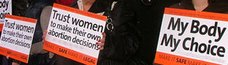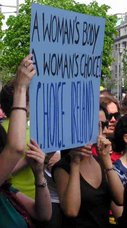
Over the sea and unheard
Northern Irish politicians agree on one thing: abortion is evil. The ban sends thousands of women abroad every year
Fionola Meredith guardian.co.uk, Monday October 20 2008
October 24, 11.55am: So Ulster said no, and Ulster got its way. For all Harriet Harman's spurious-sounding excuses about protecting Britain's liberal abortion laws from the dangerous machinations of the Lords, her reported decision to block the Commons votes that could have over-turned the Northern Ireland abortion ban looks very much like capitulation to the obstreperous Stormont boys' club. Northern Ireland politicians have used all their usual tactics of loud whining, immature grandstanding and – most effective of all – dark threats about imminent constitutional crises to get their own way. With the power-sharing executive at Stormont on the brink, they knew they held the trump card. There's nothing this intensely inward-looking band of brothers likes better than seeing off perceived Westminster interference, keeping the good old Ulster homestead pure and holy. So well done, lads, another grubby victory for your own special brand of moral probity. Meanwhile, desperate, cash-strapped Northern women with unwanted pregnancies will keep on taking their problems across the water, where you don't have to see them.
October 23, 10am: For years, I've avoided driving my young daughter home from school along Belfast's University Avenue. I didn't want her to see the images of aborted foetuses festooning the lamp-posts, placed there by anti-abortion campaigners holding their regular "prayer vigil" outside the city's FPA (formerly known as Family Planning Association) offices. Wisely, the FPA has recently decamped to more secure, upper-floor premises elsewhere in Belfast, where teenage girls no longer have to run the gauntlet of this wild-eyed, sin-haunted crew in order to access free, independent advice on an unwanted pregnancy.
Abortion is effectively illegal in Northern Ireland, and any time there's an attempt made to change that discriminatory state of affairs, the place goes nuclear. So, no surprises that when it emerged that pro-choice Labour MPs were planning to back an amendment to the Embryology Bill that would allow terminations in Northern Ireland, the same old chorus of hysteria about "babykillers" started up again, complete with – worst of all – outpourings of vicious misogyny.
Once again, though, the issue has been kicked into the middle distance: the MPs are reportedly backing down, after being warned that the move could prompt local politicians to walk away from negotiations aimed at shoring up the tottering Stormont executive. Ironically, resistance to abortion rights is the one thing our warring representatives can actually agree on. Locked in a bitter, acrimonious and increasingly destructive struggle over the devolution of policing and justice powers, it's all sunshine and roses between them when it comes to this basic human right – and the message is, you ain't getting it, ladies. Shuffle off to England, get the abortion done secretly, come back and we'll say no more about it.
Thousands of women make this costly, agonisingly difficult journey every year – many in the later stages of pregnancy because of delays caused by financial hardship. Others, perhaps unable to afford the trip, are turning to risky abortion pills bought on the internet. And a recent survey (pdf) of GPs in Northern Ireland found that 11% "have seen the results of amateur abortions". Yet our politicians continue to complacently inform us that there is no demand for abortion in Northern Ireland.
A nasty combination of strident fundamentalism, paternalistic indifference to women's rights and our politicians' bone-headed obsession with constitutional issues to the exclusion of all else mean that the Irish Sea ferries will continue to get good business from desperate Northern Irish women for quite some time to come. Meanwhile, any attempt at more measured, rational debate about the issue gets drowned out by shrieking zealots, determined – in classic Ulster style – to reduce all discourse to one simplistic polar opposition: in this case, baby-killers versus baby-lovers.
The thing is, we got what we wanted – our own little white parliament up on the hill, sworn enemies sharing power, misty-eyed dreams of a bright new future. But we're paying one hell of a price for devolution.
Thursday, October 23, 2008


Guardian: Labour Stitch-Up Will Deny Women Fundamental Rights
An apparent dirty deal to keep abortion out of Northern Ireland has also led to the shelving of crucial reforms in Britain.
Polly Toynbee The Guardian, Tuesday October 21 2008
When pro-choice demonstrators gather outside parliament today, they really will have cause to protest. In an extraordinary stitch-up, the government has cheated its way out of the abortion debate that was scheduled to be part of tomorrow's human fertilisation and embryology bill. Campaigners are blistering with fury that procedural sleight of hand will deny the chance to reform the forty-year old abortion act.
The government has agreed to let all abortion amendments slip to the bottom, with no time to debate them. Their stated reason is a fear that if reforming abortion amendments are included when the bill goes to the Lords, the upper house may overturn them and instead of making progressive reforms, revert to a harsher time limit and other restrictions. The Lib Dem MP Evan Harris, a leading reformer, rejects this argument out of hand, with plenty of evidence that the Lords has repeatedly voted pro-abortion and strongly supports the whole bill.
What's behind this? A simple miscalculation about the nature of the Lords? Unlikely since it has in recent years voted eight times in favour of abortion and embryo issues. Harris accuses Labour of political cowardice and fearing to support pro-abortion reforms.
Here's the case for reform: the 1967 abortion law casts women as too morally unreliable to decide if they should become mothers. Two doctors must agree that a pregnancy can be terminated; women must plead psychological cause and attend a registered clinic. All that adds to cruel delays: some women still wait six weeks.
Doctors are not making a medical diagnosis, but giving or withholding their moral blessing. Not surprisingly, the Royal College of Obstetricians and Gynaecologists wants an end to this archaic hypocrisy. In these days of "choice" and "empowerment" for patients, doctors are not priests. How odd that women should be morally incapable of making this most important decision and yet might be compelled against their will to become mothers - presumably morally incompetent ones.
Tomorrow's debate was due to be a tug of war between pro- and anti-abortion amendments. Reformers wanted modest change: one doctor to sign instead of two; nurses able to administer pills for early abortions; and women allowed to take those pills at a GP clinic, to make it quicker and cheaper.
Maybe the government took fright at eye-popping anti-abortion propaganda, with the Daily Mail trumpeting "Girls aged 12 could get abortion drugs", and citing the MP Nadine Dorries' lurid images of 12-year-olds home alone "experiencing pain like they've never thought possible, bleeding like they never imagined and then flushing their own abortions down the toilet".
After failing to cut the abortion limit to 20 weeks, Dorries and others put down amendments demanding a signature from three doctors, including a psychiatrist; compulsory counselling on the merits of adoption; warnings of the "psychological risks" of abortion; and a seven-day "cooling-off period". Worst of all, they want to restrict the definition of a "seriously handicapped" foetus and ban all abortions after 24 weeks, even in the case of anencephaly, where there is no chance of survival.
But there is no reason to think any of these would have passed. The suspicion remains that the reason why the government dished the whole debate is Diane Abbott's crucial amendment to extend abortion to Northern Ireland, resisted ferociously by all Northern Ireland parties and by the government. When this bill was debated in May, ministers browbeat Labour MPs to drop it with extreme warnings that the Northern Ireland peace agreement would collapse. One MP described the pressure of being told that a secret tipping point in the peace process had been reached, and that very week was make or break. The MP broke. There has been no evidence of such a tipping point, but the frighteners behind the speaker's chair were highly effective.
Despite adamant denials, many are convinced that Labour made a dirty deal with the Democratic Unionists to keep abortion out of Northern Ireland in exchange for votes to squeak through Gordon Brown's 42-day detention bill.
Abortion is one issue that binds Sinn Féin, the DUP, SDLP and Ulster Unionists in an eternal blood brotherhood. Feminists in Northern Ireland refer to the power-sharing government as "the taliban". Some 50,000 Northern Irish women have had to come to England for abortions, costing about £2,500 each, while poorer women bear unwanted children or use back-street methods: over 10% of GPs admit to dealing with the aftermath of amateur abortions.
Denying fundamental rights to Northern Irish women fits uncomfortably well with the long dishonourable record of Westminster's regard for human rights in the province. Trade-offs have always meant different rules apply. The Commons could impose an abortion law on Northern Ireland, but once full powers are restored to Stormont, there will be nothing to stop the assembly repealing it. However, the brave and much-persecuted abortion campaigners in Northern Ireland think it unlikely the assembly would revert to the present outright ban on abortion. Attitudes are shifting: a Northern Ireland poll yesterday showed 62% would support abortion in cases of rape and incest.
However, opinion polls are consistently anti-abortion on other grounds in the province, so shouldn't they be allowed self-determination? Is this another kind of imperialism? Not if you believe individual women have an inalienable right over their own bodies. Not if you think the imposition of unwanted motherhood is as monstrous an intrusion on a woman's liberty as imprisonment without trial. This should not be a question of majority decision-making, but of as fundamental a human right as any in the UN charter, to be protected from the tyranny of the majority. No one is making anyone else have an abortion. Northern Ireland's politicians have no right to conspire across party lines against the minority rights of women citizens in need of abortions - 40 a week.
If underhand arrangements mean dropping the debate, it'll be yet another dirty Northern Ireland deal. Today at 5.30pm outside the Commons they will be shouting the old cry: "Not the church, not the state, women must decide their fate."
Polly Toynbee The Guardian, Tuesday October 21 2008
When pro-choice demonstrators gather outside parliament today, they really will have cause to protest. In an extraordinary stitch-up, the government has cheated its way out of the abortion debate that was scheduled to be part of tomorrow's human fertilisation and embryology bill. Campaigners are blistering with fury that procedural sleight of hand will deny the chance to reform the forty-year old abortion act.
The government has agreed to let all abortion amendments slip to the bottom, with no time to debate them. Their stated reason is a fear that if reforming abortion amendments are included when the bill goes to the Lords, the upper house may overturn them and instead of making progressive reforms, revert to a harsher time limit and other restrictions. The Lib Dem MP Evan Harris, a leading reformer, rejects this argument out of hand, with plenty of evidence that the Lords has repeatedly voted pro-abortion and strongly supports the whole bill.
What's behind this? A simple miscalculation about the nature of the Lords? Unlikely since it has in recent years voted eight times in favour of abortion and embryo issues. Harris accuses Labour of political cowardice and fearing to support pro-abortion reforms.
Here's the case for reform: the 1967 abortion law casts women as too morally unreliable to decide if they should become mothers. Two doctors must agree that a pregnancy can be terminated; women must plead psychological cause and attend a registered clinic. All that adds to cruel delays: some women still wait six weeks.
Doctors are not making a medical diagnosis, but giving or withholding their moral blessing. Not surprisingly, the Royal College of Obstetricians and Gynaecologists wants an end to this archaic hypocrisy. In these days of "choice" and "empowerment" for patients, doctors are not priests. How odd that women should be morally incapable of making this most important decision and yet might be compelled against their will to become mothers - presumably morally incompetent ones.
Tomorrow's debate was due to be a tug of war between pro- and anti-abortion amendments. Reformers wanted modest change: one doctor to sign instead of two; nurses able to administer pills for early abortions; and women allowed to take those pills at a GP clinic, to make it quicker and cheaper.
Maybe the government took fright at eye-popping anti-abortion propaganda, with the Daily Mail trumpeting "Girls aged 12 could get abortion drugs", and citing the MP Nadine Dorries' lurid images of 12-year-olds home alone "experiencing pain like they've never thought possible, bleeding like they never imagined and then flushing their own abortions down the toilet".
After failing to cut the abortion limit to 20 weeks, Dorries and others put down amendments demanding a signature from three doctors, including a psychiatrist; compulsory counselling on the merits of adoption; warnings of the "psychological risks" of abortion; and a seven-day "cooling-off period". Worst of all, they want to restrict the definition of a "seriously handicapped" foetus and ban all abortions after 24 weeks, even in the case of anencephaly, where there is no chance of survival.
But there is no reason to think any of these would have passed. The suspicion remains that the reason why the government dished the whole debate is Diane Abbott's crucial amendment to extend abortion to Northern Ireland, resisted ferociously by all Northern Ireland parties and by the government. When this bill was debated in May, ministers browbeat Labour MPs to drop it with extreme warnings that the Northern Ireland peace agreement would collapse. One MP described the pressure of being told that a secret tipping point in the peace process had been reached, and that very week was make or break. The MP broke. There has been no evidence of such a tipping point, but the frighteners behind the speaker's chair were highly effective.
Despite adamant denials, many are convinced that Labour made a dirty deal with the Democratic Unionists to keep abortion out of Northern Ireland in exchange for votes to squeak through Gordon Brown's 42-day detention bill.
Abortion is one issue that binds Sinn Féin, the DUP, SDLP and Ulster Unionists in an eternal blood brotherhood. Feminists in Northern Ireland refer to the power-sharing government as "the taliban". Some 50,000 Northern Irish women have had to come to England for abortions, costing about £2,500 each, while poorer women bear unwanted children or use back-street methods: over 10% of GPs admit to dealing with the aftermath of amateur abortions.
Denying fundamental rights to Northern Irish women fits uncomfortably well with the long dishonourable record of Westminster's regard for human rights in the province. Trade-offs have always meant different rules apply. The Commons could impose an abortion law on Northern Ireland, but once full powers are restored to Stormont, there will be nothing to stop the assembly repealing it. However, the brave and much-persecuted abortion campaigners in Northern Ireland think it unlikely the assembly would revert to the present outright ban on abortion. Attitudes are shifting: a Northern Ireland poll yesterday showed 62% would support abortion in cases of rape and incest.
However, opinion polls are consistently anti-abortion on other grounds in the province, so shouldn't they be allowed self-determination? Is this another kind of imperialism? Not if you believe individual women have an inalienable right over their own bodies. Not if you think the imposition of unwanted motherhood is as monstrous an intrusion on a woman's liberty as imprisonment without trial. This should not be a question of majority decision-making, but of as fundamental a human right as any in the UN charter, to be protected from the tyranny of the majority. No one is making anyone else have an abortion. Northern Ireland's politicians have no right to conspire across party lines against the minority rights of women citizens in need of abortions - 40 a week.
If underhand arrangements mean dropping the debate, it'll be yet another dirty Northern Ireland deal. Today at 5.30pm outside the Commons they will be shouting the old cry: "Not the church, not the state, women must decide their fate."
Irish Times: Northern Pro-Choice Campaign May Take Legal Action
Thursday, October 23, 2008 The Irish Times
Northern pro-choice campaign may take legal action
FRANK MILLAR, London Editor
LEGAL ACTION on grounds of discrimination may be the last hope of pro-choice and equality campaigners after the failure of a parliamentary effort to extend the 1967 British Abortion Act to Northern Ireland.
As expected, the Labour government successfully carried a timetabling motion in the House of Commons yesterday which effectively killed off a series of proposed amendments to the Human Fertilisation and Embryology Bill.
The sponsor of one of those, Labour MP Diane Abbott, described the government’s unwillingness to discuss the extension of the 1967 Act to Northern Ireland as “shabby”. But Ms Abbott was sharply criticised by DUP MP Jeffrey Donaldson, who told MPs they should “leave the matter to the people of Northern Ireland and their elected representatives”.
The four main parties in Northern Ireland were united in their opposition to the proposed amendment, which campaigners saw as the likely “last chance” to extend the British legislation to Northern Ireland before any transfer of policing and justice powers to the Stormont Assembly.
Senior Alliance Party sources last night said they thought it was extremely unlikely the party would make abortion an issue in any negotiations that could see it take the policing and justice ministry as part of any resolution of the current DUP/Sinn Féin standoff.
Speaking ahead of yesterday’s Commons vote, SDLP chairman and South Down MP Eddie McGrady stressed the importance of securing the devolution of policing and justice powers.
Forced back to the drawing board by yesterday’s Commons vote, a number of those campaigning for the liberalisation of the law in Northern Ireland confirmed that legal action remained an option – with “discrimination” against citizens in part of the UK, rather than the right to have an abortion, the likely basis for any legal challenge in the British or European courts.
Controversial new legislation allowing scientists to conduct experiments using hybrid human-animal embryos was approved by the House of Commons last night despite a small rebellion by Labour backbenchers.
The staunchly Catholic former minister Ruth Kelly was one of 16 Labour MPs who voted against the Human Fertilisation and Embryology Bill.Pro-choice MPs were furious that no time was made available to debate their calls for the law to be liberalised to allow terminations to be conducted with the approval of one doctor rather than two and for abortion to be legalised in Northern Ireland.
Northern pro-choice campaign may take legal action
FRANK MILLAR, London Editor
LEGAL ACTION on grounds of discrimination may be the last hope of pro-choice and equality campaigners after the failure of a parliamentary effort to extend the 1967 British Abortion Act to Northern Ireland.
As expected, the Labour government successfully carried a timetabling motion in the House of Commons yesterday which effectively killed off a series of proposed amendments to the Human Fertilisation and Embryology Bill.
The sponsor of one of those, Labour MP Diane Abbott, described the government’s unwillingness to discuss the extension of the 1967 Act to Northern Ireland as “shabby”. But Ms Abbott was sharply criticised by DUP MP Jeffrey Donaldson, who told MPs they should “leave the matter to the people of Northern Ireland and their elected representatives”.
The four main parties in Northern Ireland were united in their opposition to the proposed amendment, which campaigners saw as the likely “last chance” to extend the British legislation to Northern Ireland before any transfer of policing and justice powers to the Stormont Assembly.
Senior Alliance Party sources last night said they thought it was extremely unlikely the party would make abortion an issue in any negotiations that could see it take the policing and justice ministry as part of any resolution of the current DUP/Sinn Féin standoff.
Speaking ahead of yesterday’s Commons vote, SDLP chairman and South Down MP Eddie McGrady stressed the importance of securing the devolution of policing and justice powers.
Forced back to the drawing board by yesterday’s Commons vote, a number of those campaigning for the liberalisation of the law in Northern Ireland confirmed that legal action remained an option – with “discrimination” against citizens in part of the UK, rather than the right to have an abortion, the likely basis for any legal challenge in the British or European courts.
Controversial new legislation allowing scientists to conduct experiments using hybrid human-animal embryos was approved by the House of Commons last night despite a small rebellion by Labour backbenchers.
The staunchly Catholic former minister Ruth Kelly was one of 16 Labour MPs who voted against the Human Fertilisation and Embryology Bill.Pro-choice MPs were furious that no time was made available to debate their calls for the law to be liberalised to allow terminations to be conducted with the approval of one doctor rather than two and for abortion to be legalised in Northern Ireland.
Tuesday, October 21, 2008
Irish Joint Letter Supporting the Extension of the 1967 Abortion Act to Northern Ireland
JOINT LETTER TO PRIME MINISTER GORDON BROWN, HARRIET HARMAN MP, DAWN PRIMAROLO MP AND OTHER BRITISH MP'S URGING SUPPORT FOR AMENDMENT 30 TO THE HUMAN FERTILISATION AND EMBRYOLOGY BILL.
We, the undersigned, are writing to urge you to support the proposed amendment 30 to the Human Fertilisation and Embryology Bill which would extend the 1967 Abortion Act to Northern Ireland. The extension of the 1967 Abortion Act has wider implications beyond Northern Ireland, and would ensure earlier access to abortion for women in the Republic of Ireland.
You may be aware that abortion on the island of Ireland, both in Northern Ireland and the Republic of Ireland is governed by the 1861 Offences Against the Person Act. We believe that it is now time to end an 1861 Victorian response to the 21st century issue of abortion, and ensure that wider international developments in medicine, science and ethics are reflected in amendments to the 1967 Abortion Act.
We support a guarantee for the full enjoyment of the human rights of women in Northern Ireland in this area of sexual health and reproductive rights. We fully support the policy of the British Medical Association, which in its Annual Representative Meeting in 2003 supports the extension of the 1967 Abortion Act to Northern Ireland.
As NGOs and individuals working in Ireland, we have witnessed the financial, emotional and health consequences for women caused by laws that deny access to abortion services on the island of Ireland. Significantly international evidence shows that countries which criminalise abortion, as Ireland does, only pushes women into accessing unsafe and life threatening illegal abortions.
The law in Ireland (both in Northern Ireland and in the Republic) allows for abortion when the life of the woman is in danger. In practice, however, abortion is unavailable in Ireland in almost all circumstances due to ambiguity about when a physician may legally perform a life-saving operation. The law also fails to make any provision for a woman who is pregnant as a result of rape or incest, experiencing severe fetal abnormality, or at risk of permanent bodily harm such as blindness, diabetes, kidney or heart disease.
Official figures show that over 7,000 women per year travel to England for abortions from the island of Ireland. This figure is based upon the number of women providing Irish addresses (from the Republic and Northern Ireland) and vastly undercounts the actual number of women travelling, some of whom may give false addresses in England or travel to other countries like Belgium and the Netherlands.
On a daily basis our we witness how a woman's age, her emotional state, and her other life circumstances affect her decision whether to carry a pregnancy to term and her ability to do so. Yet the laws restricting abortion disregard all such factors.
Pregnant women with a fetal abnormality face an added burden. These women often have wanted pregnancies and are extremely distressed. A woman, who is treated in an abortion clinic abroad or by an illegal provider, is unable to access vital genetic analysis of fetal remains to determine implications for future pregnancies. We are aware that some women attempt to bring fetal remains back to Ireland for genetic testing or to bury the foetus in a family gravesite in Ireland. Due to a combination of stigma and a lack of information, these women sometimes smuggle the remains home after an abortion abroad.
A challenge to Ireland's ban on abortion brought by three women who had been forced to travel to England to obtain abortion services necessary to protect their health and well-being is now pending before the European Court of Human Rights and known as ABC v Ireland. Likewise, the ban on abortion in Northern Ireland has been the subject of judicial inquiry. See Family Planning Association in Northern Ireland v. Minister for Health 2004.
We believe that abortion is an intimate aspect of private life, intricately linked with a woman's sexual rights, the right to control her own body, and the liberty and security of her person. These values are unacceptably infringed upon by the forced continuation of pregnancy.
The full body of international law and the authoritative interpretations of this law as provided by international and regional bodies compel the conclusion that, in order for women and girls to exercise and enjoy their human rights fully, a number of conditions related to reproductive and sexual health policy and law must be present.
We would urge you to support Amendment 30 to the Human Fertilisation and Embryology Bill to extend the 1967 Abortion Act to Northern Ireland.
Dr Mary Muldowney
Alliance for Choice, Republic of Ireland
Helen Keys, Spokesperson
Choice Ireland
Dr Sandra McAvoy
Cork Women’s Right to Choose Group
Dr Mary Favier
Doctors for Choice in Ireland
Alison Begas, Chief Executive,
Dublin Well Woman Centre
Niall Behan, Chief Executive,
Irish Family Planning Association
Proinsias De Rossa MEP, Labour,
Member of European Parliament for Dublin
Senator Ivana Bacik, Independent,
Member of Seanad Eireann,
Reid Professor of Law, Trinity College Dublin
Karen Kiernan, Director,
One Family
Catherine Forde BL, Spokesperson,
Safe and Legal in Ireland Abortion Rights Campaign
Rhonda Donaghy, Trade Union Organiser,
SIPTU
Mags O'Brien, Trade Union Tutor,
SIPTU
Keith O'Brien, Welfare Officer,
University College Cork
Linda Kelly, Equality Officer
Union of Students in Ireland
Anthony Muldoon, Welfare Officer,
Union of Students in Ireland
Dr Geraldine Moane
Senior Lecturer, School of Psychology,
University College Dublin
Margaret Martin, Director
Women's Aid
We, the undersigned, are writing to urge you to support the proposed amendment 30 to the Human Fertilisation and Embryology Bill which would extend the 1967 Abortion Act to Northern Ireland. The extension of the 1967 Abortion Act has wider implications beyond Northern Ireland, and would ensure earlier access to abortion for women in the Republic of Ireland.
You may be aware that abortion on the island of Ireland, both in Northern Ireland and the Republic of Ireland is governed by the 1861 Offences Against the Person Act. We believe that it is now time to end an 1861 Victorian response to the 21st century issue of abortion, and ensure that wider international developments in medicine, science and ethics are reflected in amendments to the 1967 Abortion Act.
We support a guarantee for the full enjoyment of the human rights of women in Northern Ireland in this area of sexual health and reproductive rights. We fully support the policy of the British Medical Association, which in its Annual Representative Meeting in 2003 supports the extension of the 1967 Abortion Act to Northern Ireland.
As NGOs and individuals working in Ireland, we have witnessed the financial, emotional and health consequences for women caused by laws that deny access to abortion services on the island of Ireland. Significantly international evidence shows that countries which criminalise abortion, as Ireland does, only pushes women into accessing unsafe and life threatening illegal abortions.
The law in Ireland (both in Northern Ireland and in the Republic) allows for abortion when the life of the woman is in danger. In practice, however, abortion is unavailable in Ireland in almost all circumstances due to ambiguity about when a physician may legally perform a life-saving operation. The law also fails to make any provision for a woman who is pregnant as a result of rape or incest, experiencing severe fetal abnormality, or at risk of permanent bodily harm such as blindness, diabetes, kidney or heart disease.
Official figures show that over 7,000 women per year travel to England for abortions from the island of Ireland. This figure is based upon the number of women providing Irish addresses (from the Republic and Northern Ireland) and vastly undercounts the actual number of women travelling, some of whom may give false addresses in England or travel to other countries like Belgium and the Netherlands.
On a daily basis our we witness how a woman's age, her emotional state, and her other life circumstances affect her decision whether to carry a pregnancy to term and her ability to do so. Yet the laws restricting abortion disregard all such factors.
Pregnant women with a fetal abnormality face an added burden. These women often have wanted pregnancies and are extremely distressed. A woman, who is treated in an abortion clinic abroad or by an illegal provider, is unable to access vital genetic analysis of fetal remains to determine implications for future pregnancies. We are aware that some women attempt to bring fetal remains back to Ireland for genetic testing or to bury the foetus in a family gravesite in Ireland. Due to a combination of stigma and a lack of information, these women sometimes smuggle the remains home after an abortion abroad.
A challenge to Ireland's ban on abortion brought by three women who had been forced to travel to England to obtain abortion services necessary to protect their health and well-being is now pending before the European Court of Human Rights and known as ABC v Ireland. Likewise, the ban on abortion in Northern Ireland has been the subject of judicial inquiry. See Family Planning Association in Northern Ireland v. Minister for Health 2004.
We believe that abortion is an intimate aspect of private life, intricately linked with a woman's sexual rights, the right to control her own body, and the liberty and security of her person. These values are unacceptably infringed upon by the forced continuation of pregnancy.
The full body of international law and the authoritative interpretations of this law as provided by international and regional bodies compel the conclusion that, in order for women and girls to exercise and enjoy their human rights fully, a number of conditions related to reproductive and sexual health policy and law must be present.
We would urge you to support Amendment 30 to the Human Fertilisation and Embryology Bill to extend the 1967 Abortion Act to Northern Ireland.
Dr Mary Muldowney
Alliance for Choice, Republic of Ireland
Helen Keys, Spokesperson
Choice Ireland
Dr Sandra McAvoy
Cork Women’s Right to Choose Group
Dr Mary Favier
Doctors for Choice in Ireland
Alison Begas, Chief Executive,
Dublin Well Woman Centre
Niall Behan, Chief Executive,
Irish Family Planning Association
Proinsias De Rossa MEP, Labour,
Member of European Parliament for Dublin
Senator Ivana Bacik, Independent,
Member of Seanad Eireann,
Reid Professor of Law, Trinity College Dublin
Karen Kiernan, Director,
One Family
Catherine Forde BL, Spokesperson,
Safe and Legal in Ireland Abortion Rights Campaign
Rhonda Donaghy, Trade Union Organiser,
SIPTU
Mags O'Brien, Trade Union Tutor,
SIPTU
Keith O'Brien, Welfare Officer,
University College Cork
Linda Kelly, Equality Officer
Union of Students in Ireland
Anthony Muldoon, Welfare Officer,
Union of Students in Ireland
Dr Geraldine Moane
Senior Lecturer, School of Psychology,
University College Dublin
Margaret Martin, Director
Women's Aid
Monday, October 20, 2008
Irish Times: 62% Support Limited Abortion in the North
62% support limited abortion in the North
Nearly two-thirds of people in the North support abortion in certain circumstances, new research indicated today.
Abortion is illegal in the North unless the mother’s health is at risk, but MPs in Westminster are this week set to consider proposals to bring the law into line with the rest of the United Kingdom, where abortion is permitted.
Legalisation would be supported by 62 per cent of local people, according to the survey by the Family Planning Association (FPA), but only in extreme circumstances such as rape and incest.
All the major political parties in Northern Ireland oppose any change in the laws and are angry at the notion of MPs ruling on what they see as a devolved matter.
However the FPA claim the findings of its research indicate that the politicians are out of step with public feeling in the region.
The group claims it is a myth that people in Northern Ireland do not want to see abortion available under any circumstances.
Only 20 per cent of those questioned said abortion should not be legal in cases of rape or incest.
Dr Audrey Simpson, director of FPA in Northern Ireland said: “It is time that the Northern Ireland Assembly faced up to the realities of the situation that people in Northern Ireland support the right to choose.
“These statistics cannot be ignored and show that MLAs have a responsibility to give women in Northern Ireland the choice to have an abortion."
MPs will vote on Wednesday on an amendment to the Human Fertilisation and Embryology (HFE) Bill to extend the 1967 Abortion Act to Northern Ireland.
Nearly two-thirds of people in the North support abortion in certain circumstances, new research indicated today.
Abortion is illegal in the North unless the mother’s health is at risk, but MPs in Westminster are this week set to consider proposals to bring the law into line with the rest of the United Kingdom, where abortion is permitted.
Legalisation would be supported by 62 per cent of local people, according to the survey by the Family Planning Association (FPA), but only in extreme circumstances such as rape and incest.
All the major political parties in Northern Ireland oppose any change in the laws and are angry at the notion of MPs ruling on what they see as a devolved matter.
However the FPA claim the findings of its research indicate that the politicians are out of step with public feeling in the region.
The group claims it is a myth that people in Northern Ireland do not want to see abortion available under any circumstances.
Only 20 per cent of those questioned said abortion should not be legal in cases of rape or incest.
Dr Audrey Simpson, director of FPA in Northern Ireland said: “It is time that the Northern Ireland Assembly faced up to the realities of the situation that people in Northern Ireland support the right to choose.
“These statistics cannot be ignored and show that MLAs have a responsibility to give women in Northern Ireland the choice to have an abortion."
MPs will vote on Wednesday on an amendment to the Human Fertilisation and Embryology (HFE) Bill to extend the 1967 Abortion Act to Northern Ireland.
Irish Times: Move To Extend Abortion to North May Fail
Move to extend abortion to North may fail
FRANK MILLAR, London Editor
MPs CAMPAIGNING for the extension of the British Abortion Act to Northern Ireland fear they may be "talked out" when the issue reaches the House of Commons on Wednesday.
Labour MP Diane Abbott has tabled an amendment to the Human Fertilisation and Embryology Bill on behalf of women in Northern Ireland she has previously described as "second class citizens" denied the "right to choose" enshrined in the 1967 Abortion Act.
In face of the local political consensus, however - the main Northern Ireland parties are united in opposition - suspicions have grown that a "filibuster" or a government procedural motion will see the equality move fail for want of parliamentary time.
There has also been speculation that, having regard to Catholic opinion there, the Brown government will happily see a range of "pro-choice" amendments fall just weeks ahead of the crucial Glenrothes by-election in Scotland.
When the DUP's nine MPs originally backed prime minister Gordon Brown's now-abandoned plan to let police hold some terror suspects for 42 days both sides denied that any form of "deal" was done. At the same time, however, DUP sources privately indicated their confidence that the government would use the "payroll vote" at Westminster or otherwise deploy its influence to block the move by backbench Labour MPs to extend the Abortion Act to Northern Ireland.
Given his possible dependence on DUP votes in a tight parliament following the next general election, similar confidence was expressed that Conservative leader David Cameron would likewise discourage his backbenchers from defying the Northern Ireland consensus on the issue.
Conservative sources last night dismissed the idea that an abortion vote could provide an early test of the promise contained in the proposed Conservative/Ulster Unionist "merger" to offer Northern Ireland voters a new form of politics. As with Labour, Tory MPs will enjoy a "free vote" on what is regarded as an individual "conscience" issue.
DUP junior minister Jeffrey Donaldson last week suggested that any attempt to liberalise the law in Northern Ireland would trigger "a constitutional crisis" and could "put an end" to the Northern Ireland Assembly.
Few senior figures at Westminster appear to actually believe this, although the government plainly does not want any form of confrontation given the current stand-off between the DUP and Sinn Féin over the devolution of policing and justice powers.
The British government has acted twice in the past year in defiance of political opinion in the North - in lowering and equalising the age of sexual consent, and in outlawing discrimination on sexual orientation grounds in the provision of goods and services.
Meanwhile in Northern Ireland, hundreds of pro-life campaigners attended a rally at Stormont on Saturday demanding that there be no change to abortion law in Northern Ireland, writes Gerry Moriarty.
The Rally for Life was supported by anti-abortion campaigners, politicians and church leaders. SDLP Assembly member Pat Ramsey said the rally was "a march for civil rights - to defend the most fundamental civil right of all - the right to life".
FRANK MILLAR, London Editor
MPs CAMPAIGNING for the extension of the British Abortion Act to Northern Ireland fear they may be "talked out" when the issue reaches the House of Commons on Wednesday.
Labour MP Diane Abbott has tabled an amendment to the Human Fertilisation and Embryology Bill on behalf of women in Northern Ireland she has previously described as "second class citizens" denied the "right to choose" enshrined in the 1967 Abortion Act.
In face of the local political consensus, however - the main Northern Ireland parties are united in opposition - suspicions have grown that a "filibuster" or a government procedural motion will see the equality move fail for want of parliamentary time.
There has also been speculation that, having regard to Catholic opinion there, the Brown government will happily see a range of "pro-choice" amendments fall just weeks ahead of the crucial Glenrothes by-election in Scotland.
When the DUP's nine MPs originally backed prime minister Gordon Brown's now-abandoned plan to let police hold some terror suspects for 42 days both sides denied that any form of "deal" was done. At the same time, however, DUP sources privately indicated their confidence that the government would use the "payroll vote" at Westminster or otherwise deploy its influence to block the move by backbench Labour MPs to extend the Abortion Act to Northern Ireland.
Given his possible dependence on DUP votes in a tight parliament following the next general election, similar confidence was expressed that Conservative leader David Cameron would likewise discourage his backbenchers from defying the Northern Ireland consensus on the issue.
Conservative sources last night dismissed the idea that an abortion vote could provide an early test of the promise contained in the proposed Conservative/Ulster Unionist "merger" to offer Northern Ireland voters a new form of politics. As with Labour, Tory MPs will enjoy a "free vote" on what is regarded as an individual "conscience" issue.
DUP junior minister Jeffrey Donaldson last week suggested that any attempt to liberalise the law in Northern Ireland would trigger "a constitutional crisis" and could "put an end" to the Northern Ireland Assembly.
Few senior figures at Westminster appear to actually believe this, although the government plainly does not want any form of confrontation given the current stand-off between the DUP and Sinn Féin over the devolution of policing and justice powers.
The British government has acted twice in the past year in defiance of political opinion in the North - in lowering and equalising the age of sexual consent, and in outlawing discrimination on sexual orientation grounds in the provision of goods and services.
Meanwhile in Northern Ireland, hundreds of pro-life campaigners attended a rally at Stormont on Saturday demanding that there be no change to abortion law in Northern Ireland, writes Gerry Moriarty.
The Rally for Life was supported by anti-abortion campaigners, politicians and church leaders. SDLP Assembly member Pat Ramsey said the rally was "a march for civil rights - to defend the most fundamental civil right of all - the right to life".
Observer Editorial: Legalise Abortion in Northern Ireland
Legalise abortion in Northern Ireland
Editorial The Observer, Sunday October 19 2008
Northern Ireland's powerful anti-abortion lobby held a rally at Stormont yesterday as part of its campaign to pile pressure on both the Assembly and Downing Street to ensure that the Province is treated differently from the rest of the UK. They want to maintain an unjust and absurd status quo: that Northern Ireland continues to be the only part of the UK where the 1967 abortion act does not apply.
The 'pro-life' alliance is backed by a coalition of Democratic Unionists, Protestant evangelicals and the Catholic Church, but with the exception of the Progressive Unionists and the Alliance party's Anna Lo, the other main Assembly parties are also opposed to extending the 1967 act to Northern Ireland.
Yet women, many of them desperately poor, some the victims of rape and abuse, will still take the boat and plane to Britain to terminate their pregnancies, often at great financial as well as personal and emotional cost.
A smaller minority will actually be offered terminations within Northern Ireland hospitals; that is those women whose lives would be in immediate mortal danger if their pregnancy went ahead. This leaves frontline medical staff, notably the midwives, in a precarious legal position. The Royal College of Midwives has warned that its members in Northern Ireland could face prosecution under 19th-century laws that still apply there unless either the 1967 act is extended or local health minister Michael McGimpsey lays down clear guidelines to protect health workers.
A group of Labour MPs is trying to end this anomaly and give Northern Ireland women the same freedom to choose as their counterparts in Britain. However, in this newspaper today a small, courageous band of pro-choice public figures in Northern Ireland claim that Downing Street is prepared to yield to the anti-abortion lobby, and use parliamentary chicanery to push any motion aimed at extending the '67 act so far down the agenda that it will disappear.
MPs on all sides of the House of Commons should ensure the government does not surrender to the forces of reaction in Northern Ireland. They should side with the women of the Province, who for almost 40 years have been denied a choice that every other woman in the UK has been able to exercise. On this issue Labour MPs in particular should rebel against their government in defence of that freedom.
Editorial The Observer, Sunday October 19 2008
Northern Ireland's powerful anti-abortion lobby held a rally at Stormont yesterday as part of its campaign to pile pressure on both the Assembly and Downing Street to ensure that the Province is treated differently from the rest of the UK. They want to maintain an unjust and absurd status quo: that Northern Ireland continues to be the only part of the UK where the 1967 abortion act does not apply.
The 'pro-life' alliance is backed by a coalition of Democratic Unionists, Protestant evangelicals and the Catholic Church, but with the exception of the Progressive Unionists and the Alliance party's Anna Lo, the other main Assembly parties are also opposed to extending the 1967 act to Northern Ireland.
Yet women, many of them desperately poor, some the victims of rape and abuse, will still take the boat and plane to Britain to terminate their pregnancies, often at great financial as well as personal and emotional cost.
A smaller minority will actually be offered terminations within Northern Ireland hospitals; that is those women whose lives would be in immediate mortal danger if their pregnancy went ahead. This leaves frontline medical staff, notably the midwives, in a precarious legal position. The Royal College of Midwives has warned that its members in Northern Ireland could face prosecution under 19th-century laws that still apply there unless either the 1967 act is extended or local health minister Michael McGimpsey lays down clear guidelines to protect health workers.
A group of Labour MPs is trying to end this anomaly and give Northern Ireland women the same freedom to choose as their counterparts in Britain. However, in this newspaper today a small, courageous band of pro-choice public figures in Northern Ireland claim that Downing Street is prepared to yield to the anti-abortion lobby, and use parliamentary chicanery to push any motion aimed at extending the '67 act so far down the agenda that it will disappear.
MPs on all sides of the House of Commons should ensure the government does not surrender to the forces of reaction in Northern Ireland. They should side with the women of the Province, who for almost 40 years have been denied a choice that every other woman in the UK has been able to exercise. On this issue Labour MPs in particular should rebel against their government in defence of that freedom.
October 17th- Letter to The Times: Time to Modernise Abortion Legislation
Time to modernise abortion legislation
Academic medical lawyers and ethicists petition for the modernisation of the Abortion Act 1967
Sir, Recent years have witnessed a welcome shift in medical practice. Paternalism, the “doctor knows best” attitude, has been largely superseded by respect for patient autonomy. This shift is mirrored in the ethical codes and legal principles governing medical practice, which generally endorse the idea that individuals are entitled to make their own healthcare decisions, even when such choices appear irrational or wrong to others. Furthermore, our courts have held that individual women’s rights to make their own decisions are not suspended during pregnancy.
Given this, subjecting pregnant women who wish to terminate a pregnancy to the current qualifying conditions of the Abortion Act 1967, whereby an abortion is only permissible if two doctors agree to it, is an anomaly. And while achieving fewer and earlier abortions is a goal shared by all, there is no evidence that this is best achieved by placing obstacles in the path of a woman wishing to end her pregnancy.
As academic medical lawyers and ethicists, we believe that the current restrictions on women’s reproductive autonomy during the first 24 weeks of pregnancy are not justified. Likewise, where other provisions of the Abortion Act (such as those limiting where, and by whom, abortions may be performed) are not dictated by the requirements of patient safety and good medical practice, they should be similarly reformed. We therefore ask Parliament to take the opportunity now before it to modernise the Abortion Act 1967.
Sally Sheldon
Professor Law, Kent University
Ruth Chadwick
Distinguished Research Professor, Cardiff University
M. D. A. Freeman
Professor of English Law, UCL
Jonathan Glover
Professor of Ethics, King’s College London
John Harris
Lord Alliance Professor of Bioethics University of Manchester
Sheila A. M. Mclean
Professor of Law and Ethics in Medicine, University of Glasgow
Celia Wells
Professor of Law, Durham University
Hazel Biggs
Professor of Law, Lancaster University
Marie Fox
Professor of Law, Keele University
Stephen Wilkinson
Professor of Bioethics, Keele University
David Archard,
Professor of Philosophy and Public Policy, Lancaster University
Richard Ashcroft
Professor of Bioethics, School of Law, Queen Mary, University of London
Dr Nafsika Athanassoulis,
Lecturer in Ethics, Centre for Professional Ethics, Keele University
Peter Bartlett
Nottinghamshire Healthcare NHS Trust Professor of Mental Health Law, School of Law, University of Nottingham
Simon Blackburn, FBA,
The Professor of Philosophy, University of Cambridge
Dr Iain Brassington
Lecturer in Bioethics, Centre for Social Ethics and Policy and Institute for Science, Ethics and Innovation, School of Law, School of Law, University of Manchester
Christine Bell
Professor of Law, Transitional Justice Institute, University of Ulster
Joanne Beswick
Lecturer in Law, Staffordshire University
Lois S Bibbings
Senior Lecturer in Law, School of Law and Honorary Research Fellow, Centre
for Ethics in Medicine, University of Bristol.
Jenny Billings
Senior Research Fellow in Health Care Research (Vulnerable Groups), Kent University
Dr Lisa Bortolotti
Lecturer in Philosophy, University of Birmingham
Dr Bob Brecher
Director, Centre for Applied Philosophy, Politics & Ethics, University of Brighton
Jo Bridgeman
Senior Lecturer in Law, Sussex Law School
Dr Jennifer Burr
Lecturer in Health Care Ethics, School of Health and Related Research, University of Sheffield
Dr Ruth Cain
Lecturer in Law, Keele University
Dr Gideon Calder
Reader in Ethics and Social Philosophy, University of Wales, Newport
Dr Sharon Cowan
Lecturer in Law, Edinburgh University
Dr Roger Crisp
Uehiro Fellow and Tutor in Philosophy, St Anne's College, Oxford
Katherine de Gama,
Lecturer in Law, Keele University
Dr Marinos Diamantidis
Reader in Law, Birkbeck College
Gillian Douglas
Professor of Law, Cardiff University
Dr Heather Draper
Reader in Biomedical Ethics, Department of General Practice and Primary Care, University of Birmingham
Eileen Fegan
Lecturer in Law, Queen's University, Belfast
Dr Rachel Fenton
Senior Lecturer in Law, Bristol Law School, University of the West of England
P R Ferguson
Professor of Scots Law, Department of Law, University of Dundee
Dr Ruth Fletcher,
Senior Lecturer in Law, Keele University
Dr Sara Fovargue,
Lecturer in Law, Lancaster University.
Lucy Frith
Lecturer in Health Care Ethics, Medical School, University of Liverpool
Dr Colin Gavaghan,
Lecturer in medical law and ethics, School of Law, University of Glasgow
Dr Simona Giordano
Senior Lecturer of Bioethics, Centre for Social Ethics and Policy (CSEP), University of Manchester
Patrick Hanafin
Professor of Law, School of Law, Birkbeck College.
Vivienne Harpwood
Professor of Law, Cardiff University
John Harrington
Professor of Law, Liverpool University
Dr Peter Herissone-Kelly
Lecturer in Philosophy, Centre for Professional Ethics, University of Central Lancashire
Tamara K Hervey
School of Law, University of Sheffield
Dr Kirsty Horsey
Lecturer in Law, Kent University
Dr Jonathan Ives,
Research Fellow, Centre for the Study of Global Ethics, Centre for Biomedical Ethics, University of Birmingham.
Dr Marie-Andree Jacob,
Lecturer in Law, Keele University
Dr David Lamb
Hon Reader in Bioethics, University of Birmingham.
Dr. Melanie Latham
Reader in Law, Manchester Metropolitan University.
J.V. McHale
Professor of Law, Faculty of Law, University of Leicester
Robin Mackenzie
Senior Lecturer in Law, Kent University
Sheelagh McGuiness
Lecturer in Ethics, Centre for Professional Ethics, Keele University
Hugh McLachlan
School of Law and Social Sciences, Glasgow Caledonian University
Dr Alasdair MacLean
Senior Lecturer in Law, University of Dundee
Dr Neil C. Manson
Senior Lecturer, Department of Philosophy, Lancaster University
Robyn Martin
Professor of Public Health Law, Centre for Research in Primary and Community Care, University of Hertfordshire
Dr Sabine Michalowski
Reader in Law, University of Essex
Susan Millns
Professor of Law, Sussex University
Dr José Miola,
Senior Lecturer in Law, University of Leicester.
Derek Morgan
Professor of Medical Law and Jurisprudence, University of Sheffield,
Linda Mulcahy
Anniversary Professor of Law and Society, Birkbeck College
Vanessa Munro
Professor of Socio-Legal Studies, University of Nottingham
Therese Murphy,
Professor of Law & Critical Theory, University of Nottingham
Richard Norman
Emeritus Professor of Moral Philosophy, Kent University.
Aurora Plomer
Professor of Law and Bioethics, School of Law, University of Sheffield
Dr Nicolette Priaulx,
Senior Lecturer in Law, Cardiff University
David Price,
Professor of Medical Law, De Montfort University School of Law, Leicester.
Jan Quallington,
Principal Lecturer, Institute of Health, Social Care and Psychology, University of Worcester.
Genevra Richardson,
Professor of Law, School of Law, King's College London
Jo Samanta,
Senior Lecturer, De Montfort University School of Law, Leicester.
Associate Professor Ralph Sandland,
Associate Professor of Law, University of Nottingham.
Professor Julian Savulescu B.Med.Sci., M.B., B.S., M.A., Ph.D.
Uehiro Chair in Practical Ethics at the University of Oxford, Director of the Oxford Uehiro Centre for Practical Ethics, Director of the Program on Ethics and the New Biosciences in the 21st Century School, University of Oxford, Director of the Oxford Centre for Neuroethics, University of Oxford.
Dr Leanne Smith
Lecturer in Law, Cardiff University
Dr John Stanton-Ife
Senior Lecturer in Law, King's College London
Dr. Dania Thomas
Lecturer in Law, Keele University
Dr Michael Thomson
Professor of Law, Culture & Society, Keele University
Dr Kenneth Veitch
Lecturer in Law, Sussex University
Dr Julie Wallbank,
Senior Lecturer in Law, Leeds University
Donna Whitehead,
Senior Lecturer in Law, University of Sunderland.
Noel Whitty
Professor of Human Rights Law, University of Nottingham
Dr E Wicks
Senior Lecturer in Law, University of Birmingham
Melanie L Williams
Professor of Law, University of Exeter School of Law
Dr James Wilson
Centre for Philosophy, Justice and Health, UCL.
Dr Anthony Wrigley
Lecturer in Ethics, Centre for Professional Ethics, Keele University
Academic medical lawyers and ethicists petition for the modernisation of the Abortion Act 1967
Sir, Recent years have witnessed a welcome shift in medical practice. Paternalism, the “doctor knows best” attitude, has been largely superseded by respect for patient autonomy. This shift is mirrored in the ethical codes and legal principles governing medical practice, which generally endorse the idea that individuals are entitled to make their own healthcare decisions, even when such choices appear irrational or wrong to others. Furthermore, our courts have held that individual women’s rights to make their own decisions are not suspended during pregnancy.
Given this, subjecting pregnant women who wish to terminate a pregnancy to the current qualifying conditions of the Abortion Act 1967, whereby an abortion is only permissible if two doctors agree to it, is an anomaly. And while achieving fewer and earlier abortions is a goal shared by all, there is no evidence that this is best achieved by placing obstacles in the path of a woman wishing to end her pregnancy.
As academic medical lawyers and ethicists, we believe that the current restrictions on women’s reproductive autonomy during the first 24 weeks of pregnancy are not justified. Likewise, where other provisions of the Abortion Act (such as those limiting where, and by whom, abortions may be performed) are not dictated by the requirements of patient safety and good medical practice, they should be similarly reformed. We therefore ask Parliament to take the opportunity now before it to modernise the Abortion Act 1967.
Sally Sheldon
Professor Law, Kent University
Ruth Chadwick
Distinguished Research Professor, Cardiff University
M. D. A. Freeman
Professor of English Law, UCL
Jonathan Glover
Professor of Ethics, King’s College London
John Harris
Lord Alliance Professor of Bioethics University of Manchester
Sheila A. M. Mclean
Professor of Law and Ethics in Medicine, University of Glasgow
Celia Wells
Professor of Law, Durham University
Hazel Biggs
Professor of Law, Lancaster University
Marie Fox
Professor of Law, Keele University
Stephen Wilkinson
Professor of Bioethics, Keele University
David Archard,
Professor of Philosophy and Public Policy, Lancaster University
Richard Ashcroft
Professor of Bioethics, School of Law, Queen Mary, University of London
Dr Nafsika Athanassoulis,
Lecturer in Ethics, Centre for Professional Ethics, Keele University
Peter Bartlett
Nottinghamshire Healthcare NHS Trust Professor of Mental Health Law, School of Law, University of Nottingham
Simon Blackburn, FBA,
The Professor of Philosophy, University of Cambridge
Dr Iain Brassington
Lecturer in Bioethics, Centre for Social Ethics and Policy and Institute for Science, Ethics and Innovation, School of Law, School of Law, University of Manchester
Christine Bell
Professor of Law, Transitional Justice Institute, University of Ulster
Joanne Beswick
Lecturer in Law, Staffordshire University
Lois S Bibbings
Senior Lecturer in Law, School of Law and Honorary Research Fellow, Centre
for Ethics in Medicine, University of Bristol.
Jenny Billings
Senior Research Fellow in Health Care Research (Vulnerable Groups), Kent University
Dr Lisa Bortolotti
Lecturer in Philosophy, University of Birmingham
Dr Bob Brecher
Director, Centre for Applied Philosophy, Politics & Ethics, University of Brighton
Jo Bridgeman
Senior Lecturer in Law, Sussex Law School
Dr Jennifer Burr
Lecturer in Health Care Ethics, School of Health and Related Research, University of Sheffield
Dr Ruth Cain
Lecturer in Law, Keele University
Dr Gideon Calder
Reader in Ethics and Social Philosophy, University of Wales, Newport
Dr Sharon Cowan
Lecturer in Law, Edinburgh University
Dr Roger Crisp
Uehiro Fellow and Tutor in Philosophy, St Anne's College, Oxford
Katherine de Gama,
Lecturer in Law, Keele University
Dr Marinos Diamantidis
Reader in Law, Birkbeck College
Gillian Douglas
Professor of Law, Cardiff University
Dr Heather Draper
Reader in Biomedical Ethics, Department of General Practice and Primary Care, University of Birmingham
Eileen Fegan
Lecturer in Law, Queen's University, Belfast
Dr Rachel Fenton
Senior Lecturer in Law, Bristol Law School, University of the West of England
P R Ferguson
Professor of Scots Law, Department of Law, University of Dundee
Dr Ruth Fletcher,
Senior Lecturer in Law, Keele University
Dr Sara Fovargue,
Lecturer in Law, Lancaster University.
Lucy Frith
Lecturer in Health Care Ethics, Medical School, University of Liverpool
Dr Colin Gavaghan,
Lecturer in medical law and ethics, School of Law, University of Glasgow
Dr Simona Giordano
Senior Lecturer of Bioethics, Centre for Social Ethics and Policy (CSEP), University of Manchester
Patrick Hanafin
Professor of Law, School of Law, Birkbeck College.
Vivienne Harpwood
Professor of Law, Cardiff University
John Harrington
Professor of Law, Liverpool University
Dr Peter Herissone-Kelly
Lecturer in Philosophy, Centre for Professional Ethics, University of Central Lancashire
Tamara K Hervey
School of Law, University of Sheffield
Dr Kirsty Horsey
Lecturer in Law, Kent University
Dr Jonathan Ives,
Research Fellow, Centre for the Study of Global Ethics, Centre for Biomedical Ethics, University of Birmingham.
Dr Marie-Andree Jacob,
Lecturer in Law, Keele University
Dr David Lamb
Hon Reader in Bioethics, University of Birmingham.
Dr. Melanie Latham
Reader in Law, Manchester Metropolitan University.
J.V. McHale
Professor of Law, Faculty of Law, University of Leicester
Robin Mackenzie
Senior Lecturer in Law, Kent University
Sheelagh McGuiness
Lecturer in Ethics, Centre for Professional Ethics, Keele University
Hugh McLachlan
School of Law and Social Sciences, Glasgow Caledonian University
Dr Alasdair MacLean
Senior Lecturer in Law, University of Dundee
Dr Neil C. Manson
Senior Lecturer, Department of Philosophy, Lancaster University
Robyn Martin
Professor of Public Health Law, Centre for Research in Primary and Community Care, University of Hertfordshire
Dr Sabine Michalowski
Reader in Law, University of Essex
Susan Millns
Professor of Law, Sussex University
Dr José Miola,
Senior Lecturer in Law, University of Leicester.
Derek Morgan
Professor of Medical Law and Jurisprudence, University of Sheffield,
Linda Mulcahy
Anniversary Professor of Law and Society, Birkbeck College
Vanessa Munro
Professor of Socio-Legal Studies, University of Nottingham
Therese Murphy,
Professor of Law & Critical Theory, University of Nottingham
Richard Norman
Emeritus Professor of Moral Philosophy, Kent University.
Aurora Plomer
Professor of Law and Bioethics, School of Law, University of Sheffield
Dr Nicolette Priaulx,
Senior Lecturer in Law, Cardiff University
David Price,
Professor of Medical Law, De Montfort University School of Law, Leicester.
Jan Quallington,
Principal Lecturer, Institute of Health, Social Care and Psychology, University of Worcester.
Genevra Richardson,
Professor of Law, School of Law, King's College London
Jo Samanta,
Senior Lecturer, De Montfort University School of Law, Leicester.
Associate Professor Ralph Sandland,
Associate Professor of Law, University of Nottingham.
Professor Julian Savulescu B.Med.Sci., M.B., B.S., M.A., Ph.D.
Uehiro Chair in Practical Ethics at the University of Oxford, Director of the Oxford Uehiro Centre for Practical Ethics, Director of the Program on Ethics and the New Biosciences in the 21st Century School, University of Oxford, Director of the Oxford Centre for Neuroethics, University of Oxford.
Dr Leanne Smith
Lecturer in Law, Cardiff University
Dr John Stanton-Ife
Senior Lecturer in Law, King's College London
Dr. Dania Thomas
Lecturer in Law, Keele University
Dr Michael Thomson
Professor of Law, Culture & Society, Keele University
Dr Kenneth Veitch
Lecturer in Law, Sussex University
Dr Julie Wallbank,
Senior Lecturer in Law, Leeds University
Donna Whitehead,
Senior Lecturer in Law, University of Sunderland.
Noel Whitty
Professor of Human Rights Law, University of Nottingham
Dr E Wicks
Senior Lecturer in Law, University of Birmingham
Melanie L Williams
Professor of Law, University of Exeter School of Law
Dr James Wilson
Centre for Philosophy, Justice and Health, UCL.
Dr Anthony Wrigley
Lecturer in Ethics, Centre for Professional Ethics, Keele University
Friday, October 17, 2008
The Guardian: 'We're Talking About Women's Lives'
'We're talking about women's lives'
Northern Ireland is the only place in the UK where abortion is illegal - but that could be about to change. Mary O'Hara reports Mary O'Hara Friday October 17 2008 The Guardian
Four years ago Annie Smith (not her real name) walked into her GP's surgery and pleaded for help.
"I'd been sick for ages, my blood pressure was through the roof and I was worried that something was seriously wrong," she says. "The last thing I expected was to be told I was 12 weeks pregnant. I was still having periods."
As a single mother on benefits, suffering with depression and chronic health problems, Smith realised she could not cope with being pregnant. After a few "very difficult days" she decided to have an abortion. "I just knew it was the right thing to do. I had to think of my two children. What use am I to them even more sick, or dead?"
What Smith had not realised was just how difficult it would be to get an abortion - she lives in Northern Ireland where the procedure is illegal in almost all circumstances. A friend helped her scrape together the cash to go to England for a termination, and the pair kept it a secret because, she says, "It's just not something you could tell people about where I live.
"If it had not been for my friend, I don't know what I would have done. I had absolutely no money. I was living on benefits. The whole thing was so distressing. I couldn't eat. I couldn't sleep. If we had the same rights here as the rest of the UK, I could have had my abortion without all that additional stress. It just doesn't make sense to me."
Smith's experience stemmed from the fact that the UK's 1967 Abortion Act was passed when Northern Ireland had its own parliament - and even after direct rule was imposed in the early 1970s the law was never extended. Now that could be about to change. Next week an amendment to the embryology and human fertilisation bill, tabled by Labour MP Diane Abbott, is due to be debated in parliament; if passed, it will extend abortion rights to Northern Ireland. This challenge to the current law has triggered outrage from anti-abortion campaigners, not to mention Northern Ireland's mainstream parties - on both sides of the political divide.
Anti-abortion campaigners have been mobilising all summer, holding public town hall-style meetings and gearing up for a "Rally for Life" scheduled for tomorrow at Stormont. The leading pro-life group, Precious Life, also launched a prominent poster and bus advertising campaign a week ago to drum up support.
On the other side of the debate, pro-choice groups are also taking their case to politicians, launching a petition on the Downing Street website and holding regular public meetings. In the summer, the FPA (formerly the Family Planning Association) launched its latest campaign for women's right to choose, and it notes that more than 50,000 women have had to leave Northern Ireland in search of abortions in the past 40 years - many in the later stages of pregnancies because of delays caused by financial hardship. In 2007 alone, it estimates, around 1,400 women fled, paying up to £2,500 each for clinic and travel costs. Audrey Simpson, director of the FPA in Northern Ireland, says the situation amounts to "discrimination" against women, particularly poorer women such as Smith.
Goretti Horgan of the pro-choice group Alliance for Choice agrees, and says that some women are so desperate they are buying abortion pills on the internet. She adds that, according to one survey of GPs in Northern Ireland, 11% "have seen the results of amateur abortions".
There are very few political figures in Northern Ireland who are openly in favour of the extension of the 1967 Act - the Democratic Unionist Party, Sinn Fein, the SDLP and the Ulster Unionist Party are all against it - but Dawn Purvis, leader of the Progressive Unionist Party, says it is about time people such as Smith were heard. As an outspoken pro-choice advocate, Purvis says she comes across "all kinds of women" who have to leave the country for a termination.
"There was the 17-year-old girl who was just about to start her A-levels when she found out she was pregnant. Her boyfriend had left her. The pregnancy was enormously difficult for her and she just couldn't go through with it. There was a woman who had grown-up children - she thought she had been through the menopause, and was feeling suicidal at the prospect of having more children. There was another woman who found herself pregnant but by the time she raised the money to go to England to have an abortion she was over the [legal] limit.
This is women's lives we are talking about. That women in Northern Ireland are treated differently from women in Bradford or Birmingham or London is a national disgrace."
So why has the Abortion Act never been extended to Northern Ireland? Liam Gibson of the Society for the Protection of the Unborn Child - an anti-abortion group established in 1967 specifically to challenge the Abortion Act - says that it has never been applied "because the people of Northern Ireland simply don't want it". He argues that people in the rest of the UK and pro-choice campaigners "just don't understand" Northern Ireland and the fact that it is "more socially conservative", and he objects to any suggestion that the law should be extended, saying, "It's a matter for the assembly, not Westminster."
Purvis agrees with Gibson that to some degree Northern Ireland has always been a more conservative society, but says he and the mainstream politicians are "spectacularly out of touch" with the reality of people's lives today. She feels that the louder anti-abortion voices "drown out" those of more moderate women and men who support the right to choose. "We are criminalising women and we have a situation where people are fearful of talking openly about abortion, never mind admitting to having one."
Abbott has been accused of trying to impose abortion on Northern Ireland against the express wishes of the assembly - an accusation she rejects. For her, the issue is simply about women's rights, and enabling women to have a voice. "This is an issue that dare not speak its name in Northern Ireland," she says.
There have been controversial suggestions - widely denied - of some kind of deal between the government and the Democratic Unionists (DUP) to prevent the Abortion Act being extended. It is difficult to see how this might happen if a vote does take place, since MPs are granted a free vote on the issue in parliament. But after the nine DUP MPs voted in favour of the 42-day detention of terror suspects earlier this year - helping the government to win the vote in the Commons - questions were asked about what the "trade-off" was. Some pro-choice campaigners, including Horgan, suggest a "soft whip" is being applied to MPs on the basis that if they vote for the amendment it could threaten the peace process.
Jeffrey Donaldson, an MP and member of the legislative assembly (MLA) for the DUP, and head of the all-party Pro-Life Group in the assembly, denies any kind of deal has been struck but says he has anecdotal evidence that many MPs would consider voting against the amendment if it would destabilise the peace process. If the amendment were carried, Donaldson says, there "would definitely be a constitutional upset" because Northern Ireland MLAs believe it is a decision that should rest with the assembly and not Westminster. The assembly could, he says, "refuse to implement" the extension of the act even if MPs in Westminster voted in favour.
What happens next - and whether a constitutional crisis would indeed ensue - hinges first on whether the speaker calls the amendment for a vote, and, ultimately, on whether the pro-choice majority in the Commons votes in favour. Les Reid of the Belfast Humanist Association, another pro-choice advocate, believes that for all the threats of constitutional crisis, the anti-abortion lobby's protestations may come to nothing in the long term. "The DUP and the Catholic church warned that gay rights would never be accepted in Northern Ireland, but time has proved them wrong," he says. "Likewise, if the abortion laws are extended, all that will happen is that, eventually, women who have been forced to find access [elsewhere] will be able to get treatment they need."
For Smith, an extension in the law can't come a moment too soon. "I understand that many people do not agree with abortion," she says. "That is their right and I respect it. But I don't see why they should be able to impose their views on me or any other woman. It's a disgrace that I had to go through what I did."
Copyright Guardian Newspapers Limited 2008
---
Northern Ireland is the only place in the UK where abortion is illegal - but that could be about to change. Mary O'Hara reports Mary O'Hara Friday October 17 2008 The Guardian
Four years ago Annie Smith (not her real name) walked into her GP's surgery and pleaded for help.
"I'd been sick for ages, my blood pressure was through the roof and I was worried that something was seriously wrong," she says. "The last thing I expected was to be told I was 12 weeks pregnant. I was still having periods."
As a single mother on benefits, suffering with depression and chronic health problems, Smith realised she could not cope with being pregnant. After a few "very difficult days" she decided to have an abortion. "I just knew it was the right thing to do. I had to think of my two children. What use am I to them even more sick, or dead?"
What Smith had not realised was just how difficult it would be to get an abortion - she lives in Northern Ireland where the procedure is illegal in almost all circumstances. A friend helped her scrape together the cash to go to England for a termination, and the pair kept it a secret because, she says, "It's just not something you could tell people about where I live.
"If it had not been for my friend, I don't know what I would have done. I had absolutely no money. I was living on benefits. The whole thing was so distressing. I couldn't eat. I couldn't sleep. If we had the same rights here as the rest of the UK, I could have had my abortion without all that additional stress. It just doesn't make sense to me."
Smith's experience stemmed from the fact that the UK's 1967 Abortion Act was passed when Northern Ireland had its own parliament - and even after direct rule was imposed in the early 1970s the law was never extended. Now that could be about to change. Next week an amendment to the embryology and human fertilisation bill, tabled by Labour MP Diane Abbott, is due to be debated in parliament; if passed, it will extend abortion rights to Northern Ireland. This challenge to the current law has triggered outrage from anti-abortion campaigners, not to mention Northern Ireland's mainstream parties - on both sides of the political divide.
Anti-abortion campaigners have been mobilising all summer, holding public town hall-style meetings and gearing up for a "Rally for Life" scheduled for tomorrow at Stormont. The leading pro-life group, Precious Life, also launched a prominent poster and bus advertising campaign a week ago to drum up support.
On the other side of the debate, pro-choice groups are also taking their case to politicians, launching a petition on the Downing Street website and holding regular public meetings. In the summer, the FPA (formerly the Family Planning Association) launched its latest campaign for women's right to choose, and it notes that more than 50,000 women have had to leave Northern Ireland in search of abortions in the past 40 years - many in the later stages of pregnancies because of delays caused by financial hardship. In 2007 alone, it estimates, around 1,400 women fled, paying up to £2,500 each for clinic and travel costs. Audrey Simpson, director of the FPA in Northern Ireland, says the situation amounts to "discrimination" against women, particularly poorer women such as Smith.
Goretti Horgan of the pro-choice group Alliance for Choice agrees, and says that some women are so desperate they are buying abortion pills on the internet. She adds that, according to one survey of GPs in Northern Ireland, 11% "have seen the results of amateur abortions".
There are very few political figures in Northern Ireland who are openly in favour of the extension of the 1967 Act - the Democratic Unionist Party, Sinn Fein, the SDLP and the Ulster Unionist Party are all against it - but Dawn Purvis, leader of the Progressive Unionist Party, says it is about time people such as Smith were heard. As an outspoken pro-choice advocate, Purvis says she comes across "all kinds of women" who have to leave the country for a termination.
"There was the 17-year-old girl who was just about to start her A-levels when she found out she was pregnant. Her boyfriend had left her. The pregnancy was enormously difficult for her and she just couldn't go through with it. There was a woman who had grown-up children - she thought she had been through the menopause, and was feeling suicidal at the prospect of having more children. There was another woman who found herself pregnant but by the time she raised the money to go to England to have an abortion she was over the [legal] limit.
This is women's lives we are talking about. That women in Northern Ireland are treated differently from women in Bradford or Birmingham or London is a national disgrace."
So why has the Abortion Act never been extended to Northern Ireland? Liam Gibson of the Society for the Protection of the Unborn Child - an anti-abortion group established in 1967 specifically to challenge the Abortion Act - says that it has never been applied "because the people of Northern Ireland simply don't want it". He argues that people in the rest of the UK and pro-choice campaigners "just don't understand" Northern Ireland and the fact that it is "more socially conservative", and he objects to any suggestion that the law should be extended, saying, "It's a matter for the assembly, not Westminster."
Purvis agrees with Gibson that to some degree Northern Ireland has always been a more conservative society, but says he and the mainstream politicians are "spectacularly out of touch" with the reality of people's lives today. She feels that the louder anti-abortion voices "drown out" those of more moderate women and men who support the right to choose. "We are criminalising women and we have a situation where people are fearful of talking openly about abortion, never mind admitting to having one."
Abbott has been accused of trying to impose abortion on Northern Ireland against the express wishes of the assembly - an accusation she rejects. For her, the issue is simply about women's rights, and enabling women to have a voice. "This is an issue that dare not speak its name in Northern Ireland," she says.
There have been controversial suggestions - widely denied - of some kind of deal between the government and the Democratic Unionists (DUP) to prevent the Abortion Act being extended. It is difficult to see how this might happen if a vote does take place, since MPs are granted a free vote on the issue in parliament. But after the nine DUP MPs voted in favour of the 42-day detention of terror suspects earlier this year - helping the government to win the vote in the Commons - questions were asked about what the "trade-off" was. Some pro-choice campaigners, including Horgan, suggest a "soft whip" is being applied to MPs on the basis that if they vote for the amendment it could threaten the peace process.
Jeffrey Donaldson, an MP and member of the legislative assembly (MLA) for the DUP, and head of the all-party Pro-Life Group in the assembly, denies any kind of deal has been struck but says he has anecdotal evidence that many MPs would consider voting against the amendment if it would destabilise the peace process. If the amendment were carried, Donaldson says, there "would definitely be a constitutional upset" because Northern Ireland MLAs believe it is a decision that should rest with the assembly and not Westminster. The assembly could, he says, "refuse to implement" the extension of the act even if MPs in Westminster voted in favour.
What happens next - and whether a constitutional crisis would indeed ensue - hinges first on whether the speaker calls the amendment for a vote, and, ultimately, on whether the pro-choice majority in the Commons votes in favour. Les Reid of the Belfast Humanist Association, another pro-choice advocate, believes that for all the threats of constitutional crisis, the anti-abortion lobby's protestations may come to nothing in the long term. "The DUP and the Catholic church warned that gay rights would never be accepted in Northern Ireland, but time has proved them wrong," he says. "Likewise, if the abortion laws are extended, all that will happen is that, eventually, women who have been forced to find access [elsewhere] will be able to get treatment they need."
For Smith, an extension in the law can't come a moment too soon. "I understand that many people do not agree with abortion," she says. "That is their right and I respect it. But I don't see why they should be able to impose their views on me or any other woman. It's a disgrace that I had to go through what I did."
Copyright Guardian Newspapers Limited 2008
---
Friday, October 10, 2008
Abortion Decriminalised in Victoria, Australia
The bill to decriminalise abortion in Victoria has passed a conscience vote of Upper House MPs by six votes.
The final vote was 23 to 17.
The decision has been welcomed by former Premier, Joan Kirner a long-time pro-choice campaigner.
Ms Kirner said she is relieved the bill passed in the Upper House.
"It was fantastic to see people from all sides of the House standing up to make sure that women were no longer potential criminals," she said.
But Ms Kirner says the changes are not a certainty yet. There are still m ore than 60 amendments to be debated before a final vote.
There was an outburst in the public gallery from anti-abortion protesters when the vote was read out.
Pro Life Victoria President, Denise Cameron, says opponents of the bill have no intention of giving in.
"This will go on forever. They need to stand up and defend human life," she said.
Greens MP, Colleen Hartland, voted to decriminalise abortion, but is concerned amendments will undermine the Bill.
"If any of the amendments got up they could actually undermine what is current clinical practice," she said.
"And that's what this bill is about. It's about putting out what is actually happening already, into the legal framework. We're happy to sit today, tomorrow, Sunday, we'll sit until this is finished."
Democratic Labor Party MP, Peter Kavanagh, spoke for more than three hours last night, denouncing the abortion legislation.
He says no amendments would change his vote against reform.
"But even if the amendments get up, it will only be slightly improving a fundamentally flawed law," he said.
The final vote was 23 to 17.
The decision has been welcomed by former Premier, Joan Kirner a long-time pro-choice campaigner.
Ms Kirner said she is relieved the bill passed in the Upper House.
"It was fantastic to see people from all sides of the House standing up to make sure that women were no longer potential criminals," she said.
But Ms Kirner says the changes are not a certainty yet. There are still m ore than 60 amendments to be debated before a final vote.
There was an outburst in the public gallery from anti-abortion protesters when the vote was read out.
Pro Life Victoria President, Denise Cameron, says opponents of the bill have no intention of giving in.
"This will go on forever. They need to stand up and defend human life," she said.
Greens MP, Colleen Hartland, voted to decriminalise abortion, but is concerned amendments will undermine the Bill.
"If any of the amendments got up they could actually undermine what is current clinical practice," she said.
"And that's what this bill is about. It's about putting out what is actually happening already, into the legal framework. We're happy to sit today, tomorrow, Sunday, we'll sit until this is finished."
Democratic Labor Party MP, Peter Kavanagh, spoke for more than three hours last night, denouncing the abortion legislation.
He says no amendments would change his vote against reform.
"But even if the amendments get up, it will only be slightly improving a fundamentally flawed law," he said.
Twenty First Anniversary of Historic Ruling to Extend Abortion to Northern Ireland
Press Release from fpa: Friday 10 October 2008
Twenty first anniversary of historic ruling to extend abortion to Northern Ireland
This week marks the twenty-first anniversary of an historic announcement by an International Tribunal of lawyers, civil libertarians, doctors and academics who found that the UK Government should extend the 1967 Abortion Act to Northern Ireland. Despite this women in Northern Ireland are still waiting for the same rights that women in Britain have. The tribunal organised by the Northern Ireland Abortion Law Reform Association, on the 7 and 8 of October 1987, heard evidence from local women, doctors, lawyers and support and advice agencies of the consequences of denying women access to abortion.
On the 8 of October 1987, the tribunal made this statement:
“We believe that the UK government has an obligation to extend the 1967 Abortion Act to Northern Ireland…Women in Northern Ireland should have at least the same rights as women in the rest of the UK. We believe the extension of the Act will reduce the unnecessary and inhumane suffering women in Northern Ireland are forced to endure through unwanted pregnancy.”
In July of this year, The United Nations Committee on the Convention on the Elimination of All Forms of Discrimination against Women, also voiced its concern that abortion continues to be illegal in Northern Ireland with detrimental consequences for women’s health.
An amendment has been put down by Diane Abbott MP to extend the 1967 Abortion Act to Northern Ireland as part of the Human Fertilisation and Embryology Bill being passed through parliament. This is seen by many as the last chance to secure equal reproductive rights for women in Northern Ireland before criminal justice is devolved to the Northern Ireland Assembly.
Audrey Simpson, Director of fpa in Northern Ireland, said:
“The anniversary of the tribunal is a powerful reminder to Westminster MPs voting on the amendment in the coming weeks, that people in Northern Ireland want the same rights to abortion as women have in Britain: and they have done for many years. Twenty-one years has passed by us, and it is unacceptable that Northern Irish women are still at the peril of an outdated, arbitrary and restrictive law on abortion. Women in Northern Ireland have been waiting decades to secure the same rights to reproductive health care services as women in Britain. The rights of women can no longer remain invisible in the context of abortion.”
Professor Bill Rolston, Professor of Sociology at the University of Ulster, and a founding member of the NIALRA, said:
“While the last 30 years have seen a global trend toward liberalization of national abortion laws, Northern Ireland has not taken the opportunity to lift the restrictions on abortion and afford women better reproductive choice. It is an urgent priority for the women of Northern Ireland to have the right to a safe and legal abortion, and that this right is not unduly restricted.”
Twenty first anniversary of historic ruling to extend abortion to Northern Ireland
This week marks the twenty-first anniversary of an historic announcement by an International Tribunal of lawyers, civil libertarians, doctors and academics who found that the UK Government should extend the 1967 Abortion Act to Northern Ireland. Despite this women in Northern Ireland are still waiting for the same rights that women in Britain have. The tribunal organised by the Northern Ireland Abortion Law Reform Association, on the 7 and 8 of October 1987, heard evidence from local women, doctors, lawyers and support and advice agencies of the consequences of denying women access to abortion.
On the 8 of October 1987, the tribunal made this statement:
“We believe that the UK government has an obligation to extend the 1967 Abortion Act to Northern Ireland…Women in Northern Ireland should have at least the same rights as women in the rest of the UK. We believe the extension of the Act will reduce the unnecessary and inhumane suffering women in Northern Ireland are forced to endure through unwanted pregnancy.”
In July of this year, The United Nations Committee on the Convention on the Elimination of All Forms of Discrimination against Women, also voiced its concern that abortion continues to be illegal in Northern Ireland with detrimental consequences for women’s health.
An amendment has been put down by Diane Abbott MP to extend the 1967 Abortion Act to Northern Ireland as part of the Human Fertilisation and Embryology Bill being passed through parliament. This is seen by many as the last chance to secure equal reproductive rights for women in Northern Ireland before criminal justice is devolved to the Northern Ireland Assembly.
Audrey Simpson, Director of fpa in Northern Ireland, said:
“The anniversary of the tribunal is a powerful reminder to Westminster MPs voting on the amendment in the coming weeks, that people in Northern Ireland want the same rights to abortion as women have in Britain: and they have done for many years. Twenty-one years has passed by us, and it is unacceptable that Northern Irish women are still at the peril of an outdated, arbitrary and restrictive law on abortion. Women in Northern Ireland have been waiting decades to secure the same rights to reproductive health care services as women in Britain. The rights of women can no longer remain invisible in the context of abortion.”
Professor Bill Rolston, Professor of Sociology at the University of Ulster, and a founding member of the NIALRA, said:
“While the last 30 years have seen a global trend toward liberalization of national abortion laws, Northern Ireland has not taken the opportunity to lift the restrictions on abortion and afford women better reproductive choice. It is an urgent priority for the women of Northern Ireland to have the right to a safe and legal abortion, and that this right is not unduly restricted.”
Thursday, October 09, 2008
Sunday Tribune: Pro-abortion group urge British MPs to Support Legislation
Sunday Tribune: Pro-abortion group urge British MPs to support legislation
October 5th 2008
Suzanne Breen Northern Editor
Forty women from the North will this week travel to Westminster to urge British MPs to support legislation to make abortion available in Northern Ireland.
An amendment to the Human Fertilisation and Embryology Bill, which has been tabled by Labour MP Diane Abbott, is due to be debated in the House of Commons later this month. It proposes that the 1967 British Abortion Act be extended to the North. Such legislation would also mean Southern women could cross the Border to have abortions. The North's four main political parties have all written to MPs to oppose any change in the law and claim they have the support of 90% of the population.
The 40 women represent the 40 women a week who currently travel from the North to Britain and Europe to have abortions. A letter signed by prominent individuals in the public, legal, academic and community sectors also urges MPs to extend the 1967 Act.
Among the signatories are Irish Congress of Trade Unions president Patricia McKeown; former Westminster MP Bernadette McAliskey; Annie Campbell, director of Northern Ireland Women's Aid; Audrey Simpson, director of the North's Family Planning Association and Eileen Calder of Belfast Rape Crisis Centre.
Alliance Assembly member Anna Lo, Progressive Unionist leader Dawn Purvis, and Baroness May Blood of the Shankill are also supporting the women. Goretti Horgan of Alliance for Choice said: "We totally reject the claim by the four main parties that 90% of people in the North oppose abortion. We challenge them to hold a referendum on the issue. But regardless of what the DUP, Sinn Féin, the SDLP and Ulster Unionists say, women will continue to vote with their feet and travel to Britain or Europe for abortions. Almost 80,000 have gone since 1967.
"Women should not be forced to make such expensive and often emotional journeys. Working-class women often struggle to raise the £1,000 it generally costs in travel and medical expenses."
Gordon Brown is rumoured to have done a deal with the DUP whereby they supported the 42-day detention of terrorist suspects in return for Westminster leaving it to the Stormont Assembly to legislate on abortion.
"That's like saying 'leave it to the Taliban to sort out women's rights'. It's also double standards because abortion has not been devolved to the Scottish or Welsh administrations," Horgan said.
October 5, 2008
October 5th 2008
Suzanne Breen Northern Editor
Forty women from the North will this week travel to Westminster to urge British MPs to support legislation to make abortion available in Northern Ireland.
An amendment to the Human Fertilisation and Embryology Bill, which has been tabled by Labour MP Diane Abbott, is due to be debated in the House of Commons later this month. It proposes that the 1967 British Abortion Act be extended to the North. Such legislation would also mean Southern women could cross the Border to have abortions. The North's four main political parties have all written to MPs to oppose any change in the law and claim they have the support of 90% of the population.
The 40 women represent the 40 women a week who currently travel from the North to Britain and Europe to have abortions. A letter signed by prominent individuals in the public, legal, academic and community sectors also urges MPs to extend the 1967 Act.
Among the signatories are Irish Congress of Trade Unions president Patricia McKeown; former Westminster MP Bernadette McAliskey; Annie Campbell, director of Northern Ireland Women's Aid; Audrey Simpson, director of the North's Family Planning Association and Eileen Calder of Belfast Rape Crisis Centre.
Alliance Assembly member Anna Lo, Progressive Unionist leader Dawn Purvis, and Baroness May Blood of the Shankill are also supporting the women. Goretti Horgan of Alliance for Choice said: "We totally reject the claim by the four main parties that 90% of people in the North oppose abortion. We challenge them to hold a referendum on the issue. But regardless of what the DUP, Sinn Féin, the SDLP and Ulster Unionists say, women will continue to vote with their feet and travel to Britain or Europe for abortions. Almost 80,000 have gone since 1967.
"Women should not be forced to make such expensive and often emotional journeys. Working-class women often struggle to raise the £1,000 it generally costs in travel and medical expenses."
Gordon Brown is rumoured to have done a deal with the DUP whereby they supported the 42-day detention of terrorist suspects in return for Westminster leaving it to the Stormont Assembly to legislate on abortion.
"That's like saying 'leave it to the Taliban to sort out women's rights'. It's also double standards because abortion has not been devolved to the Scottish or Welsh administrations," Horgan said.
October 5, 2008
Wall St Journal: When Justices Prefer Not to Judge- Court May Pass on Abortion Again
Wall St Journal
· When Justices Prefer Not to Judge: Court May Pass on Abortion Again
By PAULA PARK
A European court may decide whether a woman has a basic right to abortion to preserve her health. Or, some observers fear, it may avoid the issue, as it has in the past.
The European Court of Human Rights was established to uphold rights to life, privacy, freedom of speech, religion and the like. The court has one justice from each of the 47 nations that signed the European Convention on Human Rights. It rules on cases that applicants bring when they feel they cannot get adequate legal redress in their home countries.
Pro-choice supporters protest Ireland's abortion laws, among the strictest in Europe, outside Dublin's High Court.
But for years the court has essentially turned a blind eye to Ireland's abortion laws, considered among the most restrictive in Europe. Critics say that helps perpetuate an inequitable patchwork of rules across the region.
Regardless of which way the court ultimately rules, its delay highlights the complexity of what would seem a simple question: Aren't judges supposed to judge?
Siobhán Mullally, senior lecturer at the University College Cork Faculty of Law, says that by declining to hear certain cases, the justices can skirt a reckoning with the most central questions on abortion. "So far the court has been very cautious," she says.
The current case, A.B. and C. v. Ireland, was brought by three Irish women who received abortions in England for health reasons -- one had cancer -- and suffered medical complications upon their return to Ireland. The women say they were uncomfortable seeking medical treatment, both before and after the abortions, because of Ireland's laws, including a 1995 statute that applies criminal penalties to anyone giving information or assistance that promotes the procedure.
In addition, an abortion ban is written into the Irish constitution, which essentially states that the right to life of the fetus is equal to that of the mother. The Irish Supreme Court ruled in 1992 that abortion is legal if necessary to save a woman's life, but no laws were made to define when an abortion is necessary. The applicants argue that the Irish laws infringed on their rights to life, privacy and freedom from discrimination.
Prof. Aurora Plomer, an expert in bioethics at the University of Sheffield's School of Law, in Britain, cites the court's language that its charter "is intended to guarantee not rights that are theoretical or illusory but rights that are practical and effective."
The judges have stepped back from the issue before. They refused to examine whether a fetus is protected in cases brought from other countries. And they declined to hear an earlier challenge to Ireland's law. Applicants must exhaust all legal remedies in Ireland before seeking redress in Strasbourg.
The Catch-22: how to exhaust those remedies amid vague or conflicting laws before a dangerous due date arrives -- or it becomes too late to abort.
The U.S. Supreme Court, too, has shrunk from tough issues, though it is often accused of being too activist. Erwin Chemerinsky, a constitutional scholar and founding dean of the University of California-Irvine School of Law, cites early challenges to the ban on interracial marriage as an example. In a more recent instance, in 2004, the high court used procedural grounds to avoid ruling on a challenge to the 'one Nation under God' phrase in the Pledge of Allegiance.
It is a topic of a longstanding debate in U.S. history. Some say it's good for the justices to wait, allowing time for the political process to resolve issues. Others argue that it's the court's job to make the tough calls.
The European justices could make their own case. By requiring the applicants to exhaust civil remedies in their home countries first, they avoid exceeding their mandate. While 43 of the 47 states have laws allowing abortions for health reasons, four do not, and those bans are strict.
But the court was created, in part, to resolve conflicts. Standing pat can sustain inequity, some observers say. A woman could die in one country from complications from a pregnancy, where another state would have protected her life.
Prof. Richard Kay of the University of Connecticut School of Law says that in a landmark 2004 case, the court noted that there was no European consensus on when life begins. That consensus is critical for the court, Mr. Kay says, because, unlike the U.S. Supreme Court, the European court has no binding authority. Member states rarely resist its decisions, but enforcement is political, not legal.
Mr. Kay says the court could rule on Irish abortion and that even if the government disagreed, it would comply. It's a sophisticated country, he says. It follows the rule of law.
· When Justices Prefer Not to Judge: Court May Pass on Abortion Again
By PAULA PARK
A European court may decide whether a woman has a basic right to abortion to preserve her health. Or, some observers fear, it may avoid the issue, as it has in the past.
The European Court of Human Rights was established to uphold rights to life, privacy, freedom of speech, religion and the like. The court has one justice from each of the 47 nations that signed the European Convention on Human Rights. It rules on cases that applicants bring when they feel they cannot get adequate legal redress in their home countries.
Pro-choice supporters protest Ireland's abortion laws, among the strictest in Europe, outside Dublin's High Court.
But for years the court has essentially turned a blind eye to Ireland's abortion laws, considered among the most restrictive in Europe. Critics say that helps perpetuate an inequitable patchwork of rules across the region.
Regardless of which way the court ultimately rules, its delay highlights the complexity of what would seem a simple question: Aren't judges supposed to judge?
Siobhán Mullally, senior lecturer at the University College Cork Faculty of Law, says that by declining to hear certain cases, the justices can skirt a reckoning with the most central questions on abortion. "So far the court has been very cautious," she says.
The current case, A.B. and C. v. Ireland, was brought by three Irish women who received abortions in England for health reasons -- one had cancer -- and suffered medical complications upon their return to Ireland. The women say they were uncomfortable seeking medical treatment, both before and after the abortions, because of Ireland's laws, including a 1995 statute that applies criminal penalties to anyone giving information or assistance that promotes the procedure.
In addition, an abortion ban is written into the Irish constitution, which essentially states that the right to life of the fetus is equal to that of the mother. The Irish Supreme Court ruled in 1992 that abortion is legal if necessary to save a woman's life, but no laws were made to define when an abortion is necessary. The applicants argue that the Irish laws infringed on their rights to life, privacy and freedom from discrimination.
Prof. Aurora Plomer, an expert in bioethics at the University of Sheffield's School of Law, in Britain, cites the court's language that its charter "is intended to guarantee not rights that are theoretical or illusory but rights that are practical and effective."
The judges have stepped back from the issue before. They refused to examine whether a fetus is protected in cases brought from other countries. And they declined to hear an earlier challenge to Ireland's law. Applicants must exhaust all legal remedies in Ireland before seeking redress in Strasbourg.
The Catch-22: how to exhaust those remedies amid vague or conflicting laws before a dangerous due date arrives -- or it becomes too late to abort.
The U.S. Supreme Court, too, has shrunk from tough issues, though it is often accused of being too activist. Erwin Chemerinsky, a constitutional scholar and founding dean of the University of California-Irvine School of Law, cites early challenges to the ban on interracial marriage as an example. In a more recent instance, in 2004, the high court used procedural grounds to avoid ruling on a challenge to the 'one Nation under God' phrase in the Pledge of Allegiance.
It is a topic of a longstanding debate in U.S. history. Some say it's good for the justices to wait, allowing time for the political process to resolve issues. Others argue that it's the court's job to make the tough calls.
The European justices could make their own case. By requiring the applicants to exhaust civil remedies in their home countries first, they avoid exceeding their mandate. While 43 of the 47 states have laws allowing abortions for health reasons, four do not, and those bans are strict.
But the court was created, in part, to resolve conflicts. Standing pat can sustain inequity, some observers say. A woman could die in one country from complications from a pregnancy, where another state would have protected her life.
Prof. Richard Kay of the University of Connecticut School of Law says that in a landmark 2004 case, the court noted that there was no European consensus on when life begins. That consensus is critical for the court, Mr. Kay says, because, unlike the U.S. Supreme Court, the European court has no binding authority. Member states rarely resist its decisions, but enforcement is political, not legal.
Mr. Kay says the court could rule on Irish abortion and that even if the government disagreed, it would comply. It's a sophisticated country, he says. It follows the rule of law.
Irish Times: Northern Ireland abortion campaigners lobby British MPs
NI abortion campaigners lobby British MPs
Campaigners pressing for the extension of abortion laws to Northern Ireland today lobbied MPs at Westminster.
Forty protestors from the Alliance for Choice group — representing the 40 women who leave Northern Ireland every week for abortions — also delivered a letter to Downing Street
The group met Labour MP Dianne Abbot, who has tabled an amendment to the Human Fertilisation and Embryology Bill calling for an extension of the 1967 Abortion Act to Northern Ireland.
Abortions can currently only take place in Northern Ireland where it is proved that the woman’s physical or mental health is at risk.
Leader of the Progressive Unionist Party (PUP) Dawn Purvis was among the campaigners who travelled to Westminster and she hit out at attempts by the larger parties at Stormont to prevent a change in the law.
“I do not understand their position on women facing crisis pregnancies,” she said.
“They don’t mind if it happens in England or Wales, just not in their own backyard.
“That is not good enough.”
The East Belfast Assembly member said the current situation added to the trauma faced by women.
Ms Purvis said it also placed an additional financial burden on women from low income backgrounds who had to find the money to pay for the cost of travelling for private abortions — bills that sometimes cost up to £2,000.
She said women in Northern Ireland were being treated as second class citizens in comparison with those in Britain.
“They are not afforded the same rights as in the rest of the UK and that is a disgrace,” she said.
The Alliance for Choice’s Goretti Horgan said the group was pleased by the reception they got at Westminster.
She said many of the politicians who spoke to the Alliance group were surprised to hear the abortion laws did not extend to Northern Ireland.
Chief executive of the British Pregnancy Advisory Service Ann Furedi said: “Every year we see hundreds of Northern Irish women who travel to our clinics in Liverpool, Birmingham and London seeking abortion care.
“It’s absurd that a woman living in Newcastle, County Down, can’t access exactly the same reproductive health services that are available to women in Newcastle upon Tyne.
“Women in Northern Ireland are just as much at risk of an unintended pregnancy as women are in the rest of the UK — so they should have access to the same healthcare.”
Campaigners pressing for the extension of abortion laws to Northern Ireland today lobbied MPs at Westminster.
Forty protestors from the Alliance for Choice group — representing the 40 women who leave Northern Ireland every week for abortions — also delivered a letter to Downing Street
The group met Labour MP Dianne Abbot, who has tabled an amendment to the Human Fertilisation and Embryology Bill calling for an extension of the 1967 Abortion Act to Northern Ireland.
Abortions can currently only take place in Northern Ireland where it is proved that the woman’s physical or mental health is at risk.
Leader of the Progressive Unionist Party (PUP) Dawn Purvis was among the campaigners who travelled to Westminster and she hit out at attempts by the larger parties at Stormont to prevent a change in the law.
“I do not understand their position on women facing crisis pregnancies,” she said.
“They don’t mind if it happens in England or Wales, just not in their own backyard.
“That is not good enough.”
The East Belfast Assembly member said the current situation added to the trauma faced by women.
Ms Purvis said it also placed an additional financial burden on women from low income backgrounds who had to find the money to pay for the cost of travelling for private abortions — bills that sometimes cost up to £2,000.
She said women in Northern Ireland were being treated as second class citizens in comparison with those in Britain.
“They are not afforded the same rights as in the rest of the UK and that is a disgrace,” she said.
The Alliance for Choice’s Goretti Horgan said the group was pleased by the reception they got at Westminster.
She said many of the politicians who spoke to the Alliance group were surprised to hear the abortion laws did not extend to Northern Ireland.
Chief executive of the British Pregnancy Advisory Service Ann Furedi said: “Every year we see hundreds of Northern Irish women who travel to our clinics in Liverpool, Birmingham and London seeking abortion care.
“It’s absurd that a woman living in Newcastle, County Down, can’t access exactly the same reproductive health services that are available to women in Newcastle upon Tyne.
“Women in Northern Ireland are just as much at risk of an unintended pregnancy as women are in the rest of the UK — so they should have access to the same healthcare.”
Tuesday, September 23, 2008
Women's eNews:New Zealand Campaigns Sidestep Abortion Scuffle
A judge's ruling could add New Zealand to the list of countries making their abortion laws more restrictive, Jeff Fleischer reports today. But the issue, while hugely partisan in the United States, isn't being mentioned by the re-election campaign of Prime Minister Helen Clark.
--------------------------------------------------------------------------------
Here's today's update:
INTERNATIONAL
New Zealand Campaigns Sidestep Abortion Scuffle
By Jeff Fleischer
WeNews correspondent
WELLINGTON, New Zealand (WOMENSENEWS)--New Zealand has joined the list of nations reviewing its abortion law.
A recent court ruling, now under appeal, found the country's abortion law is being interpreted too liberally. If the law is upheld it would force the government to rewrite its policies.
Unlike the United States, however, the issue isn't stirring heated campaign interest. Neither Prime Minister Helen Clark of the Labour Party nor her main rival, John Key of the National Party, have weighed in on the appeals process, which could mark the first change in abortion law in 30 years.
"They have been worried about commenting before they understand what the ramifications of the ruling are, and this won't be known until the appeals process has finished," says Jackie Edmond, chief executive of Wellington-based New Zealand Family Planning. "I would imagine that they are not wanting abortion to become an election issue."
Edmond said she was glad to see the issue kept out of the political ring. "Any public debate around changes needed to abortion law are best done when we have the time and commitment to focus on the needs of women, rather than in the heat of an election campaign," she said.
The two-sided appeals battle doesn't have a fixed end date, but will definitely come after the next election, in which Clark and her Labour Party face their longest re-election odds since coming to power in 2000.
Clark Behind in Polls
The most recent poll, released Sept. 15, showed National with 53 percent support compared to 35 percent for Labour in the multi-party system. Under the country's parliamentary system, Clark chose the election date, Nov. 8.
As prime minister, Clark--who took office in 2000 as the country's second consecutive female premier--has helped pass laws creating civil unions and parental leave. In 1989, as health minister, she tried unsuccessfully to simplify the approval process for abortion.
Key is generally credited with moving the National Party to the political center. He opposed the civil-union law, for instance, but also voted against a National-backed bill that unsuccessfully tried to amend the constitution to prevent same-sex marriage.
In response to a lawsuit filed this year by Right to Life--an advocacy group based in the Pacific Region city of Christchurch--Justice Forest Miller of the High Court undertook a judicial review of existing abortion rules, put in place to allow "restricted abortion" in a number of cases but not "abortion on-demand."
In June, after completing the inquiry, he announced "powerful misgivings" about how the law is being followed by the Abortion Supervisory Committee, the organization set up to oversee the administration of abortion under a 1977 law.
"There is reason to doubt the lawfulness of many abortions authorized by certifying consultants," Miller said in his decision, noting that 99 percent of women who seek abortions receive approval. "Indeed, the committee itself has stated that the law is being used more liberally than Parliament intended."
Both Sides Join Appeal
Now the Abortion Advisory Committee is appealing the decision, saying abortions are being approved as the law intends. For its part, Right to Life is also appealing because Miller ruled that the existing law "neither confers nor recognizes a legal right to life for the unborn child," which contradicts the group's claim in its initial court filing.
In the wake of the ruling pro-choice groups generally sided with the committee, arguing that the law is being followed now. Activism has been fairly quiet so far, however, as groups wait to hear what the legal system decides before publicly making their next move.
If the appeals court upholds Miller's decision in the coming months, the government would be forced to either enforce the law more strictly or--if it wanted to keep the process more liberal--to change the law for the first time in more than three decades.
The Center for Reproductive Rights, based in New York, lists five countries--the United States, Japan, Nicaragua, Hungary and the Russian Federation--that added restrictions to abortion since 2000, with Nicaragua removing all exceptions to its prior abortion ban. Seven countries have loosened restrictions in the past five years. Among them, for instance, Portugal now allows abortion for any reason in the first 10 weeks of pregnancy.
Countries such as Kenya and Zambia have closed clinics and eliminated staff due in part to the "global gag rule." This policy prevents United States and Australia family-planning funds from going to foreign medical clinics that provide abortions, inform their patients about abortion or lobby to change their nation's abortion laws.
Early Leader in Female Suffrage
New Zealand women won the right to vote in 1893, making it the first developed country to permit women's suffrage. Women from both major parties have served as prime minister, starting with National's Jenny Shipley in 1997.
Abortion, however, was slower to change, and its law grew out of compromise.
After the state of South Australia legalized the procedure in 1969 and many New Zealanders began going there to obtain the procedure, the country created a commission to look into changing its own laws. That led Parliament in 1977 to pass the Contraception, Sterilization and Abortion Act, a compromise bill that capped off heated debate.
The law did not permit women to access abortion freely, or "on demand." Instead it legalized abortion in cases of incest, where the fetus is at risk of disability, when the life of the woman is in danger, or when the pregnancy risks the woman's physical or mental health. (Other situations, including rape or the pregnancy of a minor, can also be considered.)
Under existing law an abortion must be approved by two doctors, at least one of whom must be an obstetrician or gynecologist. Doctors can require applicants to receive counseling before or after the procedure.
In the first year after the law took effect, New Zealand saw 2,094 legal abortions. By 2007, the number was 18,382, which fell short of the record 18,511 in 2003.
With a population of slightly above 4 million, the nation's current rate of about 20 abortions per 1,000 women (aged 15 to 45) is slightly higher than that of the United States or Australia, and has generally hovered around those nations' rates in the recent past.
Jeff Fleischer is a Chicago-based journalist. He has written regularly for publications such as Mother Jones, the Sydney Morning Herald, Mental Floss and Chicago magazine. He is a 2008 Alicia Patterson Foundation fellow in Oceania.
Women's eNews welcomes your comments. E-mail us at editors@womensenews.org.
--------------------------------------------------------------------------------
Here's today's update:
INTERNATIONAL
New Zealand Campaigns Sidestep Abortion Scuffle
By Jeff Fleischer
WeNews correspondent
WELLINGTON, New Zealand (WOMENSENEWS)--New Zealand has joined the list of nations reviewing its abortion law.
A recent court ruling, now under appeal, found the country's abortion law is being interpreted too liberally. If the law is upheld it would force the government to rewrite its policies.
Unlike the United States, however, the issue isn't stirring heated campaign interest. Neither Prime Minister Helen Clark of the Labour Party nor her main rival, John Key of the National Party, have weighed in on the appeals process, which could mark the first change in abortion law in 30 years.
"They have been worried about commenting before they understand what the ramifications of the ruling are, and this won't be known until the appeals process has finished," says Jackie Edmond, chief executive of Wellington-based New Zealand Family Planning. "I would imagine that they are not wanting abortion to become an election issue."
Edmond said she was glad to see the issue kept out of the political ring. "Any public debate around changes needed to abortion law are best done when we have the time and commitment to focus on the needs of women, rather than in the heat of an election campaign," she said.
The two-sided appeals battle doesn't have a fixed end date, but will definitely come after the next election, in which Clark and her Labour Party face their longest re-election odds since coming to power in 2000.
Clark Behind in Polls
The most recent poll, released Sept. 15, showed National with 53 percent support compared to 35 percent for Labour in the multi-party system. Under the country's parliamentary system, Clark chose the election date, Nov. 8.
As prime minister, Clark--who took office in 2000 as the country's second consecutive female premier--has helped pass laws creating civil unions and parental leave. In 1989, as health minister, she tried unsuccessfully to simplify the approval process for abortion.
Key is generally credited with moving the National Party to the political center. He opposed the civil-union law, for instance, but also voted against a National-backed bill that unsuccessfully tried to amend the constitution to prevent same-sex marriage.
In response to a lawsuit filed this year by Right to Life--an advocacy group based in the Pacific Region city of Christchurch--Justice Forest Miller of the High Court undertook a judicial review of existing abortion rules, put in place to allow "restricted abortion" in a number of cases but not "abortion on-demand."
In June, after completing the inquiry, he announced "powerful misgivings" about how the law is being followed by the Abortion Supervisory Committee, the organization set up to oversee the administration of abortion under a 1977 law.
"There is reason to doubt the lawfulness of many abortions authorized by certifying consultants," Miller said in his decision, noting that 99 percent of women who seek abortions receive approval. "Indeed, the committee itself has stated that the law is being used more liberally than Parliament intended."
Both Sides Join Appeal
Now the Abortion Advisory Committee is appealing the decision, saying abortions are being approved as the law intends. For its part, Right to Life is also appealing because Miller ruled that the existing law "neither confers nor recognizes a legal right to life for the unborn child," which contradicts the group's claim in its initial court filing.
In the wake of the ruling pro-choice groups generally sided with the committee, arguing that the law is being followed now. Activism has been fairly quiet so far, however, as groups wait to hear what the legal system decides before publicly making their next move.
If the appeals court upholds Miller's decision in the coming months, the government would be forced to either enforce the law more strictly or--if it wanted to keep the process more liberal--to change the law for the first time in more than three decades.
The Center for Reproductive Rights, based in New York, lists five countries--the United States, Japan, Nicaragua, Hungary and the Russian Federation--that added restrictions to abortion since 2000, with Nicaragua removing all exceptions to its prior abortion ban. Seven countries have loosened restrictions in the past five years. Among them, for instance, Portugal now allows abortion for any reason in the first 10 weeks of pregnancy.
Countries such as Kenya and Zambia have closed clinics and eliminated staff due in part to the "global gag rule." This policy prevents United States and Australia family-planning funds from going to foreign medical clinics that provide abortions, inform their patients about abortion or lobby to change their nation's abortion laws.
Early Leader in Female Suffrage
New Zealand women won the right to vote in 1893, making it the first developed country to permit women's suffrage. Women from both major parties have served as prime minister, starting with National's Jenny Shipley in 1997.
Abortion, however, was slower to change, and its law grew out of compromise.
After the state of South Australia legalized the procedure in 1969 and many New Zealanders began going there to obtain the procedure, the country created a commission to look into changing its own laws. That led Parliament in 1977 to pass the Contraception, Sterilization and Abortion Act, a compromise bill that capped off heated debate.
The law did not permit women to access abortion freely, or "on demand." Instead it legalized abortion in cases of incest, where the fetus is at risk of disability, when the life of the woman is in danger, or when the pregnancy risks the woman's physical or mental health. (Other situations, including rape or the pregnancy of a minor, can also be considered.)
Under existing law an abortion must be approved by two doctors, at least one of whom must be an obstetrician or gynecologist. Doctors can require applicants to receive counseling before or after the procedure.
In the first year after the law took effect, New Zealand saw 2,094 legal abortions. By 2007, the number was 18,382, which fell short of the record 18,511 in 2003.
With a population of slightly above 4 million, the nation's current rate of about 20 abortions per 1,000 women (aged 15 to 45) is slightly higher than that of the United States or Australia, and has generally hovered around those nations' rates in the recent past.
Jeff Fleischer is a Chicago-based journalist. He has written regularly for publications such as Mother Jones, the Sydney Morning Herald, Mental Floss and Chicago magazine. He is a 2008 Alicia Patterson Foundation fellow in Oceania.
Women's eNews welcomes your comments. E-mail us at editors@womensenews.org.
Friday, September 12, 2008
Australia: Victorian Lower House Passes Abortion Law
The Victorian lower house has approved a bill to decriminalise abortion. (ABC)
A law to decriminalise abortion in Victoria has been passed by the lower house of Parliament.
The debate continued into the early hours of this morning before the bill was passed 49 to 32.
The proposed legislation, which legalises abortion up to 24 weeks, will now be sent to the upper house.
Women's Affairs Minister Maxine Morand says she is optimistic the bill will be passed by the Legislative Council.
"A lot of women have been waiting for this for a very long time, I met somebody today who told me she's been waiting for this for 40 years," she said.
"So for a lot of women who remember backyard abortions and abortions being prosecuted this a very, very important day for them."
A law to decriminalise abortion in Victoria has been passed by the lower house of Parliament.
The debate continued into the early hours of this morning before the bill was passed 49 to 32.
The proposed legislation, which legalises abortion up to 24 weeks, will now be sent to the upper house.
Women's Affairs Minister Maxine Morand says she is optimistic the bill will be passed by the Legislative Council.
"A lot of women have been waiting for this for a very long time, I met somebody today who told me she's been waiting for this for 40 years," she said.
"So for a lot of women who remember backyard abortions and abortions being prosecuted this a very, very important day for them."
Friday, August 22, 2008
Politicians On Both Sides Part Ways Over Abortion Bill
Politicians on both sides part ways over abortion bill
The Age (Australia)
MAJOR divisions have emerged in the Brumby Government and the Opposition over whether landmark legislation to make abortion legal in Victoria would increase the number of pregnancies terminated.
Sports Minister James Merlino has spoken out against the bill to decriminalise abortion, saying he would "oppose moves to allow a greater number of abortions".
His views are in conflict with Premier John Brumby, who has argued there is no evidence to suggest that passage of the bill would result in more abortions.
Coalition leader Ted Baillieu said he did not believe the legislation would increase the number of abortions.
But his Coalition partner and National's leader Peter Ryan said it was logical that if the perceived punitive aspects of abortion up to 24 weeks were removed, the number of terminations might increase.
Mr Ryan said he opposed the bill as a matter of principle. "There is no question abortion is a matter deeply bound up with women's health, but the first issue is a question of dignity of life," he said.
MPs will have a conscience vote on the bill, which, if passed, would remove abortion from the Crimes Act.
Under the legislation, introduced in Parliament this week, women would be able to choose to have an abortion during the first 24 weeks of pregnancy. Late-term abortions would be allowed if two doctors believe the termination to be appropriate on medical grounds and with regard to the woman's physical, psychological and social cir-cumstances.
A report by the Victorian Law Reform Commission, which forms the basis of the legislation, found there was no correspondence between the rate of abortion and legislation.
Women's Affairs Minister Maxine Morand also said yesterday that there was no link between the abortion rate and the restrictiveness of abortion laws.
"The rate of unwanted pregnancy is . . . relative to access to contraception," she told 3AW.
Ms Morand, who is sponsoring the bill, acknowledged there could be more hospitals offering abortions under the legislation.
The Premier, Ms Morand and Health Minister Daniel Andrews have all said the proposed law would reflect current clinical practice on abortion and take away the threat of prosecution for women and medical professionals.
But shadow attorney-general Robert Clark said there was a very substantial risk that the bill would increase the number of terminations.
"The legislation greatly increases the scope for abortions and sets standards that are much less restrictive than current practice," he said.
About 20,000 abortions are performed in Victoria each year under the protection of a 1969 Supreme Court ruling.
Former Bracks government minister and anti-abortionist Christine Campbell said the legislation would require less medical consultation for abortions than current requirements, increasing terminations.
Ms Campbell called a meeting of MPs from all parties last night to push for amendments to the bill, including: mandatory counselling for women deciding to have an abortion; no career disadvantage for medical professionals who object to performing or assisting with abortions; and a requirement that those performing abortions have obstetric or gynaecological training.
The Age (Australia)
MAJOR divisions have emerged in the Brumby Government and the Opposition over whether landmark legislation to make abortion legal in Victoria would increase the number of pregnancies terminated.
Sports Minister James Merlino has spoken out against the bill to decriminalise abortion, saying he would "oppose moves to allow a greater number of abortions".
His views are in conflict with Premier John Brumby, who has argued there is no evidence to suggest that passage of the bill would result in more abortions.
Coalition leader Ted Baillieu said he did not believe the legislation would increase the number of abortions.
But his Coalition partner and National's leader Peter Ryan said it was logical that if the perceived punitive aspects of abortion up to 24 weeks were removed, the number of terminations might increase.
Mr Ryan said he opposed the bill as a matter of principle. "There is no question abortion is a matter deeply bound up with women's health, but the first issue is a question of dignity of life," he said.
MPs will have a conscience vote on the bill, which, if passed, would remove abortion from the Crimes Act.
Under the legislation, introduced in Parliament this week, women would be able to choose to have an abortion during the first 24 weeks of pregnancy. Late-term abortions would be allowed if two doctors believe the termination to be appropriate on medical grounds and with regard to the woman's physical, psychological and social cir-cumstances.
A report by the Victorian Law Reform Commission, which forms the basis of the legislation, found there was no correspondence between the rate of abortion and legislation.
Women's Affairs Minister Maxine Morand also said yesterday that there was no link between the abortion rate and the restrictiveness of abortion laws.
"The rate of unwanted pregnancy is . . . relative to access to contraception," she told 3AW.
Ms Morand, who is sponsoring the bill, acknowledged there could be more hospitals offering abortions under the legislation.
The Premier, Ms Morand and Health Minister Daniel Andrews have all said the proposed law would reflect current clinical practice on abortion and take away the threat of prosecution for women and medical professionals.
But shadow attorney-general Robert Clark said there was a very substantial risk that the bill would increase the number of terminations.
"The legislation greatly increases the scope for abortions and sets standards that are much less restrictive than current practice," he said.
About 20,000 abortions are performed in Victoria each year under the protection of a 1969 Supreme Court ruling.
Former Bracks government minister and anti-abortionist Christine Campbell said the legislation would require less medical consultation for abortions than current requirements, increasing terminations.
Ms Campbell called a meeting of MPs from all parties last night to push for amendments to the bill, including: mandatory counselling for women deciding to have an abortion; no career disadvantage for medical professionals who object to performing or assisting with abortions; and a requirement that those performing abortions have obstetric or gynaecological training.
The Guardian: Legalised Abortion in Mexico City Faces Supreme Court Fight
Legalised abortion in Mexico City faces supreme court fight
• Abortion remains illegal in most of Mexico
• Activists argue measure violates constitution
• Number of women who die during procedure decrease
More than a year after abortion was decriminalised in Mexico City, abortion opponents hope the Mexican supreme court will reverse the legislation in a decision that could reverberate across Mexico and Latin America.
Mexico's highest court heard public testimony in the spring, and is expected to rule as early as this month on the constitutionality of the local abortion measure.
The Federal District is governed by the left-leaning Party of the Democratic Revolution. Through its control of the city assembly, the party in April 2007 legalised abortion in the city for women who are up to 12 weeks pregnant.
The measure is unusual because it legalises abortion in the capital. Except in cases of rape or risks to the mother's life, abortion remains illegal in most of rest of this devoutly Roman Catholic nation.
States in Mexico set their own policies on abortion rights, and only Yucatan in Mexico's far south has allowed abortion in cases of extreme poverty.
University studies estimate between 500,000 and 1 million abortions take place in Mexico annually, but most are of questionable legality.
The Catholic Church and anti-abortion activists want the high court to strike down the Mexico City measure. They argue that life begins at conception and carrying out an abortion amounts to a taking of life that violates Mexico's constitution.
"A person's life has such a great value that we cannot take it, we are not the owners," insists Ana Elena Cantu, a city legislator in the northern industrial city of Monterrey and an anti-abortion leader in Mexico.
But the 11 members of Mexico's high court may look beyond the constitutional question.
"It is not a philosophical debate. It is mostly about the criminality. Should you or should you not be penalising it," said Miguel Sarre, a university law professor at the Autonomous Technological Institute of Mexico.
In prior rulings, Mexico's high court declared abortion to be a crime but said it should not be penalised.
That ruling mollified both sides, but such a broad decision is unlikely this time, Sarre said, partly because Mexico City is drawing women in from other parts of the nation for abortions.
Since May 2007, 12 participating public hospitals in Mexico City have performed more than 12,000 free abortions, and are averaging about 35 to 40 such procedures per day, according to the city's director of emergency medical services, Dr. Arturo Gaytan. Most of the women are poor, he said.
"There isn't a way to measure this. What was clandestine is now authorised. We don't know what the measure is outside these medical units," Gaytan said.
Women who could afford it traditionally went to private clinics for abortions that technically were illegal. Today, these clinics continue to perform the procedures, but women who visit them have more recourse.
"If something happens, your family or you have legal grounds to allege negligence," said Daphne, a 23-year-old law student who first spoke to McClatchy Newspapers in March 2007 as she readied to have an abortion just weeks before it became legal.
Speaking again on condition that her last name be withheld to protect her privacy, Daphne said she would still choose a private clinic today for an abortion because "people are still afraid of the (public) institutions".
To combat that image of poor quality, city health officials point to the number of recorded deaths of mothers during the procedure. In 2005, 15 women died during a reported abortion, eight in 2006, one in 2007 and none in 2008, Gaytan said.
"What this suggests is that procedures in clandestine areas have disappeared and given way to this," he said.
Of the now-decriminalised abortions at public hospitals, 39 percent involved women who already have children and cannot afford another. Students represented almost 27 percent of the women seeking abortions, while 20 percent were maids and domestic workers. In 58 percent of the cases, the women seeking an abortion had an intrauterine device implanted to prevent another unwanted pregnancy.
• Abortion remains illegal in most of Mexico
• Activists argue measure violates constitution
• Number of women who die during procedure decrease
More than a year after abortion was decriminalised in Mexico City, abortion opponents hope the Mexican supreme court will reverse the legislation in a decision that could reverberate across Mexico and Latin America.
Mexico's highest court heard public testimony in the spring, and is expected to rule as early as this month on the constitutionality of the local abortion measure.
The Federal District is governed by the left-leaning Party of the Democratic Revolution. Through its control of the city assembly, the party in April 2007 legalised abortion in the city for women who are up to 12 weeks pregnant.
The measure is unusual because it legalises abortion in the capital. Except in cases of rape or risks to the mother's life, abortion remains illegal in most of rest of this devoutly Roman Catholic nation.
States in Mexico set their own policies on abortion rights, and only Yucatan in Mexico's far south has allowed abortion in cases of extreme poverty.
University studies estimate between 500,000 and 1 million abortions take place in Mexico annually, but most are of questionable legality.
The Catholic Church and anti-abortion activists want the high court to strike down the Mexico City measure. They argue that life begins at conception and carrying out an abortion amounts to a taking of life that violates Mexico's constitution.
"A person's life has such a great value that we cannot take it, we are not the owners," insists Ana Elena Cantu, a city legislator in the northern industrial city of Monterrey and an anti-abortion leader in Mexico.
But the 11 members of Mexico's high court may look beyond the constitutional question.
"It is not a philosophical debate. It is mostly about the criminality. Should you or should you not be penalising it," said Miguel Sarre, a university law professor at the Autonomous Technological Institute of Mexico.
In prior rulings, Mexico's high court declared abortion to be a crime but said it should not be penalised.
That ruling mollified both sides, but such a broad decision is unlikely this time, Sarre said, partly because Mexico City is drawing women in from other parts of the nation for abortions.
Since May 2007, 12 participating public hospitals in Mexico City have performed more than 12,000 free abortions, and are averaging about 35 to 40 such procedures per day, according to the city's director of emergency medical services, Dr. Arturo Gaytan. Most of the women are poor, he said.
"There isn't a way to measure this. What was clandestine is now authorised. We don't know what the measure is outside these medical units," Gaytan said.
Women who could afford it traditionally went to private clinics for abortions that technically were illegal. Today, these clinics continue to perform the procedures, but women who visit them have more recourse.
"If something happens, your family or you have legal grounds to allege negligence," said Daphne, a 23-year-old law student who first spoke to McClatchy Newspapers in March 2007 as she readied to have an abortion just weeks before it became legal.
Speaking again on condition that her last name be withheld to protect her privacy, Daphne said she would still choose a private clinic today for an abortion because "people are still afraid of the (public) institutions".
To combat that image of poor quality, city health officials point to the number of recorded deaths of mothers during the procedure. In 2005, 15 women died during a reported abortion, eight in 2006, one in 2007 and none in 2008, Gaytan said.
"What this suggests is that procedures in clandestine areas have disappeared and given way to this," he said.
Of the now-decriminalised abortions at public hospitals, 39 percent involved women who already have children and cannot afford another. Students represented almost 27 percent of the women seeking abortions, while 20 percent were maids and domestic workers. In 58 percent of the cases, the women seeking an abortion had an intrauterine device implanted to prevent another unwanted pregnancy.
Thursday, August 14, 2008
Women's enews: An Abortion Sets Major Milestone in Her Life
An Abortion Sets Major Milestone in Her Life
By Joy Pincus
WeNews correspondent
(WOMENSENEWS)--I have several milestones by which I measure my life; like moving to Israel, deciding to get married or quitting my job to become a full-time freelance writer.
Today, however, my life is divided into two distinct periods: before and after my abortion.
After a few years of trying to conceive, my spouse and I were overjoyed when our first attempt at in-vitro fertilization succeeded; doubly so, because six weeks later we discovered I was pregnant with twins. At age 39, I would be giving birth just short of my 40th birthday. I found a midwife and began to plan for my perfect home birth, which of course would be preceded by as few ultrasounds or other intervening procedures as possible. It all felt like a dream come true.
That feeling lasted about six weeks, until the first test results came in and we understood that fetal development would have to be carefully monitored. From that moment on, my spouse and I found ourselves strapped in a nightmare of a rollercoaster ride. When that ride finally ended, seven months had passed and we faced one of the most difficult decisions of our lives.
Knowing that something may or may not be very wrong with one's unborn children demands a precarious psychological balance. One has to walk a very thin line between expectation and resignation; simultaneously hoping for the best and preparing for the worst. I walked that line as best I could.
Losing Hope
After several inconclusive tests, we finally received confirmation beyond a doubt that one fetus was malformed to an extent that would preclude any normal existence. I gave up all hope of having twins, consoling myself with the thought that at least one child would somehow make it through.
The ride had not yet ended.
We soon discovered that the second fetus was suffering from IUGR, intrauterine growth retardation. By 27 weeks she was in terrible distress, some five weeks underdeveloped and with next to no amniotic fluid surrounding her.
The team of doctors following the case--including the specialist who had been monitoring the pregnancy from the first sign of trouble--were now recommending a full termination of both. Such a unanimous decision is extremely rare in a country where it often seems rare for even two people to agree on anything.
I went for one last consultation with my specialist, who explained that there was a strong likelihood that with termination of the first fetus, I would spontaneously go into labor and give birth to the second, with devastating consequences. Even worse, at any moment I might enter labor and give birth to two extremely damaged children. A monumental decision had to be made, quickly. I went home, feeling like Solomon, but without his wisdom.
Decision Becomes Clear
That night, my spouse and I escaped into the solace of sleep. In the morning, as we looked at each other, the decision was clear for both of us. Born in Israel and raised to be stoic, my husband may have found it easier to accept the circumstances; born in America and raised on happy endings, I felt like I had misplaced my life.
We phoned the hospital and told them we would proceed with a full termination.
In Israel, abortion at any stage of pregnancy is permissible in several cases, one of them being the presence of fetal anomaly. We met with the hospital's genetic counselor, who wrote a petition on our behalf and presented it to the official committee for their sanction. Our motion was approved, and on the following Monday morning, I was admitted for the procedure.
Termination of a 28-week pregnancy entails full labor and birth. After admission into the hospital I was shown to my room, thoughtfully located in the gynecological rather than the obstetric ward; it was explained to me in advance that this was to protect me from having to hear the sounds of mothers and their newborn babies. Mine was the only private room on the floor.
Next I was taken to the ultrasound department, where a doctor administered an injection of KCL, a chemical that stopped the hearts of the fetuses. This was followed by the insertion of seaweed into my cervix, inducing first a roaring fever throughout my body, and ultimately what became extremely severe contractions. Supported by my husband and mother-in-law, I got through the rest of the day and the night, my husband backing me up as I refused an epidural, in order to remain an active participant in what was to come.
By the following morning, it was over and I was able to sleep, and the next afternoon the hospital discharged me.
A Kind of Shiva
In Judaism, when a family member dies, one observes "shiva," a tradition of staying home to receive the condolences of visiting friends. In a similar way, for the week following my hospital stay, friends came by, bringing gifts and food and--more important--listening to the story of what had happened.
I discovered that it was a vital part of the process to tell my story, again and again, and in the telling I found understanding, new perspective and a way to remove any sense of lingering shame, stigma or self-pity.
Also helping me to avoid the feeling of stigma was the fact that the Israeli National Health Service bestowed upon me all the privileges given to every other woman who has given birth. In a case of twins, this means a monetary gift of around $2,000 and four months' paid maternity leave. Besides relieving the financial stress and giving me time in which to heal, the recognition and legitimization of what I had been through helped to maintain my sense of dignity.
Today, nine months later, my life has been transformed; not in spite of my experience, but because of it.
It has strengthened my marriage, allowing my partner and me to be there for each other in a time of great need and to discover tenderness toward one another that we had never known. It has taught me to stop measuring events as either "good" or "bad" by how they may affect me personally, and rather to see them for the opportunity they provide for me to develop and grow.
And it has shown me once and for all that while so many things we meet in life are beyond our control, how we respond to them is not. In fact, our ability to choose how we respond may be the greatest gift we have as humans, and of the most powerful things we have to offer others.
Joy Pincus is a freelance writer, lecturer and workshop facilitator living in central Israel.
Women's eNews welcomes your comments. E-mail us at editors@womensenews.org.
By Joy Pincus
WeNews correspondent
(WOMENSENEWS)--I have several milestones by which I measure my life; like moving to Israel, deciding to get married or quitting my job to become a full-time freelance writer.
Today, however, my life is divided into two distinct periods: before and after my abortion.
After a few years of trying to conceive, my spouse and I were overjoyed when our first attempt at in-vitro fertilization succeeded; doubly so, because six weeks later we discovered I was pregnant with twins. At age 39, I would be giving birth just short of my 40th birthday. I found a midwife and began to plan for my perfect home birth, which of course would be preceded by as few ultrasounds or other intervening procedures as possible. It all felt like a dream come true.
That feeling lasted about six weeks, until the first test results came in and we understood that fetal development would have to be carefully monitored. From that moment on, my spouse and I found ourselves strapped in a nightmare of a rollercoaster ride. When that ride finally ended, seven months had passed and we faced one of the most difficult decisions of our lives.
Knowing that something may or may not be very wrong with one's unborn children demands a precarious psychological balance. One has to walk a very thin line between expectation and resignation; simultaneously hoping for the best and preparing for the worst. I walked that line as best I could.
Losing Hope
After several inconclusive tests, we finally received confirmation beyond a doubt that one fetus was malformed to an extent that would preclude any normal existence. I gave up all hope of having twins, consoling myself with the thought that at least one child would somehow make it through.
The ride had not yet ended.
We soon discovered that the second fetus was suffering from IUGR, intrauterine growth retardation. By 27 weeks she was in terrible distress, some five weeks underdeveloped and with next to no amniotic fluid surrounding her.
The team of doctors following the case--including the specialist who had been monitoring the pregnancy from the first sign of trouble--were now recommending a full termination of both. Such a unanimous decision is extremely rare in a country where it often seems rare for even two people to agree on anything.
I went for one last consultation with my specialist, who explained that there was a strong likelihood that with termination of the first fetus, I would spontaneously go into labor and give birth to the second, with devastating consequences. Even worse, at any moment I might enter labor and give birth to two extremely damaged children. A monumental decision had to be made, quickly. I went home, feeling like Solomon, but without his wisdom.
Decision Becomes Clear
That night, my spouse and I escaped into the solace of sleep. In the morning, as we looked at each other, the decision was clear for both of us. Born in Israel and raised to be stoic, my husband may have found it easier to accept the circumstances; born in America and raised on happy endings, I felt like I had misplaced my life.
We phoned the hospital and told them we would proceed with a full termination.
In Israel, abortion at any stage of pregnancy is permissible in several cases, one of them being the presence of fetal anomaly. We met with the hospital's genetic counselor, who wrote a petition on our behalf and presented it to the official committee for their sanction. Our motion was approved, and on the following Monday morning, I was admitted for the procedure.
Termination of a 28-week pregnancy entails full labor and birth. After admission into the hospital I was shown to my room, thoughtfully located in the gynecological rather than the obstetric ward; it was explained to me in advance that this was to protect me from having to hear the sounds of mothers and their newborn babies. Mine was the only private room on the floor.
Next I was taken to the ultrasound department, where a doctor administered an injection of KCL, a chemical that stopped the hearts of the fetuses. This was followed by the insertion of seaweed into my cervix, inducing first a roaring fever throughout my body, and ultimately what became extremely severe contractions. Supported by my husband and mother-in-law, I got through the rest of the day and the night, my husband backing me up as I refused an epidural, in order to remain an active participant in what was to come.
By the following morning, it was over and I was able to sleep, and the next afternoon the hospital discharged me.
A Kind of Shiva
In Judaism, when a family member dies, one observes "shiva," a tradition of staying home to receive the condolences of visiting friends. In a similar way, for the week following my hospital stay, friends came by, bringing gifts and food and--more important--listening to the story of what had happened.
I discovered that it was a vital part of the process to tell my story, again and again, and in the telling I found understanding, new perspective and a way to remove any sense of lingering shame, stigma or self-pity.
Also helping me to avoid the feeling of stigma was the fact that the Israeli National Health Service bestowed upon me all the privileges given to every other woman who has given birth. In a case of twins, this means a monetary gift of around $2,000 and four months' paid maternity leave. Besides relieving the financial stress and giving me time in which to heal, the recognition and legitimization of what I had been through helped to maintain my sense of dignity.
Today, nine months later, my life has been transformed; not in spite of my experience, but because of it.
It has strengthened my marriage, allowing my partner and me to be there for each other in a time of great need and to discover tenderness toward one another that we had never known. It has taught me to stop measuring events as either "good" or "bad" by how they may affect me personally, and rather to see them for the opportunity they provide for me to develop and grow.
And it has shown me once and for all that while so many things we meet in life are beyond our control, how we respond to them is not. In fact, our ability to choose how we respond may be the greatest gift we have as humans, and of the most powerful things we have to offer others.
Joy Pincus is a freelance writer, lecturer and workshop facilitator living in central Israel.
Women's eNews welcomes your comments. E-mail us at editors@womensenews.org.
Friday, August 01, 2008
Newstrack India: Bombay High Court Allows Abortion of 25-week old Foetus
Bombay HC allows abortion of 25-week old foetus
Mumbai, Thu, 31 Jul 2008 NI Wire
Laws are made for the welfare of a large section of the society. And, if the same law creates a certain kind of discomfort to a particular people or a section of people, some kind of leniency in a particular case becomes imperative. Mind it! Leniency is made in an extreme stage to an exceptional case, but the same law remains applicable to others in the existing form.
The Bombay High Court met with such leniency when a couple from Bhayander, Mumbai was allowed to go for abortions even after surpassing 20th week of pregnancy. The Court has directed the doctors to examine the 25-week pregnant woman and admit her for abortion. The bench sought the reference of Article 21 of the Constitution which ensures fundamental right of life.
The Medical Termination of Pregnancy Act-applicable to whole of India except to the Jammu and Kashmir- was enacted in 1971 to prevent female foeticide. The Act prohibits abortions beyond 20 weeks of pregnancy, which is also the time to determine the sex of a child in foetus. Any couple found guilty in practising illegal abortions could be sent to jail for a period of two to seven years.
In this particular case, a pregnant petitioner when found during routine diagnosis in her 24th week that her unborn child was suffering from a congenital heart block, resorted to go for abortions. But, doctors denied as it was against the law. However, a paediatrician said, the baby would need the placement of a peacemaker immediately after being born.
Normally a peacemaker has four to five years of life. This way, the child would have to go for five peacemaker replacement surgeries throughout life. Doctors also said that even surgery is not the guarantee of a normal life. They also expressed fear of a possible intra-uterine death of the foetus and if survives, continuous ailment would also compromise the life of the child.
The pregnant mother and petitioner in her plea said that she “does not want to have a compromised quality of life for her own child and can not afford the expensive treatment, which may or may not give results.”
Dr Nikhil Datar, a gynaecologist and also a petitioner in the same case, informed the court that many women come across such a situation. Due to a stringent law, many such pregnant women go to ignorant medical practitioner for making illegal abortions.
The petitioner couple-identified in court papers as Mr X and Mrs Y-sought the help of Bombay High Court after being denied by doctors for the abortion in her 25th week pregnancy.
A division bench of Justices JN Patel and KA Tated gave this decision as the case was linked to the life of mother and baby.
The petition also sought amendment to the Medical Termination of Pregnancy (MTP) Act to allow abortion beyond 20-weeks if the mother faced a fatal risk due to the abnormal condition of the foetus. The two-member bench constituted a committee headed by the dean of JJ Hospital to submit report in this matter by August 1, when next hearing is scheduled.
Mumbai, Thu, 31 Jul 2008 NI Wire
Laws are made for the welfare of a large section of the society. And, if the same law creates a certain kind of discomfort to a particular people or a section of people, some kind of leniency in a particular case becomes imperative. Mind it! Leniency is made in an extreme stage to an exceptional case, but the same law remains applicable to others in the existing form.
The Bombay High Court met with such leniency when a couple from Bhayander, Mumbai was allowed to go for abortions even after surpassing 20th week of pregnancy. The Court has directed the doctors to examine the 25-week pregnant woman and admit her for abortion. The bench sought the reference of Article 21 of the Constitution which ensures fundamental right of life.
The Medical Termination of Pregnancy Act-applicable to whole of India except to the Jammu and Kashmir- was enacted in 1971 to prevent female foeticide. The Act prohibits abortions beyond 20 weeks of pregnancy, which is also the time to determine the sex of a child in foetus. Any couple found guilty in practising illegal abortions could be sent to jail for a period of two to seven years.
In this particular case, a pregnant petitioner when found during routine diagnosis in her 24th week that her unborn child was suffering from a congenital heart block, resorted to go for abortions. But, doctors denied as it was against the law. However, a paediatrician said, the baby would need the placement of a peacemaker immediately after being born.
Normally a peacemaker has four to five years of life. This way, the child would have to go for five peacemaker replacement surgeries throughout life. Doctors also said that even surgery is not the guarantee of a normal life. They also expressed fear of a possible intra-uterine death of the foetus and if survives, continuous ailment would also compromise the life of the child.
The pregnant mother and petitioner in her plea said that she “does not want to have a compromised quality of life for her own child and can not afford the expensive treatment, which may or may not give results.”
Dr Nikhil Datar, a gynaecologist and also a petitioner in the same case, informed the court that many women come across such a situation. Due to a stringent law, many such pregnant women go to ignorant medical practitioner for making illegal abortions.
The petitioner couple-identified in court papers as Mr X and Mrs Y-sought the help of Bombay High Court after being denied by doctors for the abortion in her 25th week pregnancy.
A division bench of Justices JN Patel and KA Tated gave this decision as the case was linked to the life of mother and baby.
The petition also sought amendment to the Medical Termination of Pregnancy (MTP) Act to allow abortion beyond 20-weeks if the mother faced a fatal risk due to the abnormal condition of the foetus. The two-member bench constituted a committee headed by the dean of JJ Hospital to submit report in this matter by August 1, when next hearing is scheduled.
Northern Ireland: UN Committee Urges Abortion Law Reform
August 1st 2008
Irish Times
UN committee urges abortion law reform - GERRY MORIARTY
A UNITED Nations committee has indicated support for extending the 1967 British abortion act to Northern Ireland, a suggestion that all the main Northern parties oppose.
The UN Committee for the Convention on the Elimination of Discrimination Against Women (Cedaw) said there should be a debate in Northern Ireland on removing "punitive provisions" on women who want to have an abortion in the North.
"The committee reiterates its call to the state party to initiate a process of public consultation in Northern Ireland on the abortion law," it said.
"The committee also urges the state party to give consideration to the amendment of the abortion law so as to remove punitive provisions imposed on women who undergo abortion," it said.
The North's department of health is currently holding a consultation process to clarify in what circumstances abortions can take place in Northern Ireland.
The Alliance for Choice group in the North yesterday called on trade unions, women's groups and community organisations to unite behind a campaign to extend the 1967 act.
Irish Times
UN committee urges abortion law reform - GERRY MORIARTY
A UNITED Nations committee has indicated support for extending the 1967 British abortion act to Northern Ireland, a suggestion that all the main Northern parties oppose.
The UN Committee for the Convention on the Elimination of Discrimination Against Women (Cedaw) said there should be a debate in Northern Ireland on removing "punitive provisions" on women who want to have an abortion in the North.
"The committee reiterates its call to the state party to initiate a process of public consultation in Northern Ireland on the abortion law," it said.
"The committee also urges the state party to give consideration to the amendment of the abortion law so as to remove punitive provisions imposed on women who undergo abortion," it said.
The North's department of health is currently holding a consultation process to clarify in what circumstances abortions can take place in Northern Ireland.
The Alliance for Choice group in the North yesterday called on trade unions, women's groups and community organisations to unite behind a campaign to extend the 1967 act.
BBC: Call For Northern Ireland Abortion Law Review
Thursday 31st July 2008
Call for NI abortion law review
By Martina Purdy
BBC NI political correspondent
The 1967 Abortion Act does not extend to NI at present
A UN committee has repeated its call for a review of Northern Ireland's abortion law through public consultation.
The Committee on the Elimination for Discrimination Against Women noted in its latest report the 1967 Abortion Act does not extend to Northern Ireland.
It also suggested this was having a detrimental impact on women's health.
The call coincides with moves by some Westminster MPs to have the act extended to Northern Ireland.
This is despite significant opposition from NI church and political leaders.
Labour's Diane Abbott is among the MPs who want to effectively end the ban on abortion in Northern Ireland, by tabling a legislative amendment to the Human Fertilisation and Embryology Bill.
'Punitive'
In its report, the Committee on the Elimination for Discrimination Against Women urges the UK to amend the existing law to remove what it calls the "punitive provision" imposed on women who undergo abortion.
A spokesman for the Northern Ireland Office said it had not yet received a copy of the report.
But it has long been the NIO's position that abortion law is a matter for the people of Northern Ireland, with the best place for debate being a devolved assembly once Stormont accepts responsibility for justice.
Call for NI abortion law review
By Martina Purdy
BBC NI political correspondent
The 1967 Abortion Act does not extend to NI at present
A UN committee has repeated its call for a review of Northern Ireland's abortion law through public consultation.
The Committee on the Elimination for Discrimination Against Women noted in its latest report the 1967 Abortion Act does not extend to Northern Ireland.
It also suggested this was having a detrimental impact on women's health.
The call coincides with moves by some Westminster MPs to have the act extended to Northern Ireland.
This is despite significant opposition from NI church and political leaders.
Labour's Diane Abbott is among the MPs who want to effectively end the ban on abortion in Northern Ireland, by tabling a legislative amendment to the Human Fertilisation and Embryology Bill.
'Punitive'
In its report, the Committee on the Elimination for Discrimination Against Women urges the UK to amend the existing law to remove what it calls the "punitive provision" imposed on women who undergo abortion.
A spokesman for the Northern Ireland Office said it had not yet received a copy of the report.
But it has long been the NIO's position that abortion law is a matter for the people of Northern Ireland, with the best place for debate being a devolved assembly once Stormont accepts responsibility for justice.
Ireland: State Faces Defeat Over Abortion Law in Court of Human Rights
Irish Times Wednesday July 29th 2008
State faces defeat over abortion law in court of human rights
The women who claim Irish abortion law is deficient will win their case unless Ireland settles it with legislation, writes Adam McAuley.
THE EUROPEAN Court of Human Rights will judge the legality of Irish abortion law in the near future. Three Irish women are claiming that their rights under the European Convention on Human Rights were violated because of the deficiencies in Irish abortion law. This is not the first time that the court has addressed the sensitive issue of abortion.
Two types of abortion cases have come before this court.
The first involves a claim that the convention confers a right to life on the unborn child or a right to abortion for a woman. The court has adopted an equivocal approach in these types of cases because the convention contains no reference to the unborn child or abortion.
For example, the convention protects the right to life of "everyone".
Unlike the Constitution, the convention is silent as to whether this protection extends to the unborn child.
There are exceptions to the right to life, such as the use of reasonable force in self-defence. Abortion is not listed as an exception. Therefore, the court has refused to rule that an unborn child has a right to life or that a woman has a right to abortion.
Assuming that the unborn child has a right to life, the court has stated that any right of the unborn may be limited by the mother's rights and interests, such as her right to "life and health". This suggests that a right to abortion may exist to protect the mother's rights to life and health.
The three Irish women may claim that Irish law breaches the convention because Irish law will permit an abortion only where there is a real and substantial risk to a woman's life. A risk to the mother's health is insufficient.
The European court has tentatively suggested that a threat to the mother's health could justify an abortion. It is unlikely that the court will rule that Irish law breaches the convention by failing to allow for abortion on health grounds. The reason for this is the approaches of other states to abortion.
The court has reviewed these approaches in previous cases and found that states have adopted different approaches which range from conservative to liberal. Where there is a wide spectrum of state approaches to an issue, the court grants states a "wide margin of appreciation" to determine their law.
However, these Irish women's claim will succeed as it involves the second type of abortion cases brought before the court. This involves a claim that the operation of a state's abortion law in practice is incompatible with the convention.
In 2007, the court assessed the operation of Poland's abortion law, which permits abortion under certain exceptions, such as a risk to a woman's life or health. A doctor commits a criminal offence if an abortion is performed outside these exceptions. A doctor must certify that an abortion is necessary to safeguard the woman's life or health.
The certifying doctor could not be the doctor who will perform the abortion.
In the Polish case, a woman sought an abortion because the birth threatened her limited eyesight. A doctor certified that the pregnancy was a threat to the woman's health. Another doctor disagreed with this opinion and no abortion was performed.
After the birth of the child, it was discovered that the woman's eyesight had deteriorated and there was a risk of blindness. The woman claimed that Poland had violated her right to physical integrity under the convention by failing to provide her with access to a therapeutic abortion.
The court decided that every state has a positive duty to secure respect for a person's physical and psychological integrity. It found that Poland had breached the woman's right by failing to implement procedural safeguards regarding access to a therapeutic abortion. The court decided that the law must, first and foremost, ensure clarity of the pregnant woman's legal position.
The court suggested that Polish law should establish a procedure before an independent body which could review reasons for the abortion and relevant evidence. This procedure should allow a pregnant woman to be heard in person in order to have her views considered. The independent body should also issue written grounds for its decision.
The court recognised that time is of the essence. It noted that the laws of Bulgaria, Croatia, Czech Republic, Denmark, Finland, Norway, Slovakia, Slovenia and Sweden had recognised the need to protect women's right to legal abortion in situations where a doctor denies such a request, including in cases where a woman's health was at risk.
The court found that the operation of the Polish law created for the woman a situation of prolonged uncertainty. As a result, she suffered severe distress and anguish.
The three Irish women will succeed because Irish abortion law is in a worse state than the invalid Polish law.
In the X case, the Supreme Court established a principle that abortion is lawful in very limited circumstances.
The people voted in favour of constitutional amendments guaranteeing the rights to travel and information in 1992, and against two amendments on abortion in 1992 and 2002. Therefore, the law on abortion remains the principle in X.
Legislation is necessary to regulate the operation of this principle in practice. In the absence of legislation, there is no process by which a woman can seek an abortion.
It is uncertain as to what exact circumstances must exist before a doctor can perform a therapeutic abortion. Finally, there is no established procedure for a woman who has been refused an abortion by a doctor.
The failure of successive governments to legislate is understandable - abortion legislation may cost votes. The European Court of Human Rights will ignore this political consideration when assessing Ireland's abortion law.
Ireland can settle the case by undertaking to propose legislation reflecting the approach set out by the European court in the Polish case. Such legislation would clarify the operation of the law for women and the medical profession. Surely, this is a better approach than fighting a case that Ireland looks certain to lose.
Dr Adam McAuley is a law lecturer in the school of law and government at Dublin City University
State faces defeat over abortion law in court of human rights
The women who claim Irish abortion law is deficient will win their case unless Ireland settles it with legislation, writes Adam McAuley.
THE EUROPEAN Court of Human Rights will judge the legality of Irish abortion law in the near future. Three Irish women are claiming that their rights under the European Convention on Human Rights were violated because of the deficiencies in Irish abortion law. This is not the first time that the court has addressed the sensitive issue of abortion.
Two types of abortion cases have come before this court.
The first involves a claim that the convention confers a right to life on the unborn child or a right to abortion for a woman. The court has adopted an equivocal approach in these types of cases because the convention contains no reference to the unborn child or abortion.
For example, the convention protects the right to life of "everyone".
Unlike the Constitution, the convention is silent as to whether this protection extends to the unborn child.
There are exceptions to the right to life, such as the use of reasonable force in self-defence. Abortion is not listed as an exception. Therefore, the court has refused to rule that an unborn child has a right to life or that a woman has a right to abortion.
Assuming that the unborn child has a right to life, the court has stated that any right of the unborn may be limited by the mother's rights and interests, such as her right to "life and health". This suggests that a right to abortion may exist to protect the mother's rights to life and health.
The three Irish women may claim that Irish law breaches the convention because Irish law will permit an abortion only where there is a real and substantial risk to a woman's life. A risk to the mother's health is insufficient.
The European court has tentatively suggested that a threat to the mother's health could justify an abortion. It is unlikely that the court will rule that Irish law breaches the convention by failing to allow for abortion on health grounds. The reason for this is the approaches of other states to abortion.
The court has reviewed these approaches in previous cases and found that states have adopted different approaches which range from conservative to liberal. Where there is a wide spectrum of state approaches to an issue, the court grants states a "wide margin of appreciation" to determine their law.
However, these Irish women's claim will succeed as it involves the second type of abortion cases brought before the court. This involves a claim that the operation of a state's abortion law in practice is incompatible with the convention.
In 2007, the court assessed the operation of Poland's abortion law, which permits abortion under certain exceptions, such as a risk to a woman's life or health. A doctor commits a criminal offence if an abortion is performed outside these exceptions. A doctor must certify that an abortion is necessary to safeguard the woman's life or health.
The certifying doctor could not be the doctor who will perform the abortion.
In the Polish case, a woman sought an abortion because the birth threatened her limited eyesight. A doctor certified that the pregnancy was a threat to the woman's health. Another doctor disagreed with this opinion and no abortion was performed.
After the birth of the child, it was discovered that the woman's eyesight had deteriorated and there was a risk of blindness. The woman claimed that Poland had violated her right to physical integrity under the convention by failing to provide her with access to a therapeutic abortion.
The court decided that every state has a positive duty to secure respect for a person's physical and psychological integrity. It found that Poland had breached the woman's right by failing to implement procedural safeguards regarding access to a therapeutic abortion. The court decided that the law must, first and foremost, ensure clarity of the pregnant woman's legal position.
The court suggested that Polish law should establish a procedure before an independent body which could review reasons for the abortion and relevant evidence. This procedure should allow a pregnant woman to be heard in person in order to have her views considered. The independent body should also issue written grounds for its decision.
The court recognised that time is of the essence. It noted that the laws of Bulgaria, Croatia, Czech Republic, Denmark, Finland, Norway, Slovakia, Slovenia and Sweden had recognised the need to protect women's right to legal abortion in situations where a doctor denies such a request, including in cases where a woman's health was at risk.
The court found that the operation of the Polish law created for the woman a situation of prolonged uncertainty. As a result, she suffered severe distress and anguish.
The three Irish women will succeed because Irish abortion law is in a worse state than the invalid Polish law.
In the X case, the Supreme Court established a principle that abortion is lawful in very limited circumstances.
The people voted in favour of constitutional amendments guaranteeing the rights to travel and information in 1992, and against two amendments on abortion in 1992 and 2002. Therefore, the law on abortion remains the principle in X.
Legislation is necessary to regulate the operation of this principle in practice. In the absence of legislation, there is no process by which a woman can seek an abortion.
It is uncertain as to what exact circumstances must exist before a doctor can perform a therapeutic abortion. Finally, there is no established procedure for a woman who has been refused an abortion by a doctor.
The failure of successive governments to legislate is understandable - abortion legislation may cost votes. The European Court of Human Rights will ignore this political consideration when assessing Ireland's abortion law.
Ireland can settle the case by undertaking to propose legislation reflecting the approach set out by the European court in the Polish case. Such legislation would clarify the operation of the law for women and the medical profession. Surely, this is a better approach than fighting a case that Ireland looks certain to lose.
Dr Adam McAuley is a law lecturer in the school of law and government at Dublin City University
Irish Times: Judge Withdraws from Irish Abortion Hearing
July 30th 2008
Judge withdraws from Irish abortion hearing
CARL O'BRIEN, Social Affairs Correspondent
THE IRISH judge appointed to the European Court of Human Rights is to withdraw from hearing a forthcoming case involving three women living in Ireland who are challenging the State’s ban on abortion.
Dr Ann Power SC, who was appointed to the court earlier this year, will be replaced by the Supreme Court judge Mr Justice Nicholas Kearns. The court did not say why Dr Power had withdrawn except that she had done so in accordance with rule 28 of the court. This states, among other things, that judges may not take part in the consideration of any case where they have a personal interest or where they have previously acted as an adviser, advocate of a party which has an interest in the case.
Dr Power has previously represented the Irish Bishops’ Conference at an Oireachtas hearing on abortion. The group strongly supports a constitutional ban on abortion which would guarantee the right to life of the unborn child.
No date has been set for the case to be heard involving the three women, although it is likely to be within the next year.
As many as 17 judges may sit on an individual case if it is heard in public before the court’s grand chamber.
The case involving the three women is being contested on the basis that their human rights were infringed by being forced to terminate their pregnancies outside the State. The identity of the three women – known as A, B and C – will remain confidential as it proceeds through the court.
They include a woman who ran the risk of an ectopic pregnancy, where the foetus develops outside the womb; a woman who received chemotherapy for cancer; and a woman with addiction problems whose children were placed in care. Their complaint centres around four articles in the European Convention on Human Rights, including protection from “inhuman or degrading treatment” and freedom from discrimination.
The Irish Family Planning Association, which is supporting the case as part of its campaign to introduce legal abortion services in Ireland, said the grounds on which the case is being taken are “very strong”. The association said it was pleased the case was now progressing and it understood that the Government has been invited to respond to the complaints lodged by each of the three women before the end of September.
Once the Government has submitted its response, the association – together with the three women and their legal team – will be invited to consider and comment on what has been presented.
A spokesperson for the association said: “We are hopeful that the court will issue a positive recommendation in favour of the three women. This will bring pressure to bear on the Government to reform Irish abortion laws.”
The campaign to liberalise abortion law is opposed by anti-abortion groups which argue that a new constitutional amendment is needed to prohibit abortion. They say there is a need to restore legal protection for unborn children after the 1992 Supreme Court decision in the X case, which legalised abortion in certain circumstances
Judge withdraws from Irish abortion hearing
CARL O'BRIEN, Social Affairs Correspondent
THE IRISH judge appointed to the European Court of Human Rights is to withdraw from hearing a forthcoming case involving three women living in Ireland who are challenging the State’s ban on abortion.
Dr Ann Power SC, who was appointed to the court earlier this year, will be replaced by the Supreme Court judge Mr Justice Nicholas Kearns. The court did not say why Dr Power had withdrawn except that she had done so in accordance with rule 28 of the court. This states, among other things, that judges may not take part in the consideration of any case where they have a personal interest or where they have previously acted as an adviser, advocate of a party which has an interest in the case.
Dr Power has previously represented the Irish Bishops’ Conference at an Oireachtas hearing on abortion. The group strongly supports a constitutional ban on abortion which would guarantee the right to life of the unborn child.
No date has been set for the case to be heard involving the three women, although it is likely to be within the next year.
As many as 17 judges may sit on an individual case if it is heard in public before the court’s grand chamber.
The case involving the three women is being contested on the basis that their human rights were infringed by being forced to terminate their pregnancies outside the State. The identity of the three women – known as A, B and C – will remain confidential as it proceeds through the court.
They include a woman who ran the risk of an ectopic pregnancy, where the foetus develops outside the womb; a woman who received chemotherapy for cancer; and a woman with addiction problems whose children were placed in care. Their complaint centres around four articles in the European Convention on Human Rights, including protection from “inhuman or degrading treatment” and freedom from discrimination.
The Irish Family Planning Association, which is supporting the case as part of its campaign to introduce legal abortion services in Ireland, said the grounds on which the case is being taken are “very strong”. The association said it was pleased the case was now progressing and it understood that the Government has been invited to respond to the complaints lodged by each of the three women before the end of September.
Once the Government has submitted its response, the association – together with the three women and their legal team – will be invited to consider and comment on what has been presented.
A spokesperson for the association said: “We are hopeful that the court will issue a positive recommendation in favour of the three women. This will bring pressure to bear on the Government to reform Irish abortion laws.”
The campaign to liberalise abortion law is opposed by anti-abortion groups which argue that a new constitutional amendment is needed to prohibit abortion. They say there is a need to restore legal protection for unborn children after the 1992 Supreme Court decision in the X case, which legalised abortion in certain circumstances
Subscribe to:
Posts (Atom)